Choosing a learning management system is one of the most consequential decisions a coaching institute makes — and one of the easiest to get wrong.
Most institutes compare LMS providers the way they'd compare any other software: a demo call, a feature list, a price quote. The provider with the most polished interface or the lowest number often wins the conversation.
But a coaching institute isn't buying a tool. It's choosing the platform its students, teachers and brand will depend on for years.
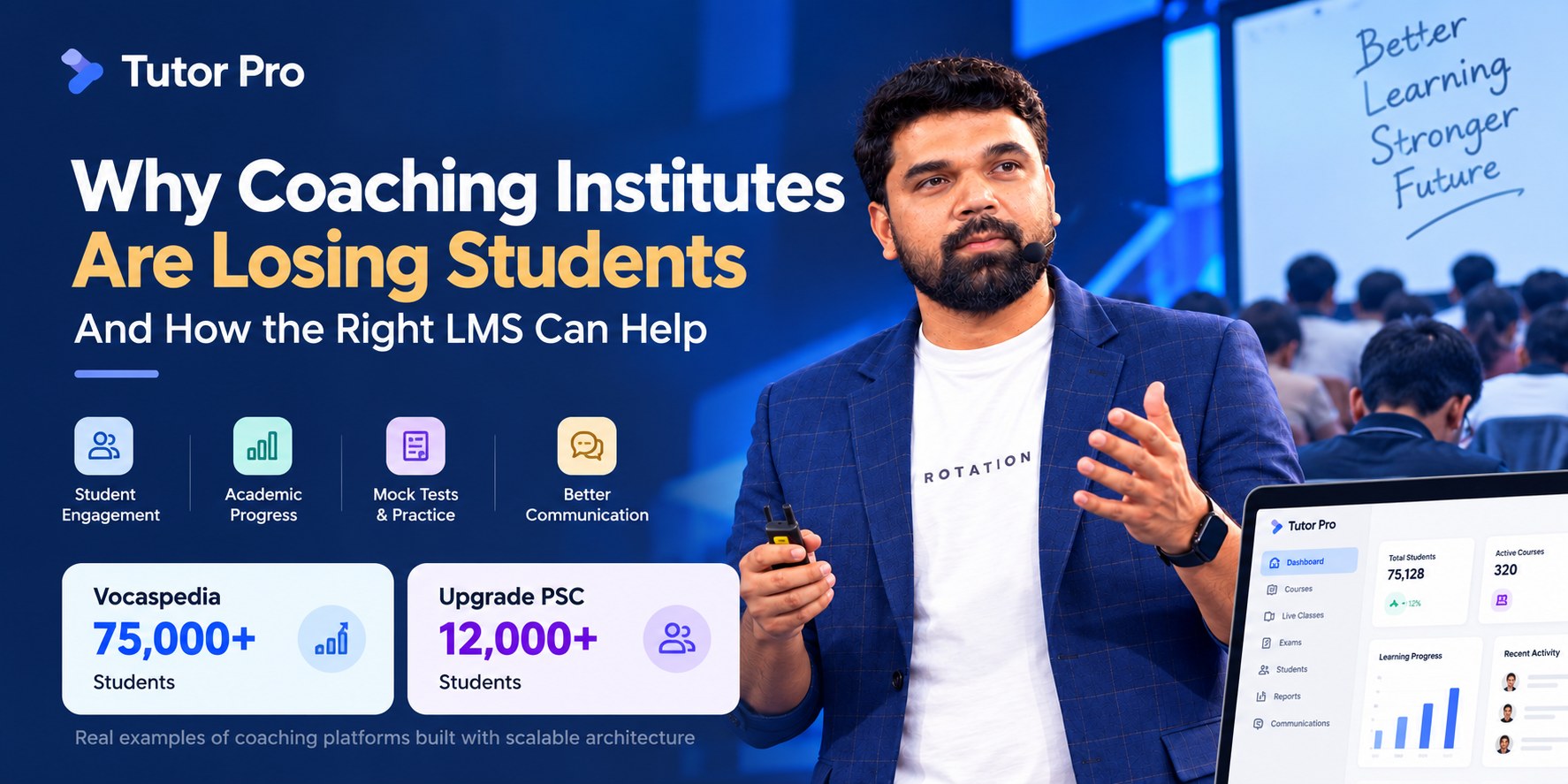
We've worked with coaching institutes at very different stages, from a few hundred students to platforms like Vocaspedia, with 75,000+ students, and Upgrade PSC, with 12,000 students, and the institutes that ended up happiest with their LMS weren't the ones who asked the fewest questions. They were the ones who asked the right ones, early.
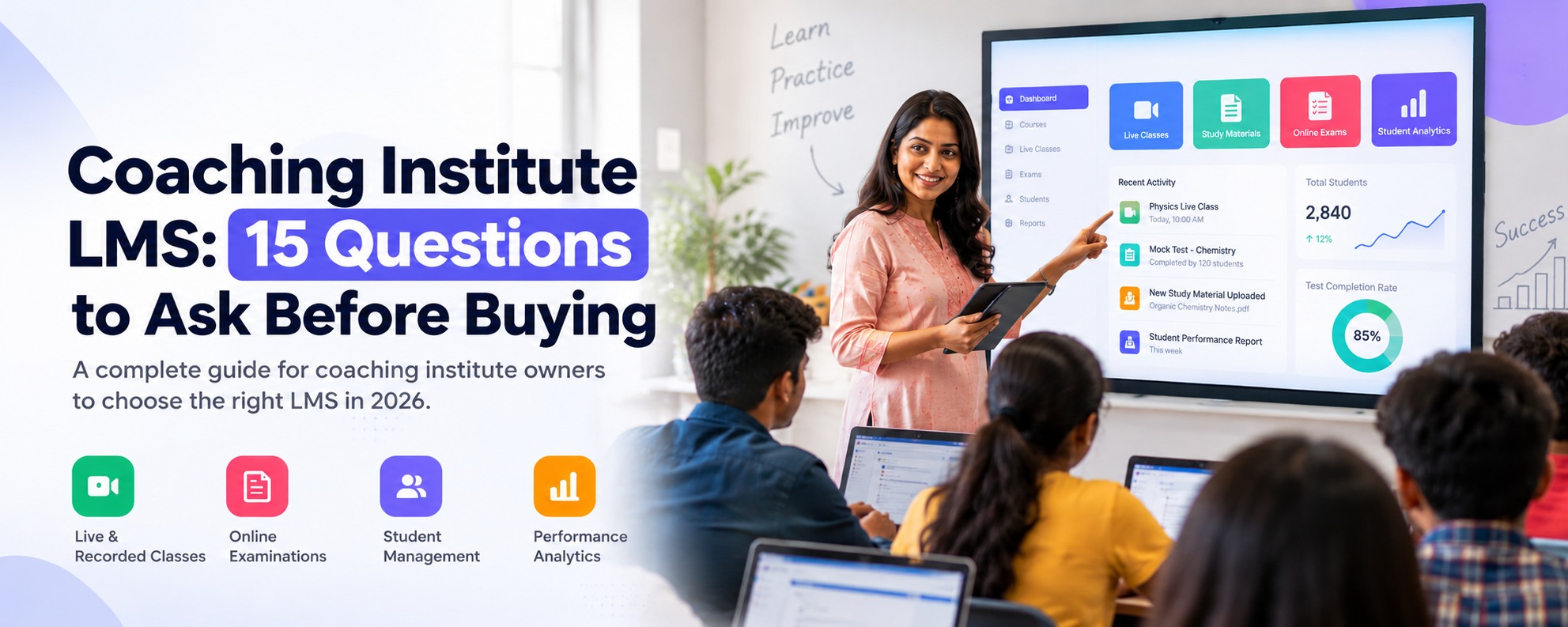
This is a working checklist of 15 questions to take into your next LMS conversation, grouped around the five things that actually determine whether a platform will serve your institute well: academic fit, scale, branding, data and support, and cost.
A good demo tells you what an LMS can do today. The right questions tell you what happens when your institute grows.
Table of Contents
- Academic Fit: Questions 1–4
- Scale & Performance: Questions 5–7
- Branding & Ownership: Questions 8–10
- Data, Security & Support: Questions 11–13
- Cost & Long-Term Partnership: Questions 14–15
- Quick Reference: All 15 Questions at a Glance
- How Tutor Pro Answers These Questions
- Frequently Asked Questions
- Ask Before You Sign, Not After
Academic Fit: Questions 1–4
Before anything else, an LMS has to work for the way your institute actually teaches. A platform can be technically impressive and still be the wrong fit if it doesn't match your academic workflow.
1. Does the platform support both live classes and recorded lessons, with offline-friendly access for students with unreliable internet?
Many students preparing for competitive exams are working professionals or students juggling other commitments. If recorded lessons are hard to find or slow to load on a weak connection, students fall behind — and that's often where disengagement starts.
2. Can it run topic-wise tests and full-length mock examinations with instant, detailed results?
Ask specifically how results are generated — instantly, or after a delay — and whether students can review a question-by-question breakdown, not just a final score.
3. Can teachers track attendance, performance and learning gaps without maintaining separate spreadsheets?
If your academic team is still exporting data to spreadsheets to understand which students are falling behind, the LMS isn't doing its job. Ask to see an actual teacher dashboard, not a mockup.
4. Does it genuinely support the exam pattern your institute teaches toward?
PSC, NEET, UPSC, banking and other competitive exams each have their own test formats, marking schemes and syllabus structures. A generic LMS retrofitted for your exam category often shows its seams during the first real mock test.
Scale & Performance: Questions 5–7
This is the section most institutes underweight — and the one that causes the most damage when it's ignored. A platform that works beautifully for 300 students can fail in ways that are hard to predict at 5,000.
5. How many students has this platform actually supported during peak concurrent usage — not just registered users?
Registered student counts are a vanity metric. What matters is how many students can use the platform at the same time without it slowing down. Ask the provider for a specific example, not a projection.
6. What happens on the platform when thousands of students log in at once for a scheduled mock exam?
Mock exams concentrate traffic into a narrow window in a way ordinary day-to-day usage doesn't. This is where under-engineered platforms slow down, time out, or lose submitted answers — at the worst possible moment for a student.
7. What is the provider's actual plan for scaling infrastructure as your institute grows from hundreds of students to thousands?
This should be a specific answer involving infrastructure planning, monitoring and capacity reviews — not a one-line reassurance that "the cloud scales automatically."

In our work with Upgrade PSC, scalability wasn't something retrofitted after a problem surfaced — it was planned around expected examination traffic from the start. That's the difference between a platform that's prepared for growth and one that's hoping to survive it. Read more about how scalable LMS architecture supports growing coaching institutes →
Branding & Ownership: Questions 8–10
These questions matter more than most institutes realize — until they try to switch providers, or try to grow their brand, and discover how little of the platform is actually theirs.
8. Will students use the platform under your institute's own name and brand, or inside a shared, generically-branded app?
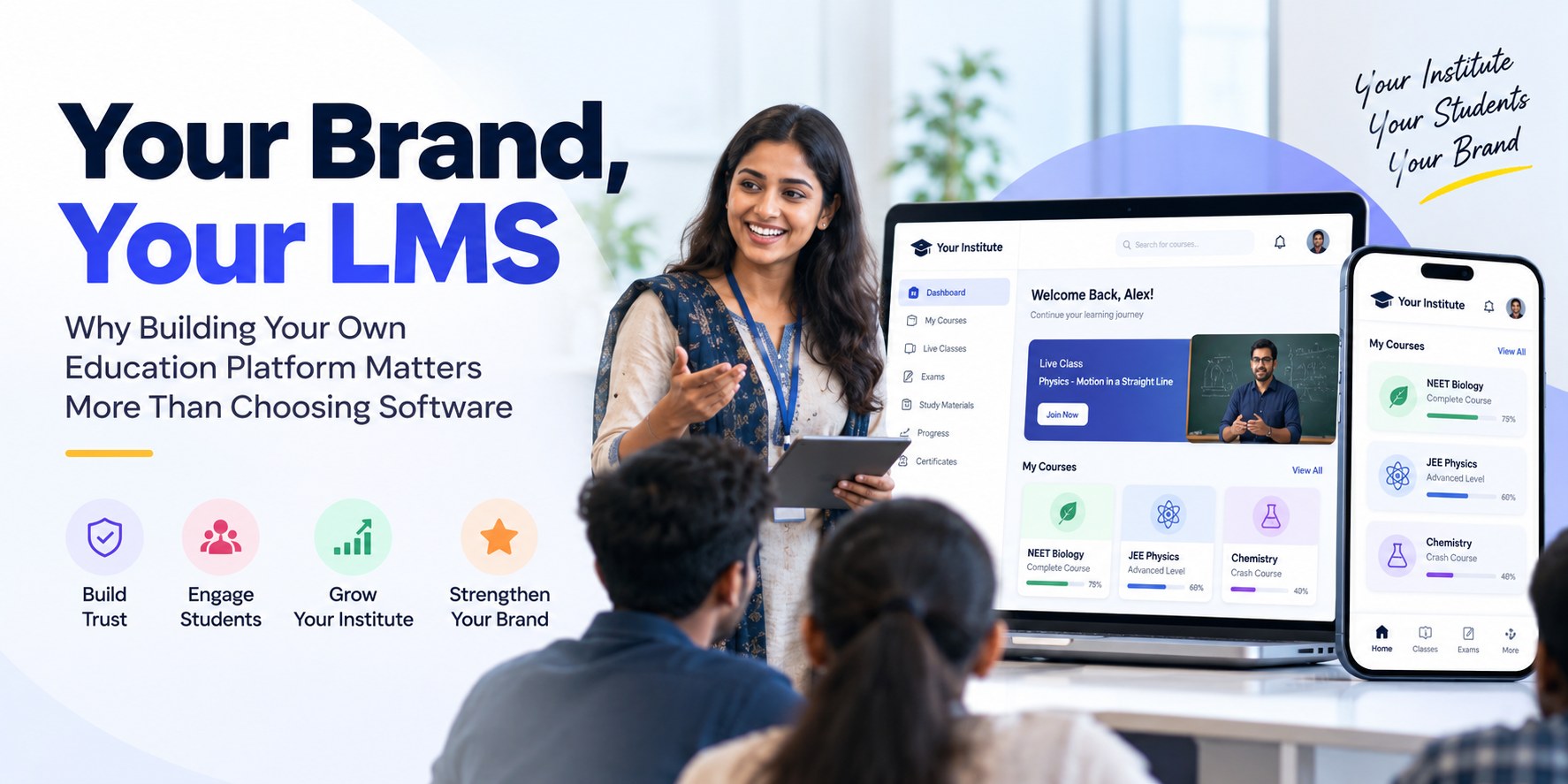
A shared app might save money upfront, but it also means every student interaction reinforces someone else's brand instead of yours. Read more on why owning your brand matters more than comparing software features →
9. Do you own the Android and iOS app listings, or are they published under the vendor's developer account?
If the app lives under the vendor's developer account, you don't fully control your own app — updates, visibility, and even its continued existence on the app store depend on that relationship staying intact.
10. If you switch providers later, can you actually take your student data, content and brand identity with you?
Ask this one directly and listen for hesitation. A confident "yes, here's how" is very different from a vague answer about "working something out."
Data, Security & Support: Questions 11–13
An LMS holds some of your institute's most sensitive information — student contact details, payment records, academic performance. These questions aren't optional diligence; they're basic risk management.
11. Who legally owns the student data collected on the platform, and can you export it on demand?
Get this in writing rather than relying on a verbal assurance during the sales process.
12. What security measures protect student information and payment data?
You don't need to become a security expert, but you should expect a specific answer covering access controls, encryption and periodic review, rather than a general statement that "security is a priority."
13. What are the actual response times and support channels when something breaks during a live class or exam?
A support ticket answered in 48 hours is of little use to a teacher mid-class or a student mid-exam. Ask what support looks like in the moments that matter most, not just during business hours.
Cost & Long-Term Partnership: Questions 14–15
14. What's included in the base price, and what costs extra — hosting, storage, app store publishing, customization, SMS or notification charges?
Ask for an itemized breakdown rather than a single number. The gap between a quoted price and the actual cost of running a platform is usually hidden in line items nobody mentioned in the first meeting.
15. Can you see a live, working example of the LMS running for an institute of a similar size — not just a sales demo?
A sales demo is built to look good. A live platform, used daily by real students and teachers, tells you what the experience actually feels like under normal use.
Choosing an LMS should feel less like buying software and more like evaluating a long-term partner — because that's what it becomes.
Quick Reference: All 15 Questions at a Glance
Keep this list handy for your next vendor conversation.
| # | Question | Why It Matters |
|---|---|---|
| 1 | Live + recorded classes with offline-friendly access? | Keeps students from falling behind |
| 2 | Topic-wise tests and instant, detailed results? | Supports structured exam preparation |
| 3 | Teacher dashboards for attendance and performance? | Replaces manual spreadsheet tracking |
| 4 | Genuine support for your exam pattern? | Avoids a generic, retrofitted platform |
| 5 | Proven peak concurrent usage, not just signups? | Reveals real performance capacity |
| 6 | Behavior under mock-exam traffic spikes? | Prevents failures at critical moments |
| 7 | A real infrastructure scaling plan? | Prepares the platform for growth |
| 8 | Institute-branded experience or shared app? | Protects your brand identity |
| 9 | Who owns the app store listings? | Determines control over your own app |
| 10 | Can you take your data and brand if you switch? | Avoids vendor lock-in |
| 11 | Who owns student data, and is it exportable? | Protects institute and student interests |
| 12 | What security measures are in place? | Basic risk management |
| 13 | Real support response times? | Matters most during live classes and exams |
| 14 | An itemized cost breakdown? | Avoids hidden recurring charges |
| 15 | A live reference platform at similar scale? | Shows real-world performance, not a demo |
How Tutor Pro Answers These Questions
Tutor Pro LMS provides customizable learning management solutions for coaching institutes, educational institutions and online educators. Depending on project requirements, the platform can include:
- Live classes and recorded courses
- Online MCQ examinations and mock tests
- Self-practice and chapter-wise assessments
- Student performance reports and analytics
- Study materials and assignments
- AI-powered learning assistance
- Branded Android and iOS learning applications
- Student and teacher management
- Notifications and academic communication
- Custom integrations and scalable infrastructure planning
Our experience supporting platforms such as Vocaspedia and Upgrade PSC means these aren't hypothetical answers — they reflect decisions we've made while building for institutes at real scale.
Request a Product Demo View LMS Features
Frequently Asked Questions
1. How many questions should I ask an LMS provider before choosing one?
There's no fixed number, but a useful evaluation covers five areas: academic fit, scale and performance, branding and ownership, data and support, and cost. The 15 questions in this guide cover all five.
2. What is the most overlooked factor when choosing a coaching institute LMS?
Scale and performance under real peak load, such as thousands of students attempting a mock exam at the same time. Many institutes evaluate an LMS based on registered student counts rather than how it performs under concurrent usage.
3. Should a coaching institute choose a shared LMS app or a branded one?
A branded LMS lets students experience the platform under the institute's own identity and gives the institute more control over its app listings, data and long-term brand value. A shared app can be cheaper initially but limits ownership.
4. How do I know if an LMS can handle my institute's exam-day traffic?
Ask the provider for specific examples of peak concurrent usage they have supported, not just total registered users, and ask what happened the last time their platform experienced a traffic spike during an examination.
5. What should be included in an LMS's base pricing?
Ask for an itemized breakdown covering hosting, storage, app store publishing, customization, and SMS or notification charges, rather than relying on a single quoted price, since many of these costs are often billed separately.
6. Does Tutor Pro help institutes evaluate these questions before signing?
Yes. Tutor Pro works with coaching institutes to assess academic requirements, expected scale, branding needs and support expectations before building a customized LMS solution.
Ask Before You Sign, Not After
Every one of these 15 questions has a version of the same story behind it: an institute that didn't ask, found out the hard way, and had to fix the problem after students, teachers and trust were already affected.
The good news is that none of these questions require you to become a technical expert. They simply require you to ask for specifics instead of accepting reassurance.
The best time to evaluate an LMS's limits is before you sign the contract — not during your institute's busiest exam season.
Planning to Launch or Switch Your Coaching Institute's LMS?
Whether you're choosing your first learning platform or evaluating a switch from your current one, Tutor Pro can walk through these questions with you against your institute's actual requirements.
Tutor Pro — Build Your Brand. Empower Your Learners.