What does it take to manage an online coaching platform with 10,000, 50,000, or even 75,000 students?
Getting students enrolled is only one part of building a successful coaching institute. Keeping them engaged, delivering classes consistently, conducting examinations, and maintaining a reliable learning experience are equally important.
For Kerala PSC coaching institutes, these challenges become more complex as the number of students increases.
A platform that works smoothly for 500 students may face very different demands when thousands of students access recorded classes, attend live sessions, or participate in online examinations.
At Tutor Pro, we've experienced these challenges while developing learning platforms for education businesses.
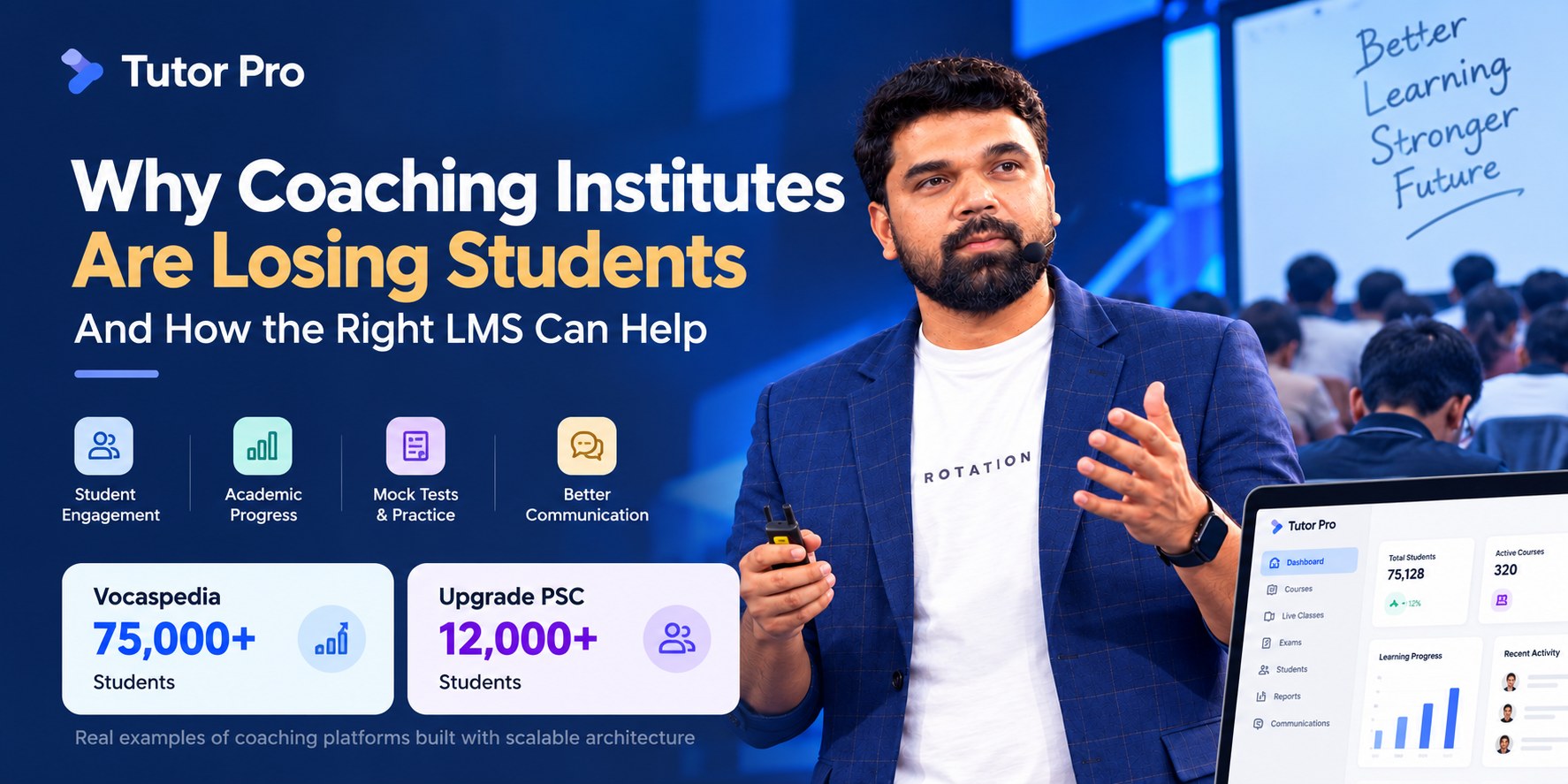
Two examples are Vocaspedia, with more than 75,000 students, and Upgrade PSC, with 12,000 students, where scalable LMS solutions play an important role in supporting large student communities.
Their scale highlights an important lesson for coaching institute owners:
Growing your student base is important. Building the technology to support that growth is just as important.
Table of Contents
- Why Are PSC Coaching Institutes Losing Students?
- The Challenge of Scaling an Online PSC Coaching Platform
- Tutor Pro Experience: Vocaspedia — 75,000+ Students
- Tutor Pro Experience: Upgrade PSC — 12,000 Students
- What We Learned From Building LMS Platforms for Growing Coaching Businesses
- How Tutor Pro LMS Helps PSC Coaching Institutes
- How to Choose the Best LMS for a PSC Coaching Institute in Kerala
- Frequently Asked Questions
- Build for Your Next 10,000 Students
Why Are PSC Coaching Institutes Losing Students?
Many coaching institutes focus heavily on generating new admissions.
But after admission, students need regular academic support, accessible study materials, consistent assessments, and a reliable learning platform.
When these expectations are not met, students may gradually become disengaged.
Some of the common challenges include:
Irregular Classes and Missed Lessons
Many Kerala PSC aspirants are working professionals or college students.
They may not always be able to attend scheduled classes.
When recorded lessons and study materials are difficult to access, students can fall behind in their preparation.
Lack of Regular Mock Tests and Practice
PSC preparation requires consistent revision and assessment.
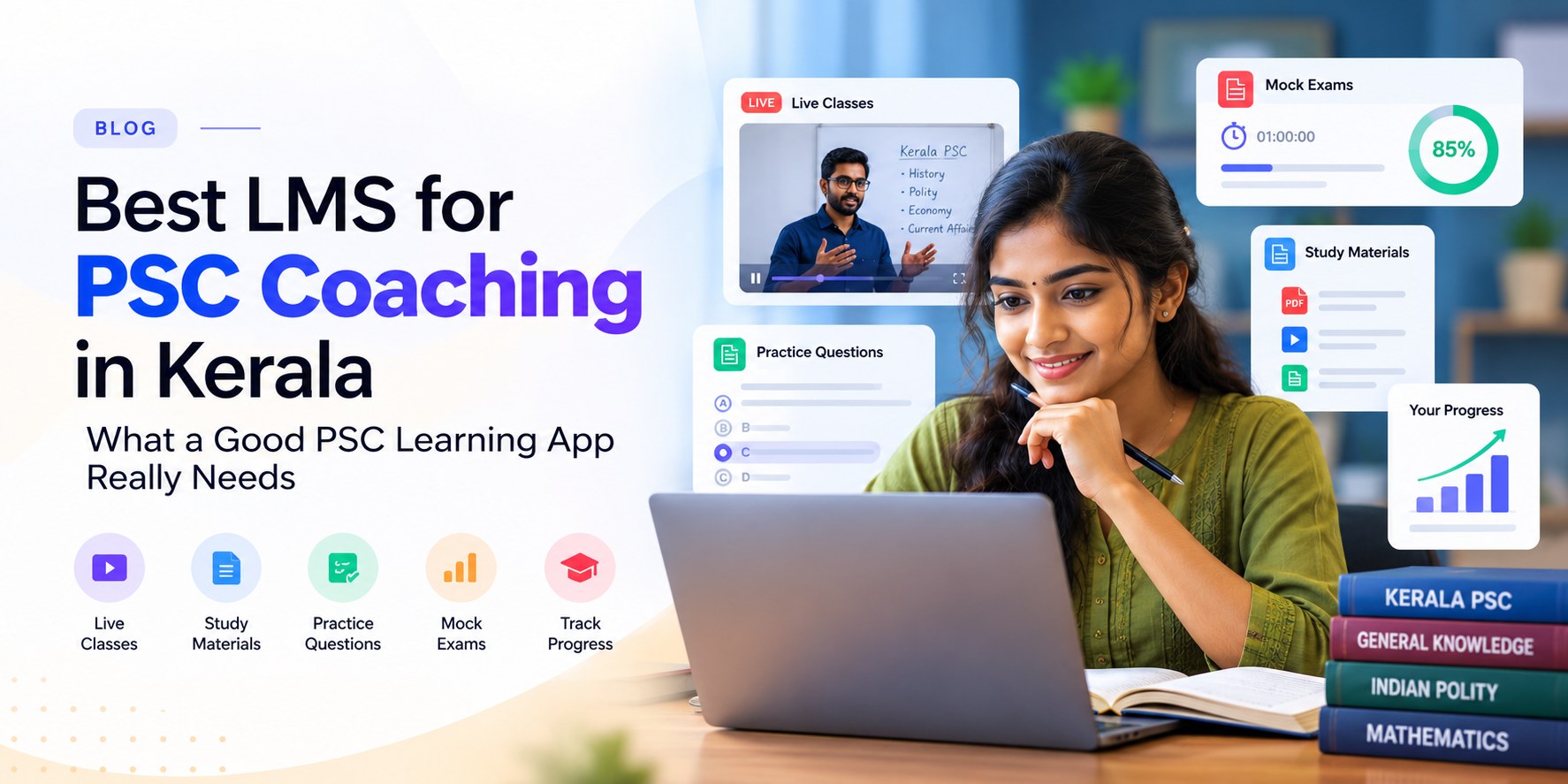
Students preparing for LDC, LGS, Degree Level, and other competitive examinations need access to relevant question banks, topic-wise practice, and mock tests.
Without structured practice, it becomes harder for students to evaluate their preparation.
Limited Academic Monitoring
As batches grow, manually monitoring student performance becomes difficult.
Teachers and academic coordinators need a way to identify students who are missing classes, performing poorly, or struggling with particular subjects.
Technical Problems During Peak Usage
Imagine thousands of students attempting a mock examination around the same time.
If the platform slows down, fails to load questions, or becomes unavailable, students can lose confidence in the learning experience.
Technical reliability is therefore an important part of running a digital coaching business.
The Challenge of Scaling an Online PSC Coaching Platform
Managing an online coaching platform with 500 students is different from managing one with 50,000 students.
As enrolments increase, so do the demands on the learning management system.
The platform must accommodate growing volumes of student accounts, learning materials, assessment records, and application activity.
Particular attention is needed when many students use the same service simultaneously.
For example, a coaching institute may experience heavy traffic when:
- A new recorded class becomes available
- Thousands of students attempt a scheduled mock examination
- Examination results are published
- Students access learning materials before an important examination
- A new batch opens for enrolment
A scalable LMS architecture helps the platform accommodate increasing workloads through appropriate infrastructure, database design, caching, monitoring, and capacity planning.
Scalability is not simply about the number of registered students.
It is also about how many students are active simultaneously and what activities they perform.
That distinction is important when evaluating LMS software for large coaching institutes.
Tutor Pro Experience: Vocaspedia — 75,000+ Students
One example from our work at Tutor Pro is Vocaspedia, an educational platform serving more than 75,000 students.
Building a learning platform for a student community of this size requires careful attention to usability, academic workflows, and the underlying technology.
The Tutor Pro work for Vocaspedia includes learning management and online examination capabilities.

At this scale, the platform must be designed with several important considerations:
Organized Learning Content
Students need a straightforward way to find the courses, lessons, and study materials relevant to their preparation.
Online Examination Management
Assessment workflows need to handle student participation, answer submissions, and examination records reliably.
Student Data Management
A growing learning platform generates increasing amounts of academic and user activity data. Database efficiency and responsible data handling become important considerations.
Infrastructure Planning
As student activity grows, the platform's infrastructure needs to be reviewed and adjusted according to actual usage patterns.
A Consistent Learning Experience
A platform should remain understandable and convenient for students, even as more courses, batches, and features are introduced.
What Vocaspedia Teaches Us
A large registered student base is a sign of business scale, but it does not automatically prove system performance or student retention.
LMS architecture should be planned with future growth in mind, rather than treated as an afterthought.
For education businesses planning to expand, technology decisions made early can influence the cost and complexity of future development.
Tutor Pro Experience: Upgrade PSC — 12,000 Students
Another example is Upgrade PSC, a PSC coaching platform with 12,000 students.
For an education business focused on competitive examination preparation, the LMS must support the academic requirements of its student community while allowing the platform to grow.
Tutor Pro's work with Upgrade PSC includes scalable architecture considerations for its learning platform.

Why Scalable Architecture Matters
As the number of students increases, the platform may need to manage more frequent course access, examination attempts, learning records, and user requests.
A scalable system can be designed to support these requirements through suitable infrastructure and application architecture.
Important technical considerations include:
- Database Optimization: Efficient data access for student records and course activity
- Application Performance: Reducing unnecessary processing and improving response times
- Infrastructure Scalability: Planning server resources around expected workloads
- Examination Reliability: Preparing for peak activity during tests and results
- Monitoring and Maintenance: Identifying performance issues before they recur
The exact technical solution depends on the platform's requirements and measured usage.
What Upgrade PSC Teaches Us
Coaching institutes should not wait until technical limitations become serious before considering scalability.
Whether an institute has 1,000 students or 12,000 students, its technology roadmap should reflect realistic growth expectations.
A good LMS implementation is not only about launching an app. It is also about planning for the students who may join next year.
What We Learned From Building LMS Platforms for Growing Coaching Businesses
Working on educational platforms such as Vocaspedia and Upgrade PSC reinforces several important lessons.
Student Experience Matters More Than the Number of Features
A platform may offer dozens of features, but students primarily need to attend classes, access lessons, practise questions, review results, and get academic support.
The experience should be simple and dependable.
Architecture Should Match Actual Usage
A platform with 75,000 registered students does not necessarily have 75,000 simultaneous users.
Infrastructure decisions should be based on expected concurrency, application workloads, traffic patterns, and performance testing.
This avoids both underprovisioning and unnecessary infrastructure costs.
Online Examinations Need Special Attention
PSC coaching institutes frequently rely on online tests and mock examinations.
These workflows deserve careful planning because many students may participate within a short period.
Academic Data Should Be Useful
Attendance reports and examination scores become more valuable when teachers use them to identify learning gaps and provide timely support.
Growth Requires Continuous Improvement
A successful LMS is not a one-time development project.
It requires ongoing monitoring, maintenance, feature improvements, and periodic infrastructure reviews.
How Tutor Pro LMS Helps PSC Coaching Institutes
Tutor Pro LMS provides customizable learning management solutions for coaching institutes, educational institutions, and online educators.
Depending on project requirements, the platform can include:
- Live classes and recorded courses
- Online MCQ examinations and mock tests
- Self-practice and chapter-wise assessments
- Student performance reports and analytics
- Study materials and assignments
- AI-powered learning assistance
- Branded Android and iOS learning applications
- Student and teacher management
- Notifications and academic communication
- Custom integrations and scalable infrastructure planning
These capabilities help coaching institutes organize their digital learning activities under their own brand.
For growing PSC coaching businesses, the ability to customize academic workflows and plan infrastructure around expected usage can be particularly valuable.
Request a Product Demo View LMS Features
How to Choose the Best LMS for a PSC Coaching Institute in Kerala
Before choosing an LMS for PSC coaching institutes, consider these questions:
1. Can the platform manage multiple PSC examination categories and batches?
2. Does it support topic-wise tests and online mock examinations?
3. Can students access recorded classes and study materials easily?
4. Does the LMS provide useful student performance reports?
5. Can the platform be customized to match the institute's academic model?
6. Has the development team worked on platforms serving large student communities?
7. How will the system handle increases in simultaneous users?
8. Are technical support, maintenance, hosting, and upgrade responsibilities clearly defined?
Choosing an LMS should involve both academic and technical evaluation.
A platform that looks attractive during a demo must also be suitable for everyday teaching and long-term operations.
Frequently Asked Questions
1. What is the best LMS for PSC coaching institutes in Kerala?
The best LMS depends on the institute's student numbers, examination requirements, teaching model, budget, and expected growth. Look for mock tests, recorded classes, student analytics, customization, and appropriate technical support.
2. Can an LMS support 10,000 or more students?
Yes, an LMS can be engineered to support large student communities. However, capacity depends on infrastructure, application design, concurrent usage, and workload characteristics. Registered student counts alone do not establish performance capacity.
3. What is scalable LMS architecture?
Scalable LMS architecture refers to designing a learning platform so its infrastructure and application components can accommodate growing usage. It may involve database optimization, caching, load balancing, monitoring, and additional computing resources.
4. Why do PSC coaching institutes need their own branded learning app?
A branded learning app allows institutes to deliver courses, examinations, and academic resources under their own identity while maintaining greater control over their student experience.
5. Does Tutor Pro develop custom LMS platforms for PSC coaching institutes?
Yes. Tutor Pro develops customizable LMS solutions for coaching institutes, including PSC-focused learning platforms with online classes, examinations, practice activities, reporting, and other requirements.
6. How can an LMS improve student retention?
An LMS can help institutes identify attendance problems, track learning progress, and organize academic support. Retention outcomes also depend on teaching quality, course relevance, communication, and mentoring.
Build for Your Next 10,000 Students
A coaching institute's growth should not be limited by its learning platform.
As student numbers increase, academic management, examination delivery, platform performance, and student support become more demanding.
Our experience working with Vocaspedia, serving 75,000+ students, and Upgrade PSC, with 12,000 students, demonstrates the scale of educational businesses that Tutor Pro works with.
For coaching institutes planning to expand, investing in the right LMS architecture can help create a stronger foundation for future growth.
Don't build your learning platform only for the students you have today. Plan for the students you want to serve tomorrow.
Planning to Launch or Scale Your PSC Coaching Platform?
Whether you are launching a new PSC coaching app or expanding an existing digital learning business, Tutor Pro can help you explore a customized LMS solution.
Tutor Pro — Build Your Brand. Empower Your Learners.