Most education businesses start their digital journey the same way: they sign up for a SaaS LMS, upload a few courses, open a few batches, and get moving.
And for a while, it works. You can run live classes, host recorded content, collect fees, and manage students without writing a single line of code.
But growth changes things.
The platform that comfortably handled 200 students starts to feel restrictive at 2,000. The features that once covered everything you needed now cover only part of it. And the requests you get from your team — a different fee structure, a specific report, a workflow unique to how you run your institute — increasingly have the same answer: "the platform doesn't support that."
This is not a sign that you chose the wrong LMS. It is usually a sign that your business has grown past what any single ready-made platform was built to do.
The real question is not whether your current LMS works today. It almost certainly does. The real question is whether it can keep working as your business changes shape over the next two, three, or five years.
Table of Contents
- The Moment an Education Business Outgrows Its LMS
- From Using an LMS to Building Your Own Learning Ecosystem
- A Real Example: From SaaS LMS to SkillPlus
- One LMS Project Became Three Digital Projects
- Why Scalability Matters More Than a Feature List
- Custom LMS vs SaaS LMS: A Quick Comparison
- Your LMS Shouldn't Become Your Growth Ceiling
- From a Software Subscription to Digital Infrastructure
- The Future of Education Platforms Isn't One-Size-Fits-All
- Questions to Ask Before Choosing Your Next LMS
- The Bottom Line
- Frequently Asked Questions
The Moment an Education Business Outgrows Its LMS
There is rarely a single dramatic moment where an education business realizes it has outgrown its LMS. It is usually a series of small frictions that add up.
- You keep hearing "that's not possible on this plan"
- Your team manages workarounds in spreadsheets
- Branding feels generic, not like your institute
- New features always need a paid add-on
- Reports don't match how you actually run the business
- Scaling to a new branch means starting over
- Support can't make business-specific changes
- Your roadmap depends on someone else's roadmap
Individually, none of these feel urgent. Together, they start to slow your business down.
A platform that once helped you move fast can quietly become the thing holding you back.
From Using an LMS to Building Your Own Learning Ecosystem
When an education business is small, an LMS is simply a tool — a place to upload content and run classes.
As the business grows, that tool needs to do more. It needs to reflect your brand. It needs to connect with your CRM, your website, your payment systems, and sometimes an entirely separate product you want to launch.
At this stage, the conversation shifts from "which LMS should we use" to "what kind of learning ecosystem do we need to build."
That shift is subtle, but it changes everything about how the platform should be built and who should be building it.
A Real Example: From SaaS LMS to SkillPlus
This shift is not just a theory. We have seen it play out directly with one of our clients, Global Education Campus (GEC).
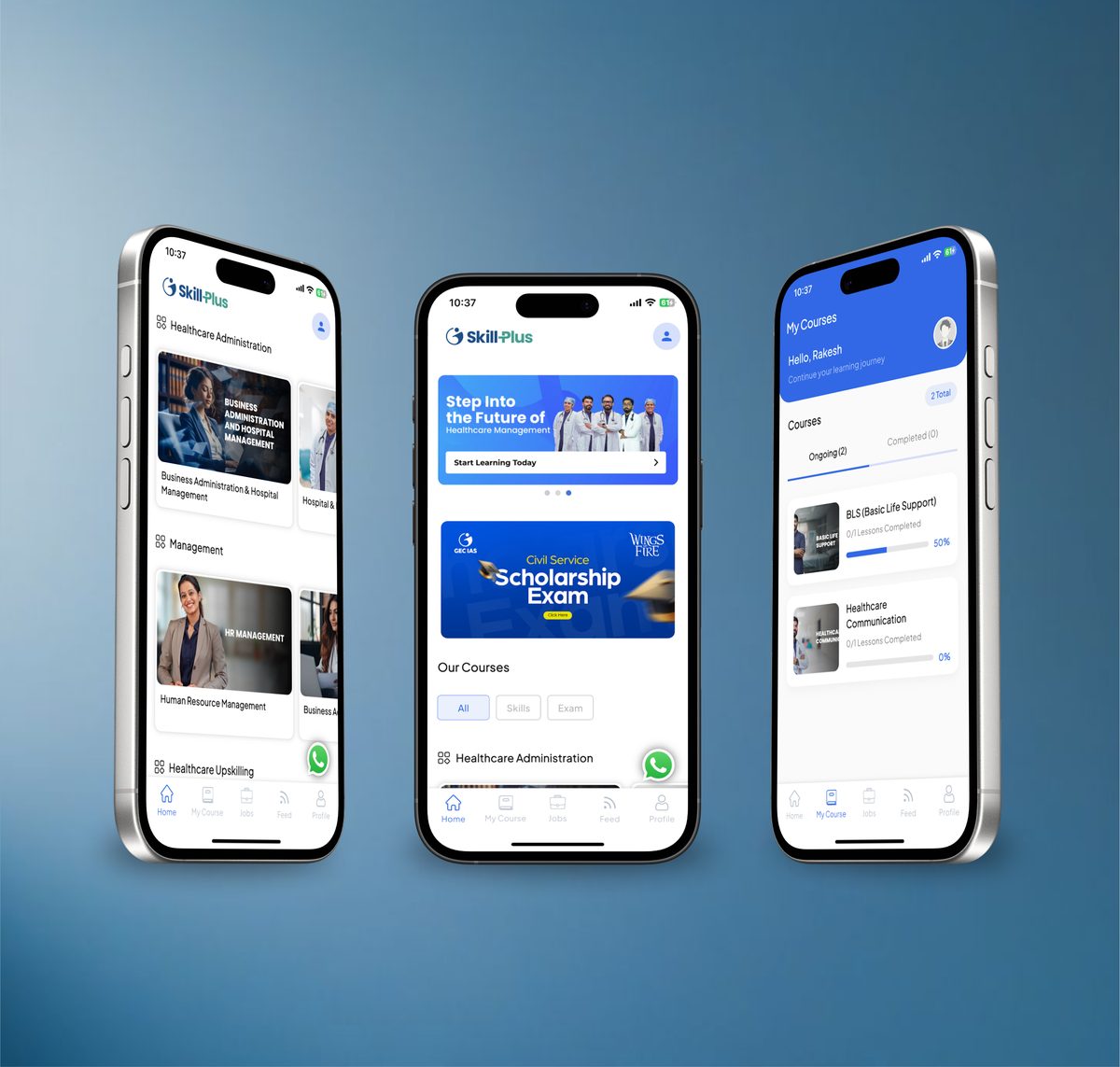
GEC started out running its allied healthcare, business and administration programs on a SaaS LMS. It worked well in the early stages, but as GEC's course catalogue and student base grew, the platform's limitations became harder to ignore — limited branding control, limited flexibility, and little room to shape the learning experience around GEC's own programs.
Rather than continuing to work around those limits, GEC partnered with TutorPro to build SkillPlus — a custom, own-branded mobile-first learning platform designed specifically around how GEC teaches and how its students learn.
The result was not just a replacement for the old LMS. It became the foundation for GEC's entire digital learning strategy going forward.
Read the full GEC & SkillPlus case study →
One LMS Project Became Three Digital Projects
Here is the part of GEC's story that best illustrates why scalability matters.
The first product TutorPro built for GEC was SkillPlus — a learning platform for its education programs. But the success and confidence that came from that first project led to something bigger.
GEC trusted the same technology partner to build two more digital products, extending beyond education into healthcare technology.
What began as a single LMS requirement became a long-term technology partnership spanning multiple products and two industries.
This is the kind of outcome that a rigid, one-size-fits-all SaaS platform is simply not built to support. It is only possible when the underlying platform and the partnership behind it are designed to scale with the business, not just with the course catalogue.
Why Scalability Matters More Than a Feature List
When education businesses compare LMS platforms, the conversation often centres on features: how many quiz types, how many integrations, how many templates.
Feature lists matter, but they answer the wrong question. They tell you what a platform can do today. They don't tell you what happens when your business needs something that isn't on the list.
Scalability is a different kind of question entirely:
- Can the platform grow as your student base grows?
- Can it adapt as your business model changes?
- Can it support new branches, products, or markets?
- Can new features be built when you actually need them?
- Can it still feel like your brand in three years?
A platform with fewer features today but genuine scalability will usually serve a growing education business better than a feature-rich platform with a hard ceiling.
Custom LMS vs SaaS LMS: A Quick Comparison
| Aspect | SaaS LMS | Custom LMS |
|---|---|---|
| Setup speed | Fast, ready to use | Takes longer, built for you |
| Branding | Limited, platform-first | Fully your own brand |
| Customization | Fixed feature set | Built around your workflows |
| Scaling branches/products | Often needs separate setups | Designed to extend |
| New feature requests | Depends on vendor roadmap | Developed when you need them |
| Long-term fit | Good for early stage | Built for sustained growth |
| Cost pattern | Lower upfront, ongoing fees scale with usage | Higher upfront, built as an asset you own |
Neither approach is wrong. The right choice simply depends on where your business is today, and where you expect it to be a few years from now.
Your LMS Shouldn't Become Your Growth Ceiling
A growth ceiling is what happens when your technology can no longer keep pace with your ambition.
You want to launch a new course format, but the platform doesn't support it. You want to expand into a new city or a new vertical, but your current setup can't scale that way. You want to build a feature your competitors don't have, but you're limited to what the platform's product team decides to prioritize.
None of these are failures of your business strategy. They are limitations of the platform underneath it.
Your business should decide how far it can grow — not your software.
This is exactly the ceiling GEC ran into before moving to SkillPlus, and exactly what a scalable, custom-built platform is designed to remove.
From a Software Subscription to Digital Infrastructure
There is an important mindset shift that happens somewhere in this journey.
In the early stage, an LMS is treated like any other software subscription — something you pay for monthly, something you can switch if a better option comes along.
As the business matures, that same platform starts to function more like infrastructure. It holds your student data, your content, your brand experience, and increasingly, the operational backbone of how your education business runs.
Infrastructure deserves a different kind of decision-making than a subscription does. It is worth asking not just "what does this cost per month" but "is this something we are building toward, or something we will eventually have to migrate away from."
The Future of Education Platforms Isn't One-Size-Fits-All
Education businesses are not identical. A PSC coaching centre, an IELTS training institute, a school, and a healthcare skilling organization like GEC all operate in fundamentally different ways.
A single standardized platform can serve all of them at a basic level. But genuine long-term fit comes from a platform that is shaped around each business's own students, programs, and growth plans — not the other way around.
This is the direction more education and training businesses are moving toward: from adopting a fixed product to building a platform that is distinctly their own.
Questions to Ask Before Choosing Your Next LMS
Whether you are evaluating your current LMS or considering a change, a few honest questions can clarify where you really stand:
- What can't we do today that we need to do?
- Are we working around the platform, or with it?
- Will this still fit us in two to three years?
- Can we add features when we need them?
- Does it reflect our own brand, or the vendor's?
- Can it support new branches or products?
- Who owns our data and our platform's future?
If more than a couple of these answers make you uneasy, it may be time to think beyond your current platform.
The Bottom Line
Your LMS working today is not the same as your LMS being right for where your business is going.
A SaaS LMS can be a sensible starting point for many education businesses. But as GEC's journey from a SaaS LMS to SkillPlus — and eventually to a multi-product technology partnership — shows, the businesses that scale well are usually the ones that recognize the growth ceiling early and move toward a platform built around them, not a platform they have to keep adapting to.
Thinking about whether your LMS can keep up with your growth?
TutorPro works with education businesses at exactly this turning point — helping them move from a ready-made platform to a custom, scalable learning ecosystem built around their own brand and business model.
TutorPro — Your Brand. Your LMS. Your Way.
Frequently Asked Questions
1. How do I know if my education business has outgrown its LMS?
Common signs include needing features the platform cannot support, hitting limits on branding or customization, working around the LMS with spreadsheets or manual processes, and finding that every new requirement needs a paid add-on or a workaround rather than a real solution.
2. Is a custom LMS always better than a SaaS LMS?
Not always. A SaaS LMS can be a practical starting point for many education businesses. A custom LMS becomes a better fit once your business has unique workflows, plans to scale across branches or products, or needs features a ready-made platform cannot provide.
3. What does it mean to move from an LMS to a learning ecosystem?
It means your digital platform grows beyond hosting courses and classes into a connected set of tools — covering your brand, website, mobile app, CRM, examinations and more — built around your business rather than a single fixed product.
4. Can an existing SaaS LMS setup be migrated to a custom platform?
Yes. Many education businesses start on a SaaS LMS and later migrate to a custom, own-branded platform as their requirements grow. TutorPro has supported this kind of transition for institutes moving from ready-made tools to a scalable learning ecosystem.
5. Why does scalability matter more than a long feature list?
A long feature list only helps if those features match your business today. Scalability determines whether the platform can keep up with your business two or five years from now, which matters more for long-term technology decisions.