Imagine running a successful coaching institute in Kerala.
You have experienced teachers, hundreds of students, quality study materials, and a growing reputation. Parents recommend your classes. Students share your results. Your institute is slowly becoming a trusted name.
Now you decide to launch online classes.
You search Google for LMS providers in India, compare a few learning management systems, and select a platform that offers live classes, recorded videos, online examinations and student management.
Everything seems perfect.
But there is one question many education entrepreneurs forget to ask:
When your students open the learning app every morning, whose brand do they see — yours or the software provider's?
This small detail can make a significant difference to the future of your education business.
Because your LMS is not simply software. It is one of the most important digital touchpoints between your institute and your students. And that experience should strengthen your own brand.
Table of Contents
- The Indian Education Market Is Changing. Your LMS Strategy Should Too.
- Renting an LMS Is Easy. Building Your Own Education Brand Takes Strategy.
- Why Your Own Branded LMS Matters More Than You Think
- A Practical Example: Two Coaching Institutes, Two Different Strategies
- What Should You Look for When Comparing LMS Providers in India?
- Why Tutor Pro Focuses on Branded and Customised LMS Solutions
- Is a Branded LMS Right for Every Institute?
- Questions to Ask Before Signing with an LMS Provider
- Your LMS Is the Platform. Your Brand Is the Business.
- Frequently Asked Questions
The Indian Education Market Is Changing. Your LMS Strategy Should Too.
A few years ago, many coaching institutes treated online education as an additional service.
Today, digital learning is becoming part of how institutes operate, communicate, teach and grow.
A NEET coaching centre may conduct classroom sessions while providing recorded revision lessons through its mobile app.
A PSC academy may use online mock tests and daily practice questions to engage students outside regular classes.
An IELTS training institute may combine live mentoring, recorded lessons, assignments and performance tracking.
The technology behind these experiences matters. But as more institutions adopt similar digital tools, software features alone become less effective at distinguishing one institute from another.
Students may have access to live classes, video lessons and online exams through dozens of platforms.
What makes them choose your institute is the educational value, teaching quality, trust, student experience and reputation associated with your brand.
That is why the conversation should move beyond simply finding an LMS provider. It should focus on finding a technology partner who helps you build a recognisable education business.
Renting an LMS Is Easy. Building Your Own Education Brand Takes Strategy.
When researching learning management system providers in India, you will usually come across three broad approaches.
Shared LMS Platforms
These platforms allow multiple institutes to use a common software product.
They can be convenient for institutions looking to start quickly, particularly when their requirements are relatively simple.
However, depending on the provider, customisation, integrations, workflows and control over branding may be limited.
White Label LMS Platforms
A white label LMS allows an institute to offer a learning platform under its own brand identity.
Depending on the solution, this may include:
- Your institute's name and logo
- Branded Android and iOS applications
- Your own website and domain
- Customised login and student dashboards
- Brand-specific colours and interface elements
- Your own course catalogue and learning experience
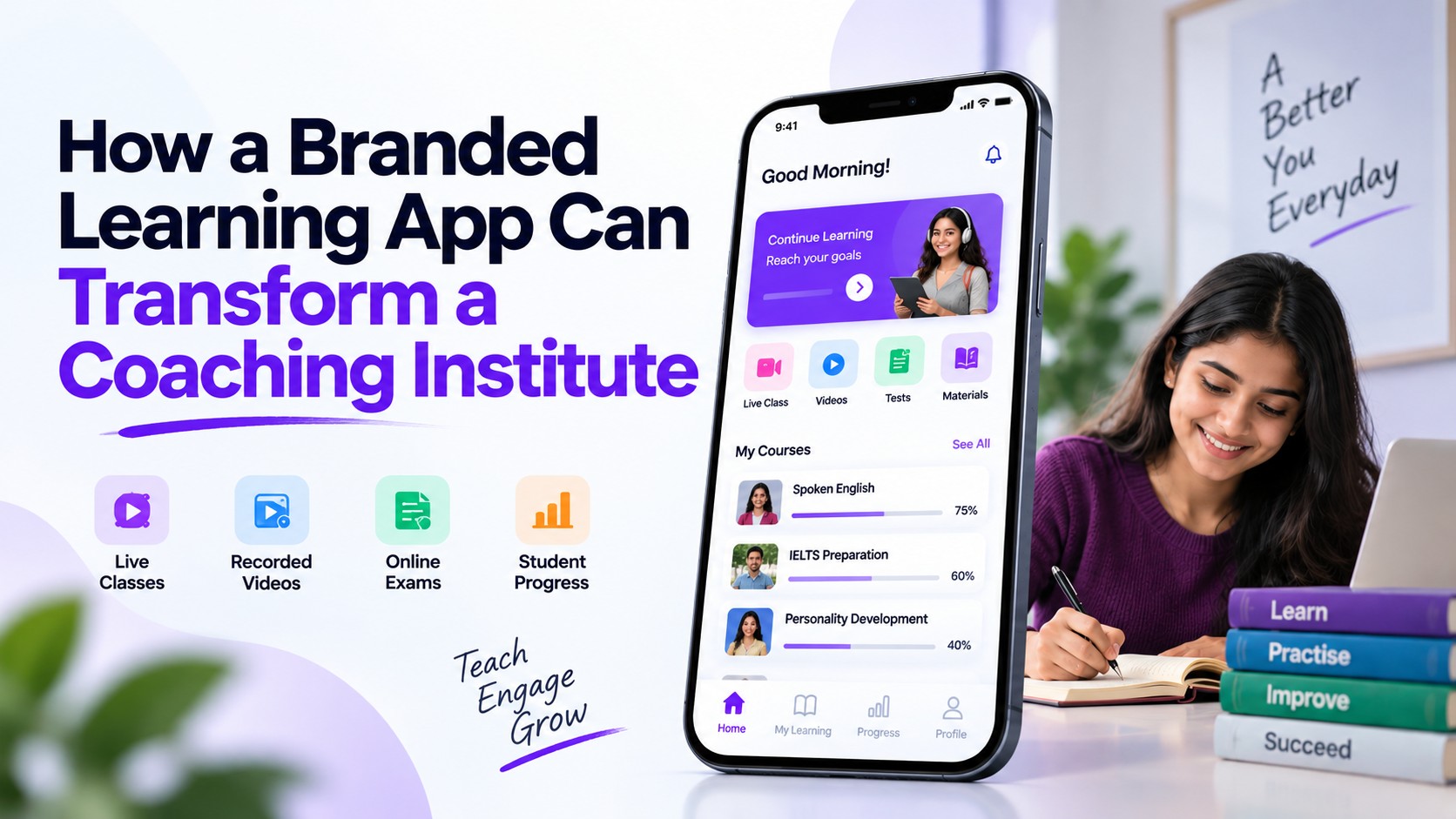
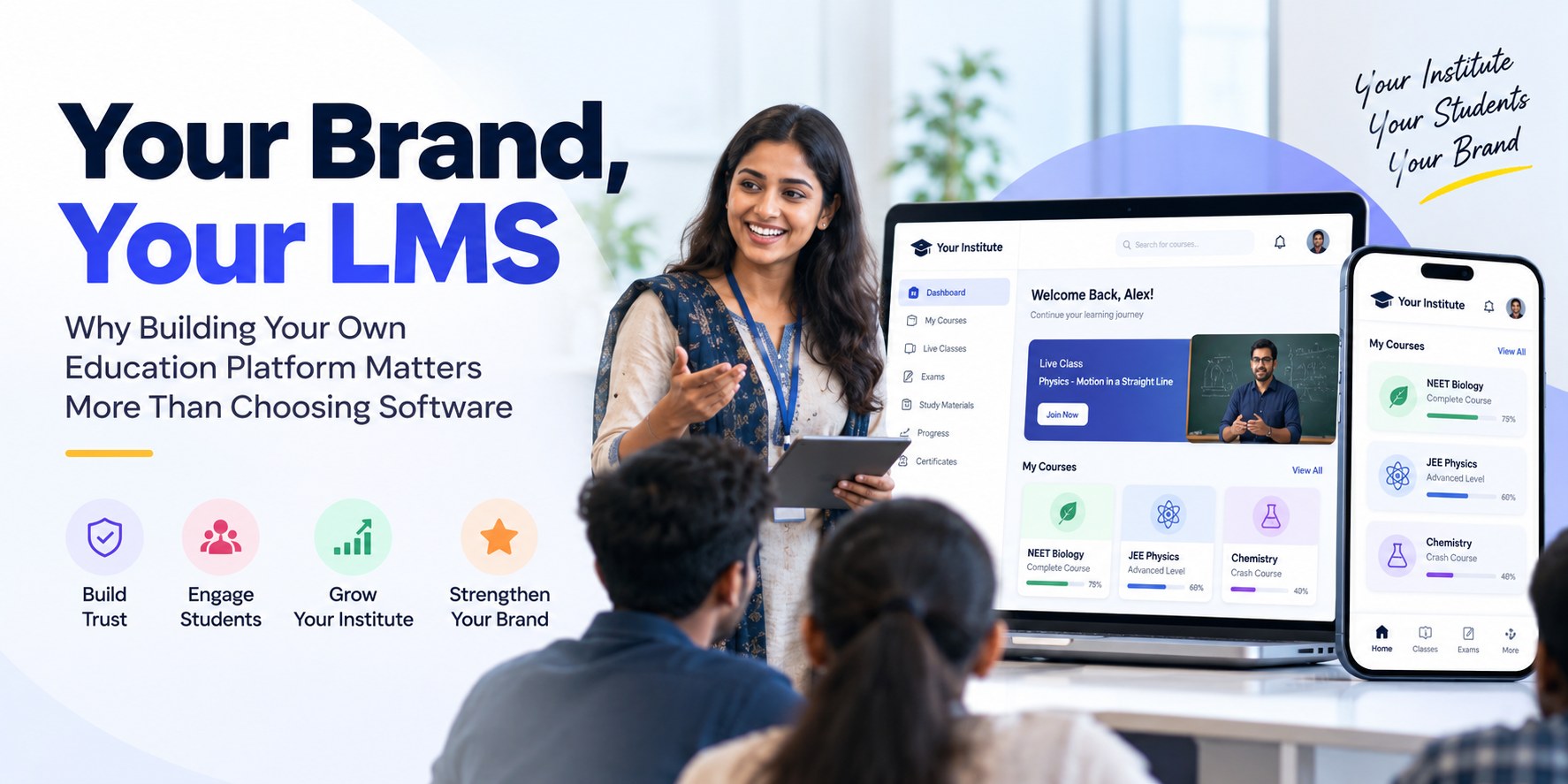
A white label learning management system can help students associate the digital learning experience with your institution rather than an unrelated software company.
Custom LMS Development
A custom LMS goes further by allowing software functionality and workflows to be developed around an institution's particular requirements.
For example, a NEET coaching institute may need detailed question-bank management, chapter-wise practice, mock examinations and performance analysis.
An IELTS training academy may prioritise speaking practice, mentor feedback, assignments and personalised learning journeys.
A corporate training company may need employee onboarding, certification, compliance tracking and management reporting.
Not every institute needs completely custom software. But every growing institute should understand which approach supports its long-term business goals.
Why Your Own Branded LMS Matters More Than You Think
Your Brand Builds Trust
Think about the brands students already recognise in Indian education.
They are not remembered only because they use good software.
They are remembered for their teachers, results, learning experiences and the confidence students place in them.
Your own education brand deserves that same opportunity.
When students interact with a professionally branded learning application, it can reinforce the identity they already associate with your institute.
Your logo, courses, notifications and learning environment become part of one consistent experience. Over time, consistency can support stronger brand recognition and trust.
Your Marketing Investment Should Strengthen Your Brand
Consider a coaching institute spending money on Instagram advertisements, Google Ads, YouTube content and local promotional campaigns.
The objective is to attract students to its courses.
But the larger objective should be to build a brand that continues generating enquiries, referrals and admissions in the future.
A branded LMS helps connect that marketing effort to an institute-owned identity.
When someone recommends your classes, they can recommend your institute and its learning app. Your digital presence becomes an extension of your marketing rather than a disconnected third-party experience.
Student Relationships Are Long-Term Business Assets
A student who completes one course may return for another.
A parent satisfied with a child's progress may recommend your institute.
A learner preparing for one examination may later enrol in an advanced programme.
These relationships are valuable.
Your LMS should help you manage student engagement, learning history, communication and future course opportunities.
When evaluating providers, ask how student information is stored, who controls it, what permissions apply, and whether data can be exported if you change platforms.
A Branded LMS Can Support Expansion
Imagine an institute beginning with 200 students in Kozhikode.
Over time, it launches new batches, attracts students from other districts, and introduces additional courses.
Eventually, it wants to serve learners across Kerala, the GCC, or other markets.
A scalable LMS can support that journey.
Rather than repeatedly rebuilding the student experience around different tools, the institute can expand its digital learning operations while maintaining a consistent brand.
The important requirement is choosing a platform with the technical capacity, operational support and commercial flexibility to grow with the business.
A Practical Example: Two Coaching Institutes, Two Different Strategies
Consider two fictional coaching institutes starting online programmes in the same year.
Institute A selects an inexpensive LMS subscription. It uploads videos, conducts classes and starts enrolling students.
The platform meets its immediate teaching needs. However, the institute later discovers that its desired integrations, advanced examination workflows and certain branding changes are not available under its plan. Expansion requires additional tools and compromises.
Institute B begins by identifying its long-term needs. It chooses a branded LMS with suitable customisation options, clear data export terms, and the ability to add new courses and learning features.
Its website, mobile app and student communication follow a consistent brand identity.
| Institute A | Institute B | |
|---|---|---|
| Platform choice | Inexpensive LMS subscription | Branded LMS with customisation options |
| Branding | Generic, tied to the software provider | Consistent institute brand across web, app and communication |
| Data & integrations | Limitations discovered later | Clear data export terms, planned integrations |
| Expansion | Requires additional tools and compromises | Adds courses and features within the same brand |
Both institutes may deliver excellent teaching. Neither technology choice guarantees better admissions or higher revenue.
But Institute B has made its technology decisions around a defined business strategy. That is the real difference.
The best LMS is not necessarily the one with the longest feature list. It is the one that supports the institution you want to build.
What Should You Look for When Comparing LMS Providers in India?
If you are searching for the best LMS software for your coaching institute, school, academy or online education business, evaluate more than the demonstration interface.
Here are seven important areas.
1. Branding and White Label Capabilities
Can you launch the platform using your own logo, app name, domain and visual identity?
Are branding options included in the quoted package, or do they require additional payments?
2. Learning Management Features
Look for features relevant to your teaching model, including:
- Live and recorded classes
- Course and batch management
- Online examinations and mock tests
- Study materials and assignments
- Student performance reports
- Teacher and student dashboards
- Attendance and engagement tracking
- Notifications and communication tools
Do not pay for features simply because they look impressive. Prioritise those that genuinely improve teaching, learning or administration.
3. Customisation and Integrations
Can the LMS adapt to your academic processes?
Can it integrate with payment gateways, video services, CRM systems or other operational tools?
Will the provider accommodate future requirements?
4. Scalability and Performance
Ask what happens when your student base grows.
Understand hosting arrangements, concurrent usage limits, video delivery costs, database capacity, backup procedures and performance monitoring.
A platform that works well for 100 students should not automatically be assumed suitable for 10,000.
5. Data Ownership and Portability
Ask who controls student records, course content, examination results and related data.
Check export formats, backup policies, data deletion provisions, privacy responsibilities and migration support.
Having your logo on the app does not automatically mean you own its source code or infrastructure. These are separate contractual questions.
6. Technical Support and Maintenance
Technology requires ongoing attention.
Ask about support hours, issue-resolution commitments, updates, security maintenance, hosting responsibilities and annual maintenance charges.
Reliable support can be as important as the initial software implementation.
7. Total Cost of Ownership
Do not compare LMS providers based only on their starting prices.
Consider setup costs, subscriptions, customisation, hosting, video bandwidth, third-party integrations, maintenance and future upgrades.
The cheapest initial package is not always the most economical long-term solution.
Why Tutor Pro Focuses on Branded and Customised LMS Solutions
At Tutor Pro, we believe an education institution's technology should support its identity — not replace it.
Our approach is built around helping coaching institutes, training academies, educational organisations and edupreneurs create learning experiences aligned with their academic and business requirements.
Instead of expecting every institution to follow exactly the same operational model, Tutor Pro focuses on customisable LMS solutions.
Depending on project requirements and the selected package, solutions can include:
Branded Learning Applications
Create a recognisable digital presence with institution-specific branding and student-facing experiences.
Live and Recorded Learning
Organise online classes, recorded lessons, study materials and course content in a structured environment.
Online Examinations and Practice
Support mock tests, MCQ-based examinations, chapter-wise practice and assessment workflows.
Student Engagement Features
Use notifications, learning progress information, leaderboards and other engagement tools where appropriate.
Academic and Business Management
Manage relevant teacher, student, course, batch and administrative processes.
AI-Enabled Learning Opportunities
Explore AI-supported mentoring and learning assistance according to the institution's requirements and implementation scope.
Customisation and Integration
Adapt selected workflows and connect suitable third-party services to meet operational needs.
The goal is simple:
Let educators concentrate on building great learning experiences while their technology supports the growth of their own brand.
Request a Product Demo View LMS Features
Is a Branded LMS Right for Every Institute?
Not necessarily.
If you are an individual tutor experimenting with your first online course, a simple subscription platform may be enough.
If you run a small academy with limited technical requirements, a standard LMS may be the most practical choice.
But if you are investing seriously in building an education brand, planning multiple courses, expanding student enrolment, or developing unique academic workflows, a branded or customised LMS deserves consideration.
The decision should depend on your business model, budget, technical requirements and growth plans.
You do not need to build every feature from scratch to create a strong brand. You need a technology strategy that fits your institution.
Questions to Ask Before Signing with an LMS Provider
Before making your final decision, ask the provider:
1. Can students access the learning platform under our institute's brand name?
2. Will we have our own Android and iOS apps, and under whose developer accounts will they be published?
3. Can the LMS be customised for our teaching and examination workflows?
4. Who controls student data, and can we export it?
5. What are the recurring charges for hosting, video delivery, maintenance and upgrades?
6. What happens if we want to migrate to another platform?
7. How does the system handle growth in student numbers?
8. What technical support and service commitments are included?
9. Which features are available immediately, and which require custom development?
10. Can we see a relevant demonstration or implementation example?
The answers will help you distinguish a software subscription from a long-term technology partnership.
Your LMS Is the Platform. Your Brand Is the Business.
Imagine a student completing a course at your institute.
They may not remember the software architecture, hosting provider or technology stack behind the application.
But they can remember the teacher who explained a difficult concept, the practice tests that helped them prepare, the support they received, and the institution that guided their progress.
That is what builds an education brand.
Technology should make those experiences accessible, reliable and consistent. It should help your institute deliver better education without losing the identity that makes it unique.
So, when you search for LMS providers in India, do not stop at comparing software features and prices.
Ask a bigger question:
Will this LMS help us build our own education brand, or will we simply become another customer using someone else's platform?
That question may be more valuable than any individual feature on a product comparison sheet.
Build Your Education Brand With Tutor Pro
Whether you operate a NEET/JEE coaching institute, PSC academy, IELTS/OET training centre, online madrassa, professional training company, or a growing online education business, your learning platform should reflect your institution's goals.
Tutor Pro provides customisable LMS solutions designed around the needs of education businesses — branded learning applications, online examinations, recorded courses, live classes, student management and customised learning workflows.
Your Institute. Your Students. Your Brand. Powered by Tutor Pro.
Request a Product Demo Explore Tutor Pro
Frequently Asked Questions
1. Which are the best LMS providers in India?
The best LMS provider depends on the institution's needs. Compare providers based on learning features, customisation, branding, scalability, security, technical support and total cost rather than relying only on rankings.
2. What is a white label LMS?
A white label LMS is a learning management system that an educational institution can present under its own brand identity, subject to the provider's branding and licensing terms.
3. Can I launch an LMS under my own institute's name?
Yes. Many white label and custom LMS providers support institute-specific branding, including logos, domains and mobile applications. Available options vary by provider and package.
4. What is the difference between a white label LMS and a custom LMS?
A white label LMS generally provides an existing platform with branding options. A custom LMS allows deeper changes to features, workflows, integrations or architecture, depending on the development agreement.
5. How much does a branded LMS cost in India?
Pricing depends on the platform, number of users, mobile apps, customisation, integrations, hosting, maintenance and licensing model. Request an itemised quotation that includes both initial and recurring costs.
6. Is a branded LMS suitable for NEET, JEE, PSC and IELTS coaching institutes?
Yes. A branded LMS can support these institutes through course management, live classes, recorded content, practice tests, assessments and student tracking. Specialised features should be verified with the provider.
7. Does having a white label LMS mean I own the software?
Not necessarily. Branding rights, software ownership, source-code access, data rights and hosting control are separate matters governed by the agreement with the LMS provider.
8. Can Tutor Pro develop a customised LMS for my coaching institute?
Tutor Pro offers customisable LMS solutions for coaching institutes and other education businesses. The exact modules, branding, integrations and development scope can be discussed according to the institution's requirements.