Running a coaching institute today is very different from running one ten years ago.
A classroom is no longer the only place where students learn. A student may attend a live class in the morning, watch a recorded lesson in the evening, take a mock test at night and check the result from a mobile app.
For the institute, this creates a practical question:
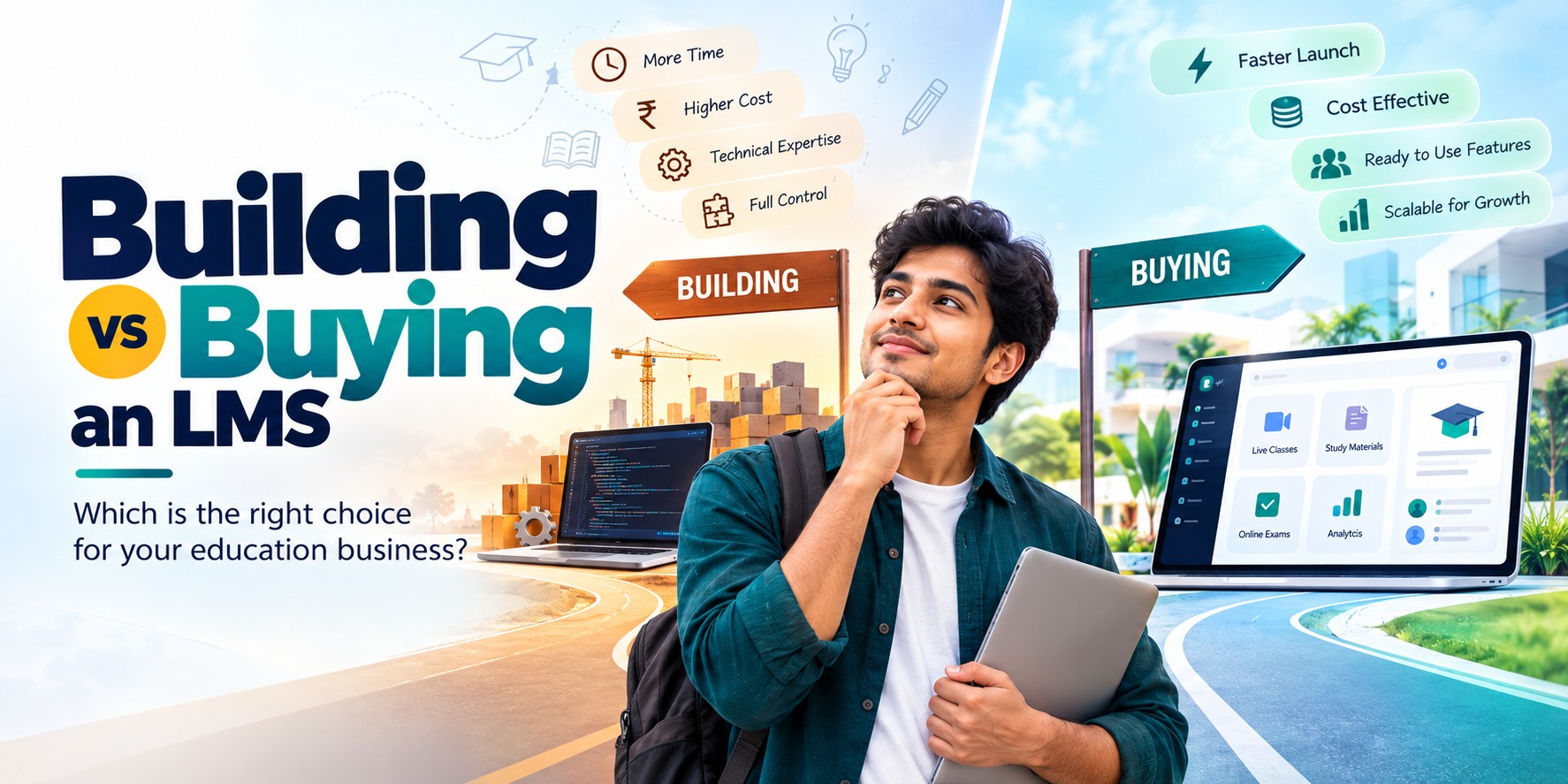
Should we build our own LMS, or should we use an existing LMS platform?
It sounds like a technology question. In reality, it is a business decision.
If you are running a PSC coaching centre in Kerala, your needs will be different from a NEET coaching institute. An IELTS academy may need speaking and writing activities, while a banking coaching centre may depend heavily on mock tests and daily practice.
So there is no single answer that works for everyone.
The better question is:
What does your institute actually need, and how much of it really needs to be built from scratch?
- What Does an LMS Actually Do for a Coaching Institute?
- Building an LMS From Scratch
- Buying an LMS
- But What If I Want My Own Learning App?
- Learning App for NEET and JEE Coaching
- LMS for PSC Coaching
- LMS for IELTS Coaching
- LMS for German Language Coaching
- LMS for Bank Coaching
- So, Should You Build or Buy?
- Start With an LMS. Customize What Makes You Different.
- Don't Compare LMS Platforms Only by Price
- A Simple Example
- The Real Question Isn't "Build or Buy"
- Final Thoughts
What Does an LMS Actually Do for a Coaching Institute?
An LMS is not just a place to upload videos.
For a coaching institute, it can become the place where students attend classes, access study materials, write exams, check their performance and stay connected with teachers.
For example, a student preparing for PSC might use the platform to:
- Watch a recorded class
- Download study materials
- Attend a live session
- Attempt a topic-wise test
- Check the score
- Identify weak areas
- Continue with the next lesson
The same platform could be used very differently by an IELTS student or a NEET aspirant.
That is why choosing an LMS based only on a feature list can be a mistake.
Building an LMS From Scratch
Building your own LMS sounds attractive.
You can decide everything — from the design and student journey to the examination system and integrations.
If your education business has a very specific way of working, this level of control can be useful.
For example, imagine an education company operating several branches, multiple brands and thousands of students. It may want its LMS to connect with its CRM, accounting software, payment system and internal operations.
It may also have its own examination model or a unique way of creating personalised learning plans.
In such cases, custom development can make sense.
But there is something people often overlook.
Building an LMS is not finished when the website or app goes live.
There will be updates.
There will be bugs.
There will be new Android and iOS versions.
Payment gateways will change.
Teachers will ask for new features.
Students will report problems.
You will need server management, security, backups and ongoing technical support.
So the actual investment is much bigger than the initial development cost.
Buying an LMS
Now consider the other approach.
Instead of spending months building the basic infrastructure, you start with an existing LMS and configure it around your institute.
Your logo.
Your domain.
Your courses.
Your batches.
Your teachers.
Your students.
Your pricing.
Your tests.
This can be a much simpler way to get started.
For many coaching institutes, the priority isn't to build software.
The priority is to build a successful education business.
If the LMS already handles the basic technology, the institute can spend more time on what actually differentiates it — teachers, content, student support and results.
But What If I Want My Own Learning App?
This is where things get interesting.
A coaching institute may not want a generic app that looks like every other education platform.
It may want students to open an app carrying its own brand.
That is where a white-label or customized LMS can be useful.
For example, a NEET coaching institute could have its own branded learning app containing:
- Biology
- Physics
- Chemistry
- Mock tests
- Previous-year questions
- Recorded classes
- Live classes
- Study materials
- Student performance
The technology can already exist underneath, while the student sees the institute's own brand.
This approach can save considerable development time compared with creating every component from zero.
Learning App for NEET and JEE Coaching
NEET and JEE preparation is heavily practice-oriented.
Students don't just watch classes.
They solve questions, take tests, revise chapters and repeatedly work on areas where they are weak.
A useful learning app for NEET/JEE should therefore bring learning and practice together.
For NEET, that could mean separate learning paths for:
For JEE:
The institute can then add chapter-wise tests, mock exams, recorded classes, live classes, revision materials and performance reports.
The important part is keeping everything in one place.
A student shouldn't have to search through WhatsApp messages to find yesterday's study material or ask a teacher for the link to an old test.
LMS for PSC Coaching
PSC coaching has its own rhythm.
Students often prepare over a long period and need regular practice.
A good LMS for PSC coaching can help an institute organize:
- Kerala PSC courses
- Subject-wise lessons
- Current affairs
- Daily practice questions
- Previous-year questions
- Mock tests
- Study materials
- Live classes
- Recorded classes
- Rank lists
- Student performance
For a Kerala-based institute, language support can also be important.
A student may prefer Malayalam study materials but use English for certain subjects or examination resources.
The LMS should make that experience simple rather than forcing the institute to manage everything through separate tools.
LMS for IELTS Coaching
IELTS is another example where simply uploading videos isn't enough.
Students need to practice.
They need feedback.
They need to understand where they are losing marks.
An LMS for IELTS coaching can organize learning around the four areas:
Listening
Practice tests, audio lessons and timed exercises.
Reading
Passages, question practice and mock tests.
Writing
Assignments, model answers and teacher feedback.
Speaking
Speaking practice, recorded responses and feedback.
This is where a well-designed LMS can become more than a content library. It can give the student a clear learning path.
LMS for German Language Coaching
A German language institute has a completely different learning journey.
Students may start with A1, move to A2, then continue to B1, B2 or C1.
An LMS for German language learning should allow the institute to organize these levels properly.
Lessons could include:
- Vocabulary
- Grammar
- Listening
- Reading
- Writing
- Speaking
- Practice exercises
- Tests
- Assignments
For the institute, managing levels and batches becomes much easier when everything is inside one system.
For the student, it becomes clear what they have completed and what they need to learn next.
LMS for Bank Coaching
Banking examination preparation is highly dependent on practice.
Students need to solve questions regularly and understand how they are performing.
A bank coaching LMS can bring together:
- Quantitative Aptitude
- Reasoning
- English
- General Awareness
- Banking Awareness
- Sectional Tests
- Full Mock Tests
- Previous-Year Questions
- Practice Tests
- Performance Reports
For an institute with hundreds or thousands of students, automatic evaluation can also reduce a significant amount of manual work.
Instead of teachers checking every answer sheet, the system can calculate results and provide performance information immediately.
So, Should You Build or Buy?
There is a simple way to think about it.
If your requirements are mostly standard — courses, videos, live classes, exams, study materials, payments, student management and analytics — you probably don't need to spend months building every component yourself.
An existing customizable LMS can give you a strong starting point.
But if your business has a very specific learning model, complex integrations or technology that itself is your competitive advantage, custom development may be worth considering.
And there is a middle path.
Start With an LMS. Customize What Makes You Different.
You don't necessarily have to choose between a completely generic platform and a completely custom product.
You can use an established LMS foundation and customize the parts that matter to your business.
For example:
Standard LMS
- Course management
- Student management
- Live classes
- Online exams
- Payments
- Notifications
- Analytics
Customized layer
- Your CRM
- Your AI features
- Your examination workflow
- Your student journey
- Your reporting
- Your business processes
This gives an institute room to grow without trying to solve every technology problem on day one.
Don't Compare LMS Platforms Only by Price
This is one of the biggest mistakes institutes make.
One provider may quote a lower price, while another may appear more expensive.
But what exactly are you getting?
Ask about:
- Mobile apps
- Video hosting
- Server infrastructure
- Number of students
- Storage limits
- Online examination capabilities
- Payment gateway
- Live-class integration
- Analytics
- Support
- Customization
- Data ownership
- Future development
- Migration options
The cheapest LMS isn't necessarily the least expensive option over several years.
And the most expensive platform isn't automatically the right one either.
Look at what your institute actually needs.
A Simple Example
Suppose a PSC coaching institute wants to launch its online learning app.
The institute needs:
Building everything from scratch means designing, developing, testing and maintaining every component.
Instead, the institute could start with a customizable LMS, launch the platform, understand how students use it and then invest in custom features where there is a genuine need.
That can be a much more practical approach for a growing education business.
The Real Question Isn't "Build or Buy"
The better question is:
Where should you spend your time and money?
If your competitive advantage is your teachers, content, student support and teaching methodology, you probably want technology to support those strengths — not become the entire project.
If your competitive advantage is a unique technology platform, assessment engine or AI-powered learning system, then investing more heavily in custom development may make sense.
The decision should come from the business model, not simply from the technology.
Final Thoughts
An LMS should make running an education business easier.
Whether you are building a NEET/JEE learning app, a PSC coaching app, an IELTS learning platform, a German language learning app or a bank coaching platform, start by understanding how your students actually learn.
Then look at the technology.
For many institutes, a customizable LMS offers a practical starting point. It provides the essential infrastructure without requiring the institute to become a software development company.
As the institute grows, the platform can grow with it.
And when something genuinely unique becomes important to the business, that is where custom development can add real value.
The goal isn't to build the biggest LMS. The goal is to build a learning experience that works for your students and your institute.