If you're planning to take your institute online, one of the first questions that usually comes up is:
How much will an LMS cost?
The answer isn't as simple as a monthly subscription price.
A Learning Management System (LMS) can be a basic platform for sharing courses and videos, or it can become the technology behind your entire education business — with online classes, exams, student management, payments, mobile apps, analytics and more.
And there's another important question educators often overlook: what will the LMS help you save, earn and manage over the next few years? That's where the real value becomes clear.
In this guide, we'll look at LMS pricing in Kerala in 2026, the different types of learning management software available, the costs that are easy to miss, and how to decide what makes sense for your institution.
Table of Contents
- The Real Cost of an LMS Isn't Just the Subscription
- How Much Does an LMS Cost in Kerala?
- What Actually Determines LMS Pricing?
- What Should an LMS Include?
- A Real-World Question: Where Does the Money Go?
- LMS Pricing vs LMS Value
- A Success Story Starts With a Problem
- Which LMS Is Right for Different Institutions?
- Hidden LMS Costs You Should Ask About
- LMS Cost in Kerala vs Building Your Own Platform
- How to Choose the Best LMS in Kerala
- Why the Cheapest LMS May Not Be the Best Choice
- TutorPro: One Platform for Your Learning Business
- Frequently Asked Questions
- Final Conclusion
The Real Cost of an LMS Isn't Just the Subscription
Imagine two coaching institutes. Both have 1,000 students. One chooses an LMS because it has the lowest monthly price. The other chooses a platform that includes course management, online exams, mobile learning, payments, analytics and support.
At first glance, the first institute appears to have made the cheaper choice. But then additional costs start appearing:
- Video hosting
- Payment integration
- Mobile app
- Technical support
- Customisation
- Migration
- Additional users
- Reports
- Third-party tools
Within a year, the cheaper LMS may not be cheaper anymore. This is why educators should compare the total cost of running an LMS — not just the advertised price.
How Much Does an LMS Cost in Kerala?
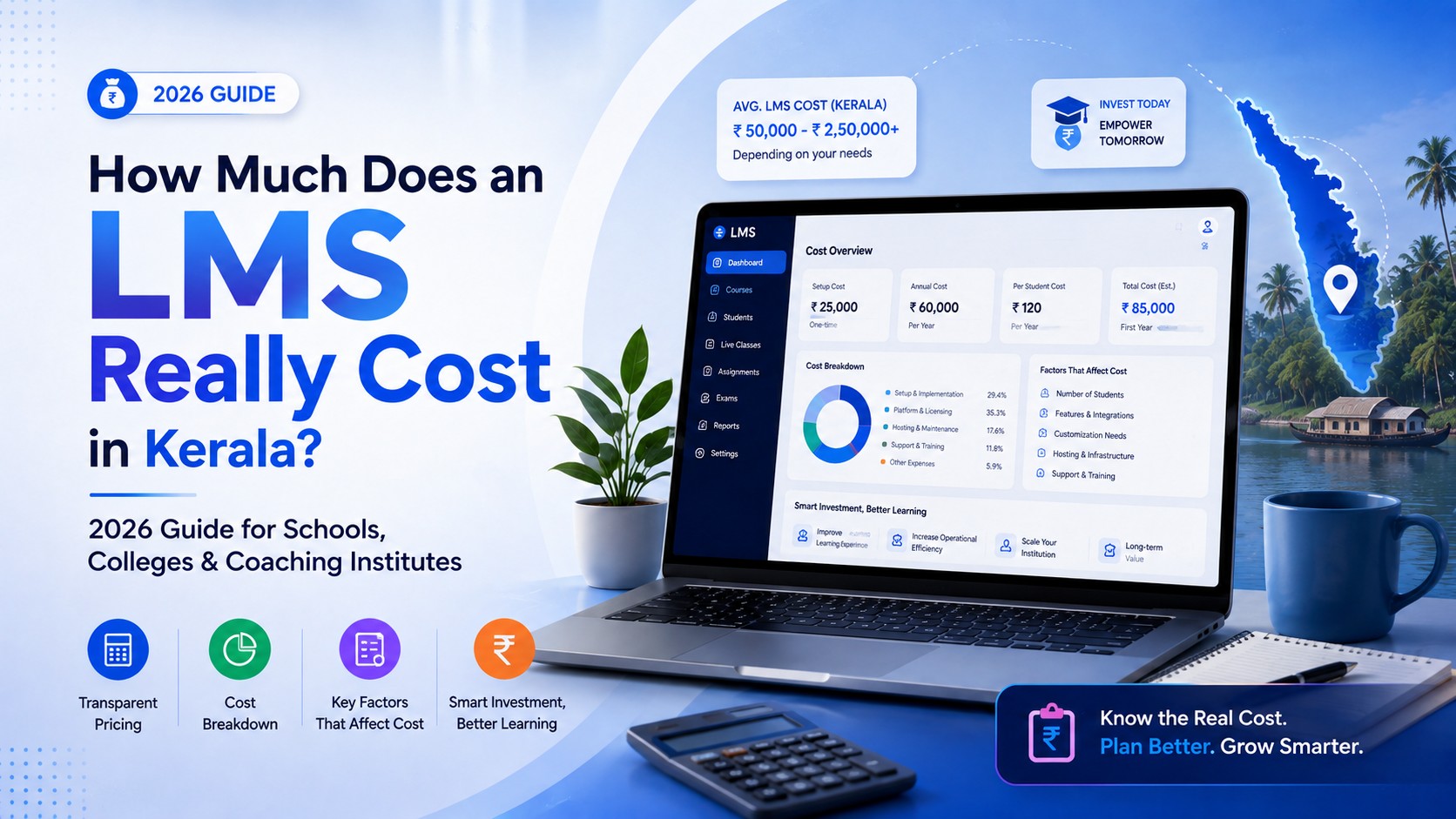
There is no single price for a Learning Management System in Kerala. The cost depends on what you need and how many learners you have. Generally, institutions can choose from three approaches:
1. Ready-Made LMS. You subscribe to an existing learning management platform. Best for: Small institutes and organisations that want to get started quickly.
2. White-Label LMS. You use an existing LMS but present it under your own brand. Best for: Coaching centres, academies and education businesses that want their own branded learning platform.
3. Custom LMS. The software is built or heavily customised around your organisation's requirements. Best for: Larger institutions and education businesses with specific workflows or advanced requirements.
The important thing is not simply asking "Which one is cheapest?" Instead ask: "Which option gives us the best value as we grow?"
What Actually Determines LMS Pricing?
When comparing LMS software in Kerala, these are some of the biggest factors that affect the overall cost.
Number of Learners. Some platforms charge according to registered or active users. If your student base grows from 500 to 5,000, your LMS cost can change significantly.
Courses & Content. The number of courses, videos, documents, quizzes and other learning materials can affect your requirements.
Mobile App. If students primarily learn through smartphones, an LMS with Android and iOS apps can make a major difference.
Online Exams. Coaching institutes may need question banks, mock tests, automated evaluation, rankings and detailed exam reports.
Live Classes. If you conduct online classes, check whether live learning is included or requires additional services.
Payment Integration. For institutes selling courses online, payment gateway integration is an important part of the LMS setup.
Customisation. Your requirements may include custom branding, domain setup, workflows, dashboards or integrations.
Support & Migration. Moving from another platform and getting your team comfortable with the new system can also affect the overall project cost.
What Should an LMS Include?
Before comparing prices, make a list of the features you actually need. A good LMS platform may include:
- Course Management — Create courses, lessons, modules and learning paths.
- Video Learning — Upload and organise recorded classes and learning videos.
- Live Classes — Conduct online sessions and connect instructors with learners.
- Online Exams — Create tests, question banks, mock exams and assessments.
- Student Management — Manage learners, enrolments, batches and access.
- Instructor Management — Give teachers the tools they need to manage their courses.
- Payments — Sell courses and accept online payments.
- Certificates — Issue certificates after course completion.
- Reports & Analytics — Understand learner progress, course completion and assessment performance.
- Mobile Learning — Give students access to their learning from smartphones.
- Branding — Build a learning experience that reflects your own organisation.
A Real-World Question: Where Does the Money Go?
Let's say an institute is planning to launch online learning. The initial requirement may sound simple:
We just need an LMS for our students.
But once the project starts, the requirements often become:
That's why two LMS quotes can look completely different. One vendor may include everything in one package. Another may charge separately for each component. Always ask:
- What's included?
- What's extra?
- What happens when our student count increases?
- Is technical support included?
- Is migration included?
- Is the mobile app included?
These questions can save an institute from unexpected costs later.
LMS Pricing vs LMS Value
Here's where the conversation becomes more interesting. Suppose an institute spends money on an LMS — what does it get back?
A good LMS can help reduce repetitive administrative work, make courses available beyond the classroom, improve learner access and give administrators better visibility into student performance. For an online education business, it can also become the infrastructure for selling and delivering courses.
So instead of calculating only:
think about:
That's a much more useful way to evaluate learning management software.
A Success Story Starts With a Problem
The strongest case studies don't start with "We implemented an LMS." They start with a problem.
Before the LMS, an institute may be managing:
- Student lists in spreadsheets
- Course content across different drives
- Classes through separate meeting tools
- Tests using different platforms
- Payments through another system
- Student communication through messaging apps
The team spends time moving information between systems.
After the LMS, the institute can bring much of that workflow into one place:
The result isn't simply "we bought LMS software." The real result is less manual work, better organisation and a smoother learner experience.
Which LMS Is Right for Different Institutions?
Different educators have different priorities.
| Institution | What to prioritise |
|---|---|
| Coaching Institute | Exams, question banks, batches, analytics |
| School | Courses, assignments, assessments |
| College | Course management, faculty, reports |
| Training Institute | Courses, certificates, payments |
| Online Academy | Course sales, mobile app, branding |
| Corporate Training | Employee learning, reports, completion |
| PSC Coaching | Mock tests, rankings, question banks |
| Language Academy | Live classes, assignments, assessments |
There is no reason for a small coaching centre to pay for enterprise features it will never use. Likewise, a large education business shouldn't choose a platform simply because it has the lowest starting price.
Hidden LMS Costs You Should Ask About
Before signing an LMS contract, ask about:
- Setup Fees — Is implementation included?
- Migration — Will your existing courses and learner data be moved?
- Mobile App — Is the Android/iOS app included?
- Video Storage — How much storage is available?
- Integrations — Are payment gateways and other integrations included?
- Additional Users — What happens when you cross your current learner limit?
- Support — Is ongoing technical support included?
- Customisation — Which branding and workflow changes are included?
- Training — Will your administrators and instructors receive training?
- Renewal — Will the price change after the first year?
These questions are often more important than the headline price.
LMS Cost in Kerala vs Building Your Own Platform
Some institutions consider developing their own learning management system. It sounds attractive: "We'll build exactly what we want." And sometimes that is the right choice.
But building software also means managing:
- Development
- Hosting
- Security
- Maintenance
- Updates
- Bug fixes
- Mobile apps
- Integrations
- Technical staff
- Long-term support
A ready-made or white-label LMS can often get an institute online much faster. A custom LMS makes more sense when your requirements genuinely justify the additional investment and responsibility.
How to Choose the Best LMS in Kerala
Don't start with the price. Start with your requirements.
- Step 1. List your current learning processes.
- Step 2. Identify the problems your team faces.
- Step 3. List the features you actually need.
- Step 4. Decide how many learners you expect now and in the future.
- Step 5. Compare the total cost — not just the subscription.
- Step 6. Ask about migration, training and support.
- Step 7. Request a live demo.
A good LMS vendor should be able to show you how the platform would work for your institution, not just give you a generic feature list.
Why the Cheapest LMS May Not Be the Best Choice
Price matters. But the cheapest platform can become expensive if your team spends hours working around its limitations. Likewise, the most expensive LMS isn't automatically the best.
The sweet spot is a platform that gives you the features you need, the support you expect, and room to grow. That's what educators should look for when comparing LMS platforms in Kerala.
TutorPro: One Platform for Your Learning Business
TutorPro is built to bring the different parts of digital learning together. From course creation and student management to online exams, live classes, payments, analytics and mobile learning, TutorPro gives education and training organisations one place to manage their learning experience.
Whether you're a coaching institute in Kochi, a training academy in Kozhikode, a school in Thrissur or an online educator serving learners across India, the platform can be adapted to your learning model.
Frequently Asked Questions
How much does an LMS cost in Kerala in 2026?
There is no fixed LMS price. Cost depends on learner numbers, features, mobile apps, integrations, customisation, support and whether you choose a SaaS, white-label or custom LMS.
What is the difference between LMS software and a Learning Management System?
In practice, LMS software and Learning Management System usually refer to the same type of platform. Both describe software used to create, deliver, manage and track learning.
What is the best LMS for coaching institutes in Kerala?
The right LMS should support the institute's actual needs. For coaching centres, important features often include online exams, question banks, live and recorded classes, batch management, student analytics and mobile learning.
Is a custom LMS better than a ready-made LMS?
Not necessarily. A ready-made LMS can be faster and more affordable to launch, while a custom LMS offers more control. The right choice depends on your requirements, budget and long-term plans.
Should schools use an LMS?
An LMS can help schools organise courses, learning materials, assignments, assessments and student progress in one place.
Is an LMS useful for online coaching?
Yes. An LMS can bring course delivery, recorded classes, live sessions, exams, payments, learner management and analytics into one platform.
What should I ask an LMS provider before buying?
Ask about total pricing, user limits, migration, mobile apps, integrations, support, security, customisation, training and future price increases.
Final Conclusion
Choosing an LMS is not simply a software purchase. For an educator, it can become the system that sits behind the entire learning experience.
That's why the right question isn't "What is the cheapest LMS in Kerala?" It's "Which learning management system gives our students a better experience and helps our team run learning more efficiently?"
Once you answer that, comparing LMS pricing, learning management software and LMS platforms becomes much easier. And that's where the real value of an LMS begins.