
Running a coaching institute, school, training centre or online education business involves much more than taking classes. Someone has to upload study materials, conduct tests, manage batches, track attendance, communicate with students and check performance.
That is where an LMS becomes useful.
But when an institute starts looking for an LMS, one question usually comes first:
How much does an LMS cost in India?
The answer is not a single number. In 2026, LMS pricing in India can range from a relatively small annual subscription for a basic platform to a much larger investment for a customised LMS with branded apps, integrations, advanced exams, analytics and dedicated infrastructure.
The important part is understanding what you are actually paying for.
This guide explains the different LMS pricing models, what affects the cost, what features you should look for, and how schools, coaching institutes and educators can plan their LMS budget.
Table of Contents
- Quick Answer: How Much Does an LMS Cost in India?
- What Is an LMS?
- What Are the Different LMS Pricing Models in India?
- LMS Cost in India: A Simple Comparison
- What Actually Increases the Cost of an LMS?
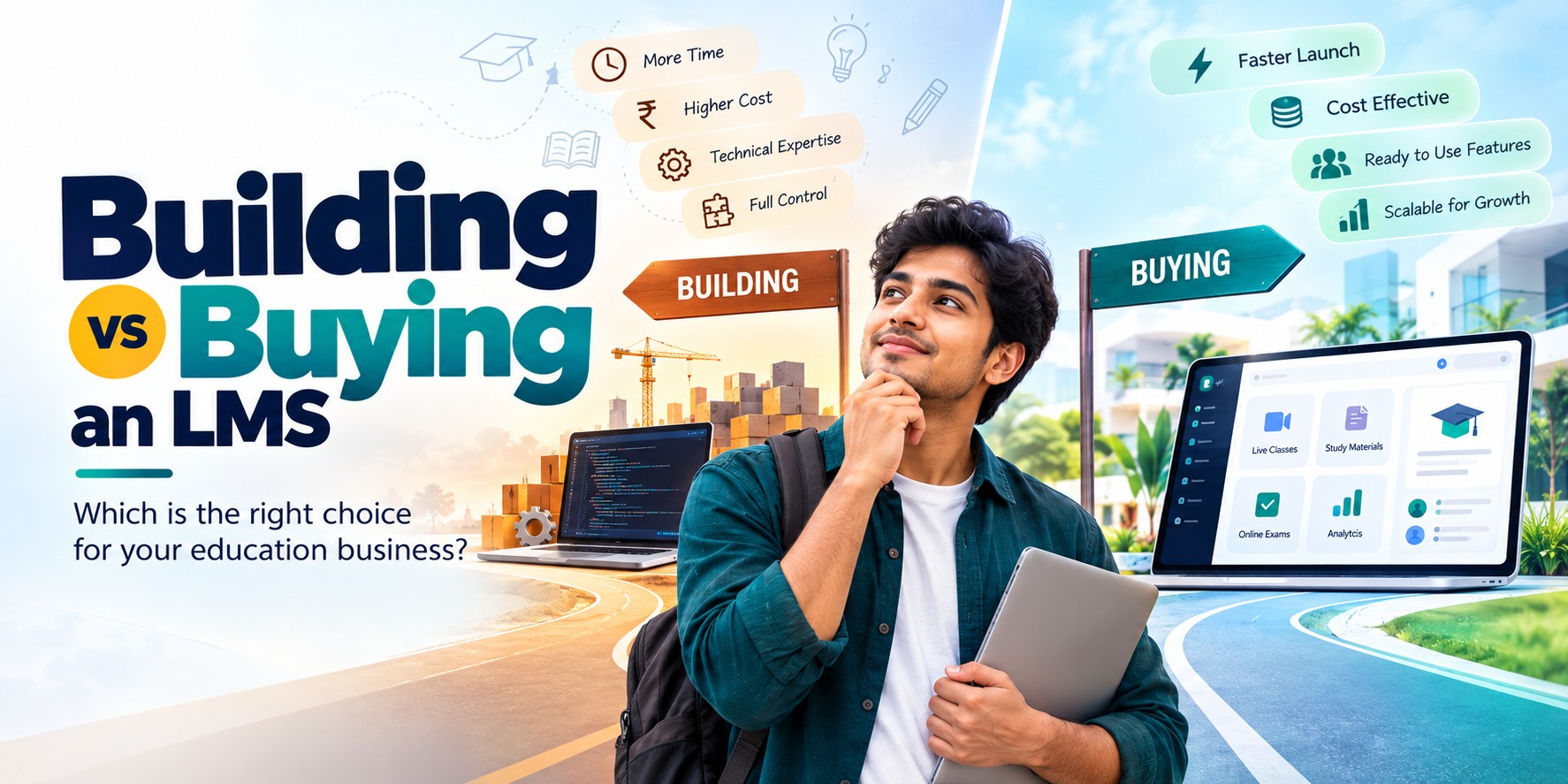
- Build vs Buy an LMS: Which Costs More?
- What Should a Coaching Institute Budget For?
- What Features Should You Get for Your LMS Budget?
- LMS Cost Is More Than the Software Subscription
- What About Tax?
- How to Choose an LMS Without Overpaying
- Questions to Ask an LMS Provider Before Paying
- What About Security and Student Data?
- Is a Cheap LMS Always Better?
- LMS Pricing for Different Types of Education Businesses
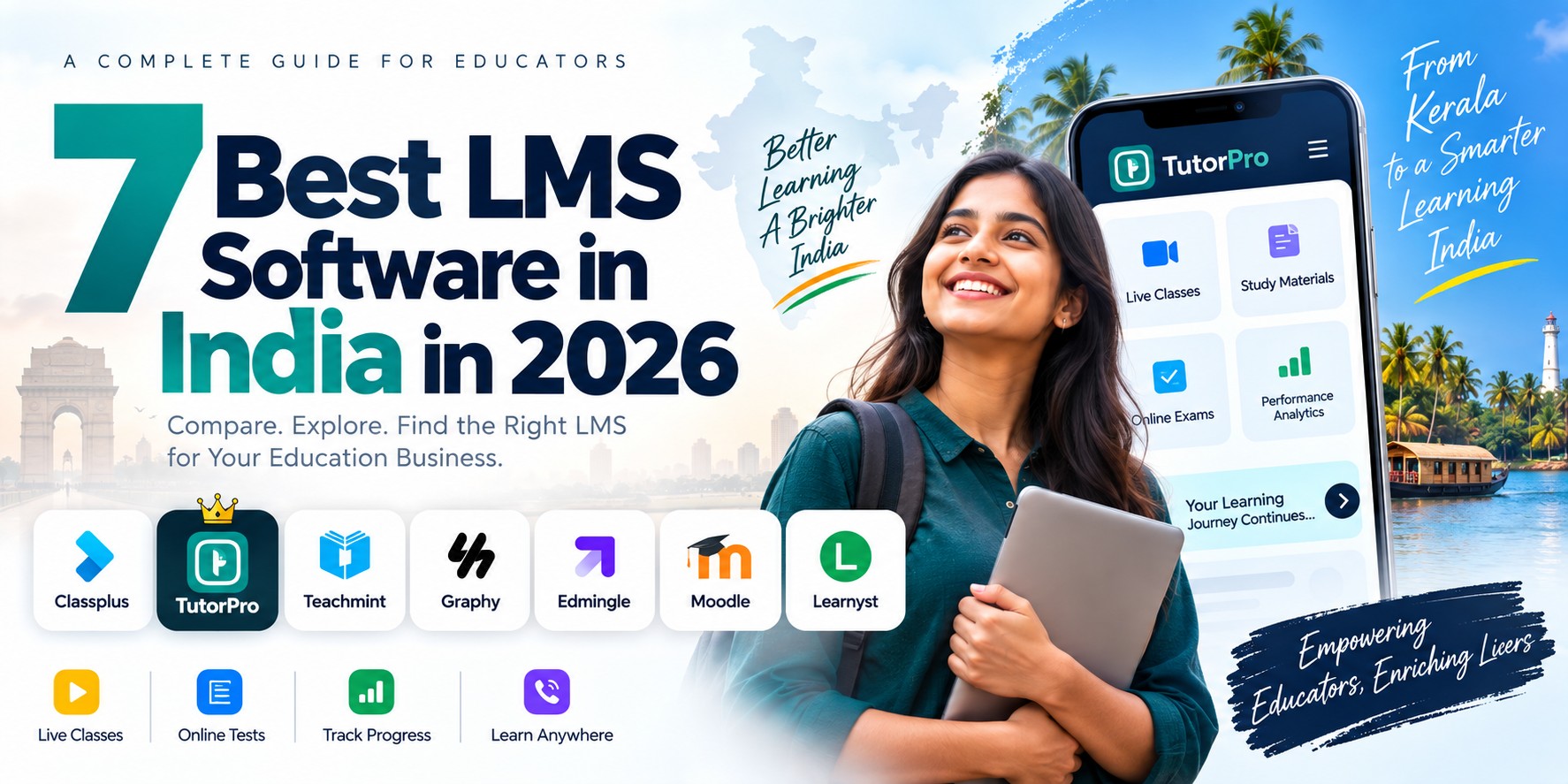
- Where Does TutorPro Fit?
- LMS Cost in Kerala: What Should Institutes Consider?
- The Bottom Line: How Much Should You Spend on an LMS?
- Frequently Asked Questions
Quick Answer: How Much Does an LMS Cost in India?
There is no standard LMS price in India because different platforms use different pricing models.
As a broad market reference, publicly listed plans from Indian education platforms currently show significant variation. For example, Classplus lists a one-year plan at ₹29,999 on its website, while Learnyst lists plans from ₹3,499 per month to ₹49,999 per month depending on the plan. Graphy also uses a combination of subscription and transaction-based pricing for some offerings.
For an educator or institute, the actual cost depends on:
- Number of students
- Number of teachers and administrators
- Live class requirements
- Online examination requirements
- Mobile app requirements
- Video hosting and storage
- Customisation
- Payment gateway integration
- CRM or ERP integration
- Branding and domain
- Security requirements
- Data migration
- Technical support
- Whether you buy an existing LMS or build one from scratch
So, instead of asking only "What is the LMS price?", it is better to ask:
"What will it cost to run the LMS I actually need?"
What Is an LMS?
An LMS, or Learning Management System, is software used to manage teaching and learning activities in one place.
Depending on the platform, an LMS can help an institute manage:
- Courses and batches
- Students and teachers
- Live classes
- Recorded videos
- Study materials
- Online exams
- Question banks
- Assignments
- Attendance
- Student performance
- Certificates
- Payments
- Notifications
- Learning analytics
- Mobile learning
For example, a PSC coaching centre in Kozhikode may use an LMS to upload daily study materials, conduct mock tests and track student scores.
An IELTS institute in Kochi may use it for recorded classes, speaking practice, assignments and student progress.
A school may need a different combination of features, especially if the LMS has to work with an existing SIS or school ERP.
That difference is one reason LMS pricing varies so much.
What Are the Different LMS Pricing Models in India?
Before comparing prices, understand how LMS companies usually charge customers.
1. Monthly or Annual Subscription
This is one of the simplest models.
You pay a fixed amount every month or year and use the platform according to the plan.
For example, Learnyst currently publishes plans ranging from ₹3,499/month to ₹49,999/month on its pricing page, depending on the features and level of the plan.
This model can work well when:
- You want to launch quickly
- You don't need heavy customisation
- You want predictable recurring costs
- You want the provider to handle hosting and maintenance
Things to check
Don't compare only the monthly price.
Check what is included:
- Number of learners
- Storage
- Admin accounts
- Mobile apps
- Live classes
- Exams
- Integrations
- Support
- Branding
- Migration
- API access
A cheaper plan may become expensive when important features are added as paid add-ons.
2. Annual LMS Plans
Some platforms offer annual packages instead of monthly subscriptions.
For example, Classplus currently lists a one-year plan at ₹29,999 on its website, with features including an Android app, website, admin portal, recorded courses, live classes and student enrolments.
Annual plans can make sense for an educator who already knows that the platform will be used for at least a year.
But again, check the renewal price and exactly what happens when the subscription expires.
3. Transaction-Based Pricing
Some education platforms combine platform fees with a percentage of course sales.
Graphy's published documentation for Indian creators, for example, describes a revenue-share model and states that it charges a percentage of transactions plus applicable taxes, along with an onboarding fee.
This can look attractive when you are starting with very few students.
But imagine an institute selling ₹20 lakh worth of courses in a year.
Even a small percentage of revenue can become a significant amount.
So, if your education business is growing quickly, calculate the total yearly cost, not just the starting price.
4. Custom LMS Development
The other option is to build a customised LMS.
Here, there is usually no fixed market price.
The cost depends on what you want to build.
For example, an institute may need:
- Custom website
- Android and iOS apps
- Admin panel
- Teacher panel
- Student panel
- Live classes
- Recorded video
- Online examinations
- Question bank
- CRM
- Payment gateway
- Attendance
- Certificates
- Analytics
- WhatsApp integration
- Multi-branch management
- Multi-language support
- API integrations
- Custom reports
A simple customised LMS and a large education platform with thousands of users are two very different projects.
There may also be separate costs for:
- UI/UX design
- Development
- Cloud hosting
- Video storage
- CDN
- Security
- App store publishing
- Third-party APIs
- Maintenance
- Technical support
- Future development
This is why a company quoting a custom LMS should ideally provide a detailed scope instead of giving you one unexplained number.
LMS Cost in India: A Simple Comparison
| LMS Approach | Typical Pricing Method | Suitable For |
|---|---|---|
| Basic SaaS LMS | Monthly/annual subscription | Individual educators |
| Branded education platform | Annual/monthly subscription | Small and medium institutes |
| Revenue-share platform | Subscription + transaction fee/revenue share | Course creators |
| Custom LMS | Project-based development | Institutes with specific requirements |
| Enterprise LMS | Custom quotation | Large organisations and complex requirements |
These are pricing models, not fixed industry price ranges. The actual amount depends on the provider and scope.
What Actually Increases the Cost of an LMS?
Two LMS platforms may look similar on the surface but have completely different prices.
Why?
Because the infrastructure and features behind them can be very different.
1. Number of Students
A platform for 500 students is different from a platform that needs to support 50,000 learners.
Ask the provider:
- Is there a student limit?
- Is storage unlimited?
- Are there limits on concurrent users?
- Are there limits during examinations?
- Does the price increase as students increase?
This is especially important for NEET/JEE, PSC and other competitive exam institutes where thousands of students may attempt a test at the same time.
2. Live Classes
If you only upload recorded videos, your infrastructure requirements may be relatively simple.
Live classes are different.
You may need integration with:
- Zoom
- Google Meet
- Video conferencing systems
- Interactive whiteboards
- Attendance systems
- Recording systems
Also ask about concurrent users.
An LMS supporting 5,000 registered students does not necessarily mean 5,000 students can attend a live class simultaneously.
3. Video Hosting
Video can become one of the biggest operational costs for an online education business.
Suppose an institute uploads hundreds of hours of classes.
You need to consider:
- Video storage
- Bandwidth
- Streaming
- CDN
- Content protection
- Backup
- Video processing
This is why "unlimited video" should always be examined carefully.
Ask what unlimited actually means.
4. Online Exams and Question Banks
For coaching institutes, exams are often more important than the course player itself.
A PSC coaching institute may require:
- Previous-year questions
- Mock tests
- Negative marking
- Random questions
- Subject-wise tests
- Time limits
- Automatic evaluation
- Rank lists
- Detailed performance reports
A NEET/JEE institute may need a much larger question bank and more advanced test analysis.
If exams are important to your business, don't select an LMS based only on its video and course features.
5. Mobile App
Many Indian learners expect to access classes through their phones.
A branded Android or iOS app can involve additional costs depending on the LMS model.
For example, Learnyst includes common or branded mobile app options in different plans, while Classplus promotes branded apps as part of its education platform offering.
When comparing an app, check whether it is:
- A common app
- Your own branded app
- White-labelled
- Published under your developer account
- Published under the provider's account
These differences matter if your institute wants to build a long-term digital brand.
6. Customisation
This is one of the biggest differences between a ready-made LMS and a custom LMS.
A standard platform may give you:
But an institute may want:
The second requirement needs more integration and development.
For example, a multi-branch coaching institute in Kerala may want separate dashboards for each branch while keeping central control at the head office.
That requirement can significantly change the project scope.
7. Integrations
Your LMS may need to communicate with other systems.
Common integrations include:
- Payment gateways
- SMS
- Zoom
- Google Meet
- CRM
- ERP
- Accounting software
- Analytics tools
- Single Sign-On
- Third-party APIs
Before purchasing an LMS, make a list of all the systems you already use.
It is much easier to identify integration costs before implementation than after signing the contract.
8. Data Migration
Suppose your institute already has:
- 5,000 student accounts
- 2,000 videos
- 10,000 PDFs
- 50,000 questions
- Existing course data
Moving everything to a new LMS is not simply a matter of uploading files.
You may need to migrate:
- Student records
- Course structure
- Videos
- Documents
- Questions
- Test results
- Payment records
Ask whether migration is included in the LMS price.
Build vs Buy an LMS: Which Costs More?
This is one of the most important decisions for an education business.
Buying an Existing LMS
You start with an already-developed platform.
Advantages
- Faster launch
- Lower initial development effort
- Existing features
- Regular updates
- Technical infrastructure already available
- Easier to test before committing
Limitations
- Customisation may be limited
- Some integrations may cost extra
- You may depend on the provider
- Your workflow may need to adapt to the platform
Building a Custom LMS
You develop a system around your own requirements.
Advantages
- Greater control
- Custom workflows
- Custom integrations
- Custom dashboards
- Greater flexibility for future development
Limitations
- Higher initial development effort
- Longer implementation
- Testing responsibility
- Infrastructure management
- Ongoing maintenance
- Need for a technical partner or internal team
There isn't one correct option for every institute.
A small IELTS centre may not need a large custom system.
A multi-branch coaching company with its own CRM, test engine and mobile apps may have very different requirements.
What Should a Coaching Institute Budget For?
Let's take a practical example.
Imagine a PSC coaching centre in Malappuram wants to move its classroom business online.
Initially, it may need:
- Student registration
- Course management
- Recorded classes
- Live classes
- Study materials
- Mock tests
- Notifications
- Payment gateway
- Basic performance reports
- Mobile access
It may not need a highly customised ERP on day one.
A better approach could be to start with the essential features and add advanced modules when the business actually needs them.
Now consider a larger institute operating in Kochi, Calicut and Thiruvananthapuram.
It may need:
- Multi-branch management
- CRM
- Counselling management
- LMS
- Mobile apps
- Online exams
- Question bank
- Attendance
- Payment management
- Advanced analytics
- Role-based access
That is a completely different LMS project.
The number of features matters more than the word "LMS" itself.
What Features Should You Get for Your LMS Budget?
Before comparing prices, create a feature checklist.
Basic LMS features
- Course management
- Student management
- Teacher management
- Study materials
- Recorded videos
- Assignments
- Basic reports
For coaching institutes
- Live classes
- Mock tests
- Question bank
- Online exams
- Batch management
- Attendance
- Performance analytics
- Notifications
- Payment gateway
For larger education businesses
- CRM integration
- Multi-branch support
- Multiple administrators
- Custom roles
- API access
- Advanced analytics
- Mobile applications
- White labelling
- Custom workflows
- Third-party integrations
This checklist will make price comparisons much more meaningful.
LMS Cost Is More Than the Software Subscription
This is where many first-time buyers make a mistake.
They compare:
vs
Platform B – ₹1,00,000/year
and assume the first option is cheaper.
But the real cost could look like this:
| Cost Area | What to Check |
|---|---|
| LMS subscription | Monthly or annual platform fee |
| Mobile app | Included or additional |
| Video hosting | Storage and bandwidth limits |
| Live classes | Integration and participant limits |
| Payment gateway | Gateway charges |
| Transaction fee | Platform revenue share, if applicable |
| Customisation | Additional development |
| Migration | Existing data transfer |
| Domain | Website/domain costs |
| SMS/WhatsApp | Usage-based charges |
| Support | Standard or dedicated support |
| Maintenance | Updates and technical work |
The final annual cost should include the costs that your institute will actually incur.
What About Tax?
When comparing software prices in India, always check whether the displayed amount is inclusive or exclusive of taxes.
For example, Learnyst's published pricing states that its listed prices are subject to taxes.
So if a vendor gives you a quote of ₹1,00,000 plus applicable TAX, your actual invoice amount will be higher than ₹1,00,000.
Don't compare one vendor's tax-inclusive price with another vendor's pre-tax price.
How to Choose an LMS Without Overpaying
Here is a simple process that can help.
Step 1: List Your Current Problems
Don't start with features.
Start with problems.
Are teachers spending too much time sending PDFs on WhatsApp?
Are students missing tests?
Are you struggling to track performance?
Are payments being managed manually?
Are recorded classes difficult to organise?
Write these problems down.
Step 2: Separate Must-Have and Nice-to-Have Features
For example:
Must-have
- Online exams
- Recorded videos
- Study materials
- Student management
- Payment gateway
Nice-to-have
- Gamification
- AI tools
- Advanced dashboards
- Affiliate system
- Custom automation
This can prevent you from paying for features you may never use.
Step 3: Calculate Your 3-Year Cost
Don't compare only the first-year price.
Calculate:
for at least three years.
This gives you a much clearer picture.
Step 4: Ask for a Demo
A demo is more useful than a long feature list.
Ask the provider to show you exactly how your teachers and students will use the system.
For example:
"Show me how a teacher creates a test, publishes it to a batch, evaluates the results and checks student performance."
That will tell you much more than a brochure.
Questions to Ask an LMS Provider Before Paying
Before signing a contract, ask these questions:
- How many students are included?
- Is there a limit on concurrent users?
- How much video storage is included?
- Is bandwidth limited?
- Are mobile apps included?
- Is the app branded?
- Who owns the data?
- Can I export my student data?
- Can I migrate away later?
- Are payment gateway charges included?
- Are third-party integrations included?
- Is customisation available?
- What is the implementation timeline?
- Is data migration included?
- What technical support is provided?
- What happens during high-traffic exams?
- What is the renewal price?
- Are there additional charges for APIs or integrations?
These questions can prevent unpleasant surprises later.
What About Security and Student Data?
An LMS stores important information.
Depending on the system, this can include:
- Student names
- Contact details
- Course information
- Exam results
- Attendance
- Payment information
- Learning activity
So security should be part of your buying decision.
Ask about:
- Data backups
- Access control
- Encryption
- Secure authentication
- Admin permissions
- Data export
- Server infrastructure
- Backup and recovery
- Audit logs where required
For schools and education businesses, data protection should not be treated as an optional feature.
India's Digital Personal Data Protection Act, 2023 is also relevant to organisations handling digital personal data, so institutions should understand their responsibilities and discuss data handling with their legal or compliance advisers where appropriate.
Is a Cheap LMS Always Better?
Not necessarily.
And an expensive LMS is not automatically better either.
Suppose an IELTS institute has 800 students and mainly needs:
- Video lessons
- Live classes
- Assignments
- Speaking practice
- Tests
- Progress tracking
It may not need a large enterprise LMS.
On the other hand, a growing education company with multiple branches, thousands of learners, its own mobile app and integrated CRM may quickly outgrow a basic platform.
The right question is:
Does the LMS solve the problems my organisation has today, while giving me enough room to grow tomorrow?
LMS Pricing for Different Types of Education Businesses
| Organisation | Important LMS Requirements |
|---|---|
| Individual educator | Courses, videos, payments, basic student management |
| IELTS institute | Live classes, recorded content, assignments, tests |
| OET institute | Courses, practice tests, progress tracking |
| PSC coaching | Large question bank, mock tests, rankings, analytics |
| NEET/JEE coaching | Test engine, video, live classes, performance analytics |
| Bank coaching | Mock tests, question banks, performance reports |
| German language institute | Live classes, recordings, assignments, assessments |
| School | Courses, attendance, assessments, parent/student access |
| College | Course management, assessments, reports, integrations |
| Skill development institute | Courses, certifications, assessments, learner tracking |
| EdTech company | Scalability, APIs, apps, analytics, custom workflows |
This is also why searching for the "best LMS software in India" without first defining your requirements can make the buying process harder.
Where Does TutorPro Fit?
For institutes that need more than a basic course-hosting platform, TutorPro takes a customised LMS approach.
It can bring together functions such as live classes, recorded learning, online exams, study materials, analytics, batch management, attendance, payment integration and personalised learning activities in one education platform. It also supports AI-based education features such as AI-assisted lesson planning, personalised revision and evaluation workflows.
This type of approach can be useful for institutions that want their LMS to match their existing teaching process rather than changing the entire workflow around a standard platform.
For example, a coaching institute may need one system connecting its website, admissions, student management, learning content, exams and performance tracking.
In that situation, the right question is less about "What is the cheapest LMS?" and more about "What system can handle our complete learning workflow without creating unnecessary complexity?"
LMS Cost in Kerala: What Should Institutes Consider?
Kerala has a wide range of education businesses, from individual tutors to large coaching centres and professional training institutes.
An institute in Kochi may have very different requirements from a small coaching centre in Kannur or Malappuram.
Similarly, an IELTS centre in Calicut may focus heavily on live classes and assignments, while a PSC coaching institute may care more about mock tests and question-bank management.
Before choosing an LMS provider in Kerala, consider:
- Local implementation support
- Customisation
- Mobile app requirements
- Online exam capabilities
- Integration requirements
- Student support
- Data migration
- Scalability
- Long-term maintenance
Location is less important than capability, but having a support team that understands the local education market can sometimes make implementation easier.
The Bottom Line: How Much Should You Spend on an LMS?
There is no universal LMS price in India.
Current public pricing already shows a wide range: Classplus publishes annual plans around the ₹30,000 level, while Learnyst's published plans range from ₹3,499/month to ₹49,999/month, and Graphy publishes subscription plans alongside transaction-based pricing for some Indian creators.
The bigger lesson is this:
Don't choose an LMS only because it has a lower price.
Look at the total cost, the features you actually need, the number of students you expect, your mobile app requirements, integrations, support, data migration and future growth.
For a small educator, a simple SaaS LMS may be enough.
For a coaching institute, exams, live classes, analytics and student management may be more important.
For a growing education company, a customised LMS connected with CRM, mobile apps and other systems may make more sense.
The best starting point is not a budget.
It is a clear list of your learning, business and technology requirements.
Once you have that list, comparing LMS pricing becomes much easier.
Frequently Asked Questions
1. How much does an LMS cost in India?
LMS pricing varies widely depending on the provider and features. Publicly listed plans in India currently range from annual plans costing tens of thousands of rupees to platforms charging several thousand rupees per month or more. Custom LMS development is normally quoted separately based on requirements.
2. What is the cheapest LMS option for an educator?
A basic subscription-based LMS is generally simpler to start with than developing a custom platform. However, educators should also check transaction fees, storage limits, app charges and other additional costs before comparing prices.
3. How much does a custom LMS cost?
There is no fixed price for a custom LMS. The cost depends on features, design, mobile apps, integrations, infrastructure, security, data migration and ongoing maintenance.
4. Is an LMS worth it for a coaching institute?
It can be useful when an institute needs to manage recorded classes, live classes, study materials, exams, student performance and communication in one system. The value depends on how much of the institute's workflow the LMS actually handles.
5. What is included in an LMS subscription?
It depends on the provider and plan. Common features include course management, student management, videos, study materials, assessments and reports. Advanced features such as branded apps, APIs, white labelling, advanced analytics and custom integrations may be available only on higher plans.
6. Should I build or buy an LMS?
Buying an existing LMS can be practical when you need to launch quickly and your requirements fit an existing platform. Building a custom LMS can make more sense when your organisation has specific workflows or integrations that standard platforms cannot support. If you're weighing this decision in detail, see our guide on building vs buying an LMS.
7. Does LMS pricing include TAX?
Not always. Some providers display prices before taxes. Always check whether TAX is included in the quoted price before comparing different LMS providers.
8. What should I check before buying an LMS?
Check student limits, concurrent users, video storage, exams, live classes, mobile apps, integrations, data ownership, migration, security, technical support, renewal pricing and additional charges.
Conclusion
Choosing an LMS is a technology decision, but it is also a business decision.
The cheapest platform may not be the lowest-cost option in the long run. At the same time, an expensive enterprise system may be unnecessary for a small institute.
Start with your students, teachers and daily workflow.
Then decide which features you actually need.
Whether you are running an IELTS centre in Kochi, a PSC coaching institute in Calicut, a NEET/JEE academy, a German language institute, a school, college or professional training centre, the right LMS should make teaching and administration easier—not add another complicated system for your team to manage.