Every admission season, coaching institutes face a familiar challenge.
Students and parents enquire about courses, compare fees, attend demo classes and explore different institutions before making a decision.
For coaching institute owners, the question is simple: how do you attract serious students and give them a convincing reason to choose your institute?
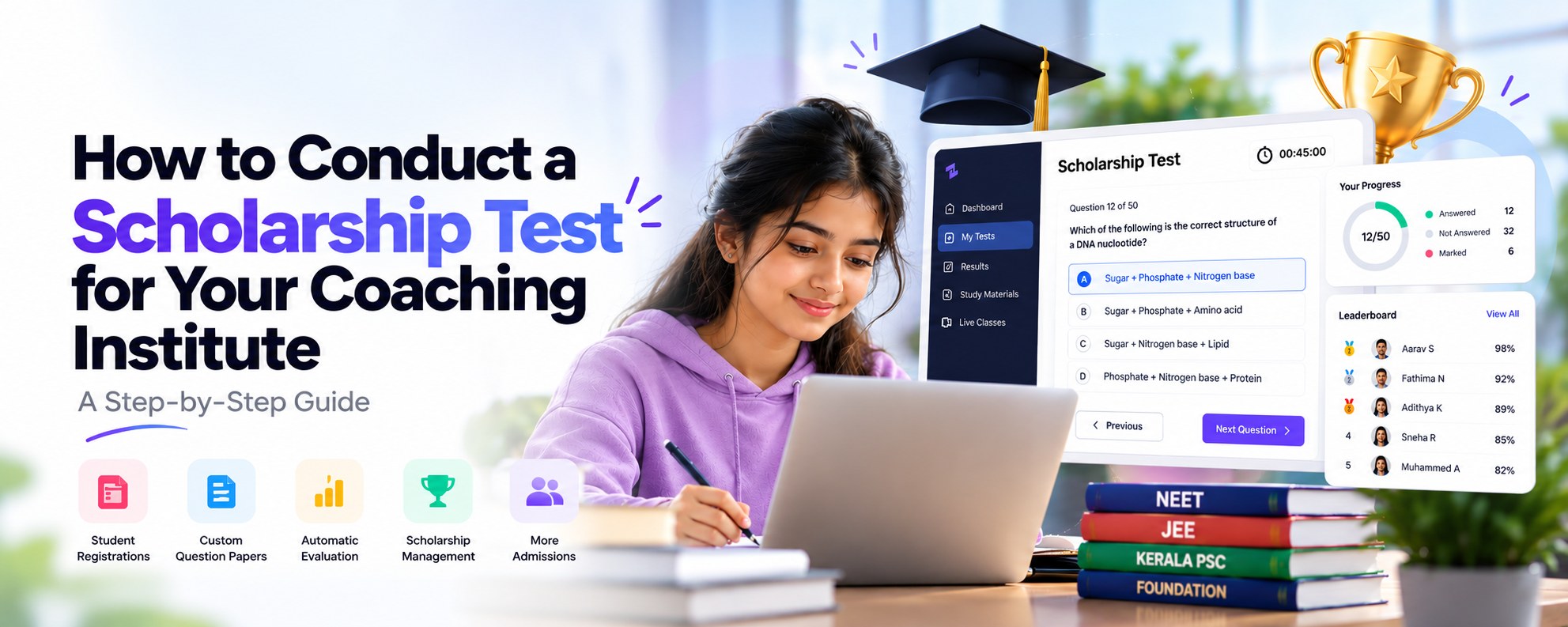
One effective approach is to organise a scholarship test.
A well-planned scholarship examination does more than offer fee discounts. It helps institutions discover talented students, assess their academic abilities, introduce their teaching methods and build relationships with prospective students and parents.
But conducting a successful scholarship test requires more than preparing a question paper and announcing a prize.
Let's explore how to organise one, from planning to admissions.
Table of Contents
- What Is a Scholarship Test for a Coaching Institute?
- Why Should Coaching Institutes Conduct Scholarship Tests?
- Step-by-Step Guide to Conducting a Scholarship Test
- How to Calculate the Success of Your Scholarship Campaign
- Common Mistakes Coaching Institutes Should Avoid
- How Tutor Pro Helps Coaching Institutes Conduct Online Scholarship Tests
- Final Thoughts
- Frequently Asked Questions
What Is a Scholarship Test for a Coaching Institute?
A scholarship test is an examination conducted by an educational institution to identify eligible students for financial assistance, tuition fee concessions or other academic benefits.
For example, a NEET coaching centre may conduct a scholarship examination for students entering Class 11 or preparing for medical entrance examinations.
Based on their performance, eligible students may receive scholarships covering a portion of their tuition fees.
The examination also helps the institute understand students' academic strengths and weaknesses before they begin their courses.
Scholarship tests are commonly organised by:
- NEET and JEE coaching institutes
- Kerala PSC coaching centres
- Foundation and entrance coaching institutes
- Civil service academies
- School tuition centres
- Professional and competitive examination training institutes
For students, a scholarship test creates an opportunity to access education at a more affordable cost. For institutions, it creates a structured way to connect with potential students.
Why Should Coaching Institutes Conduct Scholarship Tests?
1. Attract More Students During Admission Season
Consider a coaching institute planning to launch a new NEET batch.
Instead of promoting only its course fees and facilities, the institute announces a scholarship examination for eligible students.
The campaign gives prospective students a reason to engage with the institution even before they decide to enrol. This can help the institute reach students who might otherwise never enquire about its programmes.
2. Identify Talented Students
Scholarship examinations allow institutions to identify academically strong students based on a consistent assessment.
They also help teachers understand students' preparation levels before assigning them to suitable batches.
3. Build Trust With Parents
Parents want to understand whether an institute is the right choice for their children.
A professionally conducted scholarship examination, followed by transparent results and academic counselling, can demonstrate the institute's commitment to student development.
4. Generate Qualified Admission Enquiries
Unlike a general advertisement, a scholarship test encourages students to take a specific action.
Students register, share their academic interests and participate in an assessment. With appropriate consent, this information can help admission teams provide relevant course guidance and follow-up communication.
5. Promote Your Institute's Academic Brand
A scholarship examination can become an annual event associated with your institution.
Over time, a well-managed programme can strengthen recognition among students, parents and schools.
Step-by-Step Guide to Conducting a Scholarship Test
Step 1: Define the Purpose of Your Scholarship Examination
Before announcing the examination, decide what you want to achieve.
Are you trying to increase admissions for a new batch? Identify talented students? Reach new schools? Or introduce your coaching institute to a wider audience?
Your objective will influence the examination pattern, marketing campaign and scholarship structure.
Avoid starting with an attractive discount announcement without calculating whether the scholarship programme is financially sustainable.
Step 2: Decide Between Online and Offline Scholarship Tests
Coaching institutes can organise scholarship examinations in three formats.
| Format | Suitable for |
|---|---|
| Online | Reaching students across multiple locations |
| Offline | Conducting supervised examinations at a physical centre |
| Hybrid | Combining wider reach with in-person participation |
Online scholarship tests can reduce the need for printed question papers and manual evaluation. They are particularly useful for institutions operating across different districts or offering online coaching programmes.
Offline tests, on the other hand, give parents and students an opportunity to visit the institution and interact with faculty.
Choose the format based on your target audience, infrastructure and examination requirements.
Step 3: Prepare a Fair and Relevant Question Paper
The quality of your scholarship examination directly affects its credibility.
The questions should reflect the academic level of the participating students and the type of course they are planning to join.
For example, a NEET foundation scholarship examination may assess relevant science and mathematics concepts, while a Kerala PSC coaching institute may evaluate general knowledge, reasoning and basic aptitude.
A sample examination pattern could be:
| Section | Questions | Marks |
|---|---|---|
| Subject knowledge | 30 | 30 |
| Logical reasoning | 20 | 20 |
| General aptitude | 20 | 20 |
| Mathematics | 30 | 30 |
| Total | 100 | 100 |
This is an illustrative pattern. The actual syllabus and distribution should be determined by the academic team.
Include questions of varying difficulty levels so the examination can distinguish between different preparation levels.
Every question and answer key should be reviewed by qualified faculty before publication.
Step 4: Create a Transparent Scholarship Structure
Students and parents should understand how scholarships are awarded.
One approach is to link fee concessions to examination performance.
Example scholarship structure:
| Test score | Tuition fee scholarship |
|---|---|
| 90–100% | 75% |
| 80–89% | 50% |
| 70–79% | 30% |
| 60–69% | 15% |
| Below 60% | No automatic scholarship |
These percentages are examples, not recommended universal rates.
Institutes should calculate the financial impact before finalising scholarship amounts. They should also specify eligibility criteria, tie-breaking rules, scholarship validity and any maximum number of awards.
Be clear whether the concession applies only to tuition fees or includes other charges.
Step 5: Launch Online Scholarship Registrations
A complicated registration process can discourage students from participating. Keep the registration form simple.
Collect only the information required to organise the examination, such as student name, class, target examination, contact information and preferred test location or slot.
For minors, provide appropriate parent or guardian information and consent arrangements.
After successful registration, students should receive clear instructions about the examination date, syllabus, reporting time and login process.
Using a digital registration and examination system can make this process easier to manage.
Step 6: Promote Your Scholarship Test
Even a well-designed scholarship examination will struggle to attract students if the target audience doesn't hear about it.
Start promotion sufficiently early to give students time to register and prepare.
Digital marketing channels
Use Instagram, Facebook, Google Search, your institute's website and permission-based WhatsApp communication to reach relevant audiences.
A simple campaign message could be:
"Preparing for NEET 2027? Register for our Scholarship Test and get an opportunity to earn tuition fee concessions based on your performance."
Include the date, eligibility, registration link and scholarship conditions.
Offline promotion
Local school outreach, educational seminars, posters and student referral programmes may also help, where permission is obtained.
For institutes targeting students in Kerala, consider creating location-specific pages for relevant areas such as Kozhikode, Kochi, Thrissur, Malappuram and Thiruvananthapuram.
These pages should provide genuinely useful local information rather than repeating identical content with different city names.
Step 7: Conduct the Examination Professionally
The examination experience creates an early impression of your institute.
For online scholarship tests, ensure that students can access the platform, understand the examination instructions and submit their answers successfully.
Useful online examination capabilities include:
- Scheduled examinations
- Question banks
- Timed assessments
- Automatic evaluation for supported question types
- Randomised questions, where appropriate
- Individual performance reports
- Rank lists and result management
Conduct a trial examination before the actual event.
For offline examinations, organise seating arrangements, invigilation, question papers and student assistance.
A clearly communicated support process is important in both formats.
Step 8: Publish Results and Scholarship Details
Students should not have to wait unnecessarily long for their scholarship results.
For objective examinations, automated evaluation can significantly reduce the time needed to prepare results.
A useful student report may include:
- Total score and percentage
- Subject-wise performance
- Rank or percentile, where applicable
- Scholarship eligibility
- Tuition fee concession
- Scholarship acceptance deadline
Make results accessible privately to individual students. If publishing rank lists, follow applicable privacy requirements and obtain appropriate consent.
Clear results help parents understand both the scholarship award and the student's academic preparation level.
Step 9: Convert Scholarship Participants Into Admissions
Conducting the examination is only one part of the process.
The next step is helping interested students make an informed admission decision.
Your admission team can contact eligible students and parents, explain their performance, provide course details and offer academic counselling.
A practical follow-up process might include:
Keep communication helpful rather than applying unnecessary pressure.
Students who do not immediately enrol may still benefit from free learning resources or future programme information, provided they have agreed to receive such communication.
How to Calculate the Success of Your Scholarship Campaign
A scholarship test should be evaluated as an academic initiative and an admission campaign.
Consider a hypothetical coaching institute that records the following results:
| Metric | Example |
|---|---|
| Registrations | 1,000 |
| Students who attended | 750 |
| Students who enrolled | 120 |
| Attendance rate | 75% |
| Admission conversion from attendees | 16% |
The institute can use these figures to understand how effectively its campaign performed.
It should also monitor marketing expenditure, scholarship concessions, actual fees collected and the cost of acquiring each student.
A campaign with high registrations but few admissions may require better targeting, clearer course communication or improved counselling.
The goal is not simply to conduct the largest scholarship test. It is to create genuine value for students while building a sustainable admission process.
Common Mistakes Coaching Institutes Should Avoid
One frequent mistake is announcing large scholarships without defining the eligibility conditions or overall budget.
Another is making the examination unnecessarily difficult. A scholarship test should identify academic ability without discouraging students through an unsuitable question paper.
Institutes should also avoid poor registration experiences, delayed results, unclear fee concessions and unstructured admission follow-ups.
Finally, don't treat every scholarship participant as a sales lead alone.
Students deserve a fair examination, meaningful feedback and transparent information about their options.
How Tutor Pro Helps Coaching Institutes Conduct Online Scholarship Tests
Organising a scholarship examination involves several connected activities: managing students, preparing questions, conducting assessments, evaluating results and communicating with participants.
When these activities are handled through separate spreadsheets, messaging groups and examination tools, administration can become complicated.
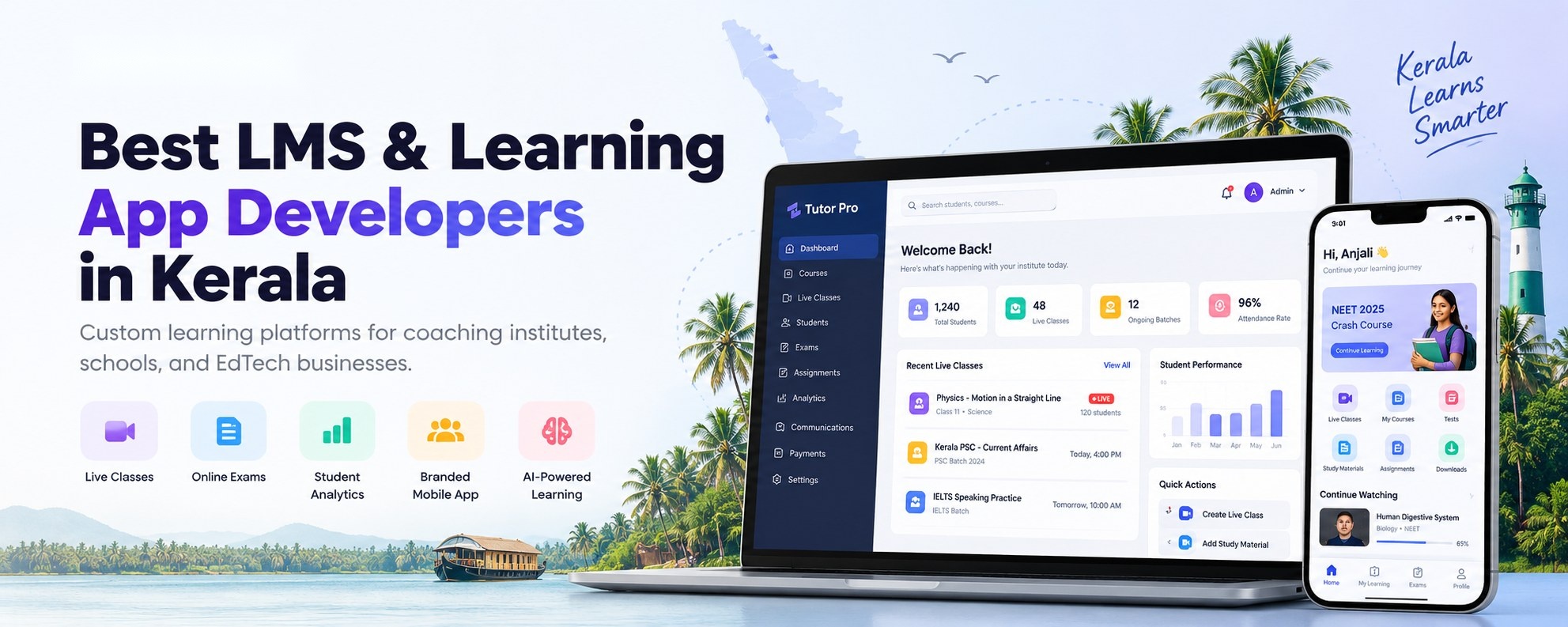
Tutor Pro, developed by Trogon Media Pvt. Ltd., offers custom Learning Management System solutions for coaching institutes and education businesses.
Tutor Pro's online examination capabilities can support institutions in creating structured assessments, managing question banks, conducting MCQ-based examinations and analysing student performance.
Depending on the project configuration, a customised Tutor Pro platform can also support student registration workflows, reports, notifications, course enrolment and payment integrations.
An important advantage of a dedicated LMS is that the institution can continue using the platform after the scholarship campaign.
Students who enrol can access live classes, recorded lessons, study materials, practice examinations, assignments and academic support through the same branded learning environment.
For NEET, JEE, PSC and other coaching institutes planning regular scholarship examinations, this can help create a more connected experience from the first assessment to ongoing learning.
Why consider Tutor Pro:
With a focus on custom LMS development, Tutor Pro helps institutions build learning platforms around their academic requirements rather than forcing every institution into an identical workflow.
Request a Product Demo Explore Tutor Pro
Final Thoughts
A scholarship test can be much more than a seasonal admission promotion.
When organised properly, it gives students an opportunity to demonstrate their abilities, helps parents understand the institute's academic approach and provides coaching centres with valuable insights into prospective learners.
The most effective scholarship programmes combine fair assessments, transparent awards, accessible technology and thoughtful admission counselling.
Whether you're running a NEET coaching centre, PSC academy, JEE training institute or foundation programme, investing in a well-planned scholarship examination can strengthen both your student outreach and academic processes.
Planning to conduct an online scholarship test?
Make your next scholarship examination easier to organise with a customised learning and examination platform. Tutor Pro helps coaching institutes build branded LMS solutions with online examinations, student analytics and integrated learning management features.
Frequently Asked Questions
1. How can I conduct an online scholarship test for my coaching institute?
Define your eligibility criteria, prepare a question paper, set scholarship rules, open registrations and conduct the examination through an online exam platform. After evaluation, share individual results and scholarship details.
2. Which software is suitable for conducting scholarship exams?
Look for software that supports question banks, timed examinations, automatic evaluation, student performance reports and result management. Tutor Pro offers custom LMS and online examination solutions for coaching institutes.
3. How can scholarship tests help increase coaching institute admissions?
Scholarship tests give prospective students an opportunity to engage with an institution, demonstrate their academic ability and explore courses. Clear results and academic counselling can help interested families make admission decisions.
4. Can NEET and JEE coaching institutes conduct online scholarship tests?
Yes. NEET and JEE coaching institutes can conduct online scholarship examinations using subject-specific questions, timed assessments and performance-based scholarship criteria.
5. How should a coaching institute decide scholarship percentages?
Scholarship percentages should be based on the institute's budget, course fees, expected enrolment and financial sustainability. Publish clear eligibility conditions before the examination.
6. Can I conduct a scholarship test through my own branded learning app?
Yes. A customised LMS can support scholarship examinations within an institute's branded application, depending on the features included in the solution.
7. How long should a scholarship examination be?
The duration depends on the target age group, syllabus and assessment objectives. Many institutes can begin by considering a 60–90-minute examination, then adjust the duration based on academic requirements.
8. How can I manage scholarship results and student rankings?
An online examination management system can automate scoring for supported question types and generate reports. Institutions should establish clear ranking, tie-breaking and privacy policies before publishing results.