A Conversation With Rafeeque Parakkal on What Students Must Learn Beyond the Classroom
For years, we have asked students the same question: "What do you want to become?"
Doctor. Engineer. Teacher. Developer. Accountant. Entrepreneur.
But today, I think we need to ask a different question: "What skills will help you succeed when the job you prepare for today looks completely different tomorrow?"
I have spent more than a decade working closely with educational institutions, educators, edupreneurs and technology teams. Through 200+ LMS implementations and learning platforms reaching 2 million+ users, I have seen a pattern that concerns me.
Students are learning. They are completing courses. They are writing exams. They are collecting certificates.
But are they learning how to adapt?
That, in my view, is the bigger question for education today.
Table of Contents
- The Problem Isn't That Students Know Too Little
- 1. AI Literacy Will Become a Basic Skill
- 2. Critical Thinking Will Become More Valuable, Not Less
- 3. Communication Will Separate Good Candidates From Great Ones
- 4. Problem-Solving Is More Important Than Memorization
- 5. Creativity Will Matter Even More
- 6. Adaptability May Become the Most Important Skill
- 7. Students Need to Learn How to Learn
- 8. Emotional Intelligence Will Still Matter
- 9. Digital Responsibility Will Become Essential
- 10. Entrepreneurship Is a Mindset, Not Just a Business Course
- What I Have Learned From Working With Educators
- The LMS of the Future Shouldn't Just Deliver Content
- If I Were Designing Education for the Next Generation
- My Message to Students
- My Message to Educators
- My Final Thought
The Problem Isn't That Students Know Too Little
It is that the world is changing faster than what they are being taught.
A student can memorize a textbook today and find much of that information instantly through Google, AI tools or other digital resources tomorrow.
That doesn't make knowledge unimportant. It changes what knowledge is valuable.
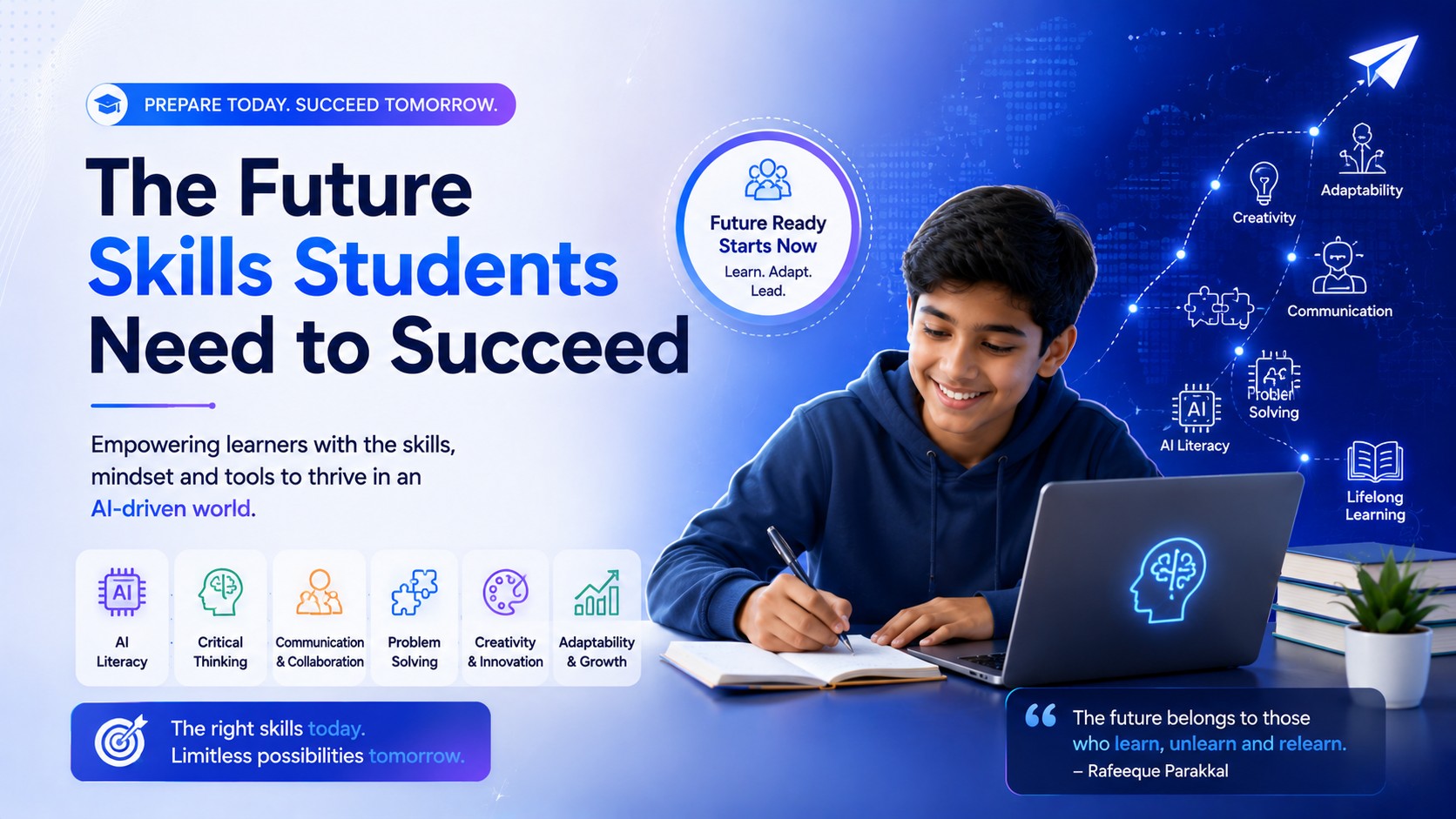
The real advantage will increasingly belong to students who can:
- Think critically
- Solve unfamiliar problems
- Use AI intelligently
- Communicate clearly
- Work with different people
- Learn independently
- Adapt when things change
- Create rather than simply consume
- Make responsible decisions
- Keep learning throughout their careers
The World Economic Forum's Future of Jobs Report 2025 similarly highlights analytical thinking, resilience, creativity, technological literacy, AI and big data, curiosity and lifelong learning among the skills becoming increasingly important.
This is where I believe education needs to change.
1. AI Literacy Will Become a Basic Skill
I don't believe every student needs to become an AI engineer.
But every student should understand how to work with AI.
A future accountant will use AI. A teacher will use AI. A designer will use AI. A lawyer will use AI. A doctor will use AI. An entrepreneur will use AI.
So the question is not: "Will AI replace students?"
The better question is: "Will students who know how to use AI outperform those who don't?"
I believe they will.
But AI literacy isn't simply knowing how to write prompts. Students need to learn how to:
- Ask better questions
- Verify AI-generated information
- Identify hallucinations and bias
- Protect personal and confidential information
- Use AI to improve — not replace — their thinking
- Understand when AI should not be trusted
UNESCO also emphasizes that digital and AI competencies are becoming essential, while responsible use requires ethical understanding and critical thinking.
My advice to educators:
Don't teach students to compete with AI. Teach them to think better with AI.
2. Critical Thinking Will Become More Valuable, Not Less
Imagine two students using ChatGPT to answer the same question.
Student A
Copies the answer.
Student B
Asks: "Is this actually correct? What evidence supports it? What might be missing?"
The second student is developing a skill that machines cannot simply hand to them. That is critical thinking.
As information becomes easier to generate, the ability to evaluate information becomes more valuable. Students need to learn to question:
- Why?
- How?
- What evidence?
- What are the alternatives?
- What could go wrong?
- Is this actually true?
The World Economic Forum identifies analytical thinking as the most sought-after core skill among employers in its 2025 report.
For me, this is one of the biggest changes education needs to make. We should reward better questions — not only correct answers.
3. Communication Will Separate Good Candidates From Great Ones
I have seen technically capable people struggle because they cannot communicate their ideas.
They may know the answer. But they cannot explain it. They cannot present it. They cannot convince a team. They cannot communicate with a client.
The future workplace will require students to work across teams, platforms, cultures and even countries. That means students need to become comfortable with:
- Writing
- Speaking
- Listening
- Presenting
- Collaborating
And communication isn't just English proficiency. It's the ability to take a complicated idea and make another person understand it. That's a very different skill.
4. Problem-Solving Is More Important Than Memorization
Here's something I have noticed repeatedly while working around education technology: students can be very good at answering questions they have already seen.
But what happens when the question changes? That is where real learning begins.
A future-ready student shouldn't only be able to say: "I know this."
They should be able to say: "I don't know yet — but I know how to figure it out."
That mindset is incredibly powerful. Education should therefore give students more opportunities to:
- Work on real problems
- Build projects
- Analyse situations
- Make decisions
- Experiment
- Fail safely
- Try again
Because the workplace doesn't come with multiple-choice options.
5. Creativity Will Matter Even More
There is a common misconception that AI will make creativity less important. I see it differently.
AI can generate thousands of ideas. But which idea is worth pursuing? That's where human creativity, judgment and context matter.
Students need opportunities to create:
- Projects
- Businesses
- Designs
- Stories
- Products
- Solutions
- Experiments
- New ideas
Instead of asking students only: "What is the correct answer?" we should sometimes ask: "What would you create?"
6. Adaptability May Become the Most Important Skill
If there is one thing I would tell every student today, it would be this:
Don't build your identity around one skill. Build your ability to learn new skills.
Technology will change. Job titles will change. Industries will change. Some jobs will disappear. New jobs will appear that we cannot even predict today.
The WEF estimates that around 39% of workers' existing skill sets are expected to be transformed or become outdated between 2025 and 2030.
So education cannot end with graduation. Learning has to become a lifelong habit.
7. Students Need to Learn How to Learn
This is one of the most underrated future skills.
A student who knows how to learn can enter almost any industry. They know how to:
- Find reliable information
- Break a difficult topic into smaller pieces
- Ask for help
- Practice deliberately
- Learn from mistakes
- Use technology effectively
- Teach themselves new concepts
This is especially important now because information is everywhere.
Access to information is no longer the biggest problem. Knowing what to do with that information is.
8. Emotional Intelligence Will Still Matter
Technology can automate tasks. It cannot automatically make someone a good teammate.
Students will still need:
- Empathy
- Patience
- Self-awareness
- Leadership
- Conflict resolution
- Collaboration
- Listening skills
- Resilience
A brilliant employee who cannot work with people will always have limitations. The future isn't only about technical intelligence. It is also about human intelligence.
The WEF's latest skills outlook similarly places resilience, flexibility, leadership, collaboration and social influence alongside technical capabilities.
9. Digital Responsibility Will Become Essential
Students are growing up in a world where almost everything leaves a digital footprint.
What they post. What they share. What they create. What AI generates for them. What information they provide to platforms.
Digital literacy therefore needs to include digital responsibility. Students should understand:
- Privacy
- Cybersecurity
- Digital identity
- Misinformation
- AI ethics
- Copyright
- Responsible technology use
We shouldn't simply teach students how to use technology. We need to teach them how to use technology responsibly.
10. Entrepreneurship Is a Mindset, Not Just a Business Course
Not every student needs to start a company. But every student can benefit from entrepreneurial thinking.
That means learning to:
This mindset is useful whether someone becomes an entrepreneur, employee, teacher, engineer or researcher. Because organizations don't just need people who can follow instructions. They need people who can spot opportunities and solve problems.
What I Have Learned From Working With Educators
After working with educational institutions and speaking with educators and edupreneurs over the years, I've come to believe that the biggest challenge isn't technology.
It's mindset.
We sometimes ask: "How can we teach more?"
I think the more important question is: "How can we prepare students better?"
Those are not the same thing.
A student doesn't necessarily need another 100 hours of recorded classes. Sometimes they need:
- A real project
- A mentor
- Better feedback
- A difficult problem
- A chance to present
- A chance to collaborate
- A reason to think independently
- The confidence to try something unfamiliar
Technology can help create these experiences. But technology itself is not the answer.
The LMS of the Future Shouldn't Just Deliver Content
This is particularly important from my experience in building learning platforms.
The traditional LMS model is often:
But I believe the future needs to look more like:
That's a completely different learning journey.
An LMS should increasingly help institutions understand not only: "Did the student complete the course?" but also: "Can the student actually use what they learned?"
That is the real measure of learning.
If I Were Designing Education for the Next Generation
I would build the learning experience around six pillars:
Put these together and you get something more valuable than a certificate. You get a student who is ready for change.
My Message to Students
If you are a student reading this, I don't want you to worry about predicting exactly which job you will have ten years from now. Nobody can predict that perfectly.
Instead, build skills that will remain useful even when the world changes.
- Learn AI — but don't stop thinking.
- Learn technology — but don't forget people.
- Get certificates — but build something too.
- Study for exams — but solve real problems.
- Choose a career — but don't stop learning.
And most importantly:
Don't prepare only for the job that exists today. Prepare yourself to learn the jobs that will exist tomorrow.
My Message to Educators
We cannot prepare tomorrow's students using only yesterday's teaching methods.
The role of an educator is becoming even more important — not less.
Because when information is everywhere, students need someone who can help them understand:
- What matters
- What doesn't
- What to question
- What to explore
- And how to think
The future classroom shouldn't be a place where technology replaces teachers. It should be a place where teachers use technology to give students better opportunities to think, create and grow.
My Final Thought
After years of working in education technology, one thing has become very clear to me:
The future doesn't belong to students who know the most. It belongs to students who can learn, adapt, think and create.
Technology will continue to change. AI will become more powerful. Jobs will evolve.
But curiosity, critical thinking, creativity, communication and the ability to learn will remain deeply human advantages.
So perhaps the biggest future skill isn't AI. It isn't coding. It isn't even technology.
It is the ability to keep becoming better.
And that is what I believe education should ultimately prepare every student to do.