A classroom rarely has 30 students who learn in exactly the same way.
One student understands a mathematics concept after one explanation. Another needs three examples. Someone else may understand the concept but struggle to apply it in a real problem. One student asks questions constantly, while another remains silent because they are afraid of getting the answer wrong.
Yet traditionally, all of them receive almost the same lesson, at almost the same pace.
This is one of the biggest challenges in education—and it is exactly where Artificial Intelligence (AI) is beginning to make a difference.
AI is not about replacing teachers with machines. The real opportunity is much more practical: helping teachers understand learners better, personalize learning, reduce repetitive work, and give students more meaningful support when they need it.
And this shift is already happening.
Table of Contents
- AI in Education Is No Longer Just a Future Idea
- Imagine a Classroom Where Every Student Gets a Different Learning Path
- What Does Personalized Learning With AI Actually Mean?
- 7 Powerful Ways AI Is Changing Education
- The Biggest Mistake: Using AI Just Because It Is AI
- What Should an AI-Powered Learning Platform Actually Include?
- AI + LMS: Where the Real Transformation Can Happen
- The Human Side of AI in Education
- What Should Schools and Educators Do Next?
- The Future of Education Isn't Human vs AI
- AI in Education: Frequently Asked Questions
AI in Education Is No Longer Just a Future Idea
For years, artificial intelligence in education sounded like something that belonged to the future.
Today, students are already using generative AI to explain difficult concepts, brainstorm ideas, summarize information, practise languages and prepare for exams. Teachers are using AI to create lesson plans, assessments, learning materials and classroom activities.
The numbers tell an important story.
The OECD's Digital Education Outlook 2026 reports that 37% of lower-secondary teachers used AI for their work in 2024. At the same time, 57% said AI can help them write or improve lesson plans.
But there is another number educators should pay attention to: 72% of lower-secondary teachers believe AI can harm academic integrity by allowing students to present AI-generated work as their own.
That tells us something important.
The question is no longer whether AI will enter education. The question is how we use it properly.
Imagine a Classroom Where Every Student Gets a Different Learning Path
Consider a student named Anu.
Anu is good at science but struggles with mathematics. In a traditional classroom, she may receive the same worksheet, the same explanation and the same homework as everyone else.
She might understand 60% of the lesson.
The next day, the teacher moves forward.
Now Anu is learning the next topic on top of a foundation that is already incomplete.
This happens repeatedly.
Eventually, the student doesn't necessarily think: "I need help with fractions."
They think: "I'm just not good at maths."
Now imagine the same learning environment supported by an AI-powered learning platform.
The system notices that Anu repeatedly struggles with a particular type of problem. Instead of simply marking her answer wrong, an AI-enabled system could:
- Identify the concept she is struggling with
- Provide a simpler explanation
- Give additional examples
- Recommend a short learning activity
- Generate practice questions at the appropriate difficulty
- Provide instant feedback
- Track her improvement
- Alert the teacher if she needs additional support
That is the real promise of personalized learning with AI.
The technology doesn't need to replace the teacher. It helps the teacher see the learner more clearly.
What Does Personalized Learning With AI Actually Mean?
Personalized learning isn't simply giving every student different content.
It means understanding that learners have different:
- Learning speeds
- Knowledge levels
- Strengths and weaknesses
- Interests
- Learning patterns
- Language abilities
- Practice requirements
AI can analyse learning interactions and use those insights to recommend what a learner should do next. For example:
- Student A: Needs basic concept revision
- Student B: Ready for intermediate practice
- Student C: Needs challenging application questions
- Student D: Understands the topic but needs more revision
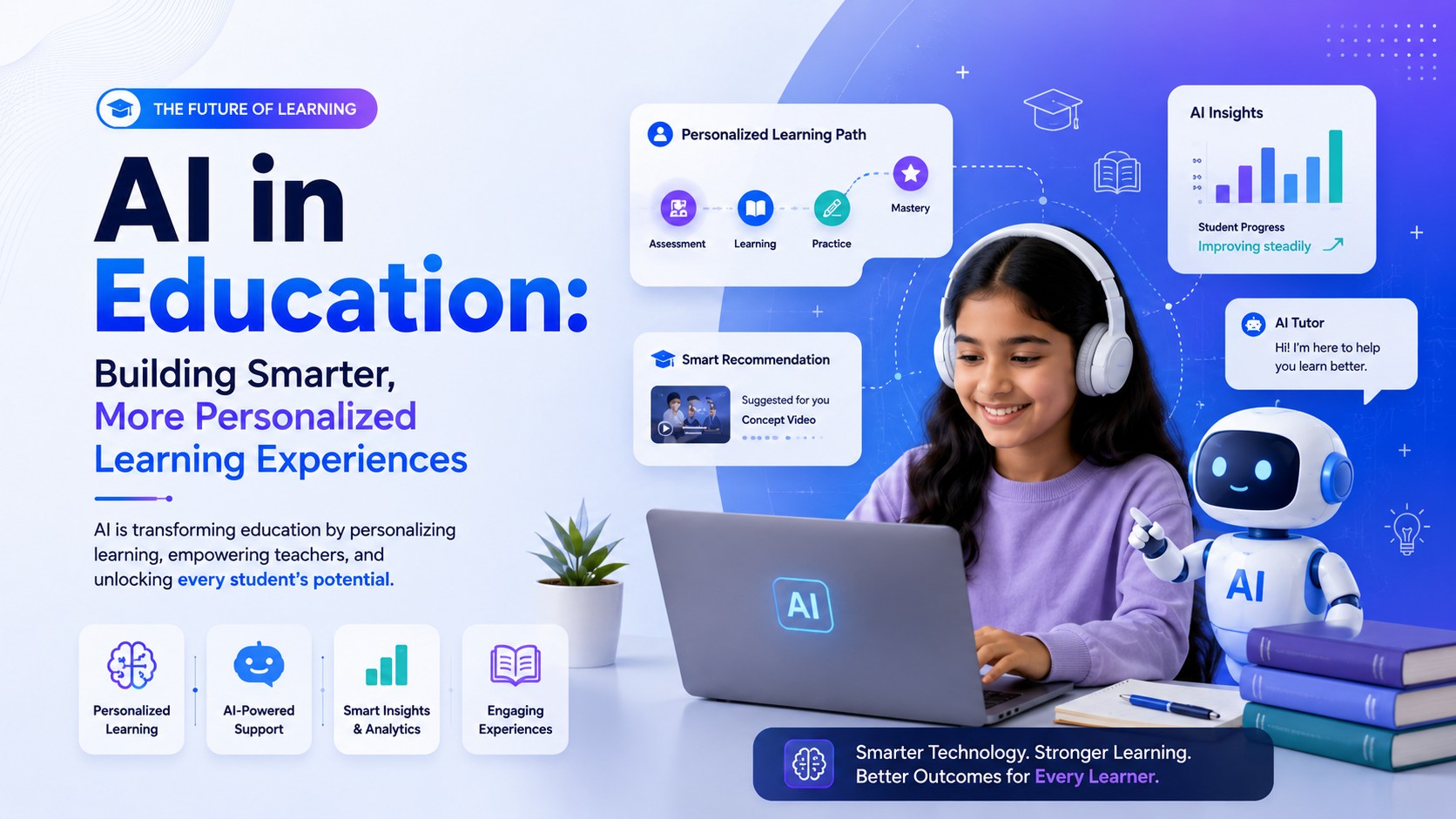
Instead of forcing all four students through exactly the same learning journey, an AI-powered platform can help create more flexible learning pathways.
This is where AI-powered learning becomes much more interesting than simply adding a chatbot to an LMS.
7 Powerful Ways AI Is Changing Education
1. AI Can Create More Personalized Learning Experiences
One of the biggest opportunities for AI in education is personalization.
Traditional digital learning often follows a fixed structure:
AI can make that journey more adaptive.
If a student performs poorly in a particular topic, the system can recommend additional resources. If another student consistently performs well, the platform can introduce more advanced content.
This creates a learning experience that can respond to the learner rather than forcing every learner to respond to the same course structure.
2. AI Can Become a 24/7 Learning Assistant
A teacher cannot realistically answer every student's question at 11:30 PM.
An AI-powered educational assistant can provide support whenever students are studying.
Students can ask: "Explain photosynthesis in simple words."
Then: "Give me an example."
Then: "Now ask me five questions."
Then: "Why is my third answer wrong?"
This conversational learning experience can make digital education more interactive.
But there is an important distinction.
A general-purpose AI chatbot may produce a good answer without necessarily producing good learning.
The OECD's 2026 research specifically warns that completing a task successfully with generative AI does not automatically mean the student has learned the underlying skill. Educational AI works better when it is designed around clear pedagogical objectives.
That distinction should guide every education technology decision.
3. Teachers Can Spend Less Time on Repetitive Work
Teachers don't enter education because they love spending hours formatting worksheets or preparing repetitive administrative documents.
Yet these tasks consume valuable time.
AI can assist with:
- Lesson-plan preparation
- Quiz generation
- Question-bank creation
- Learning-resource development
- Content summarization
- Feedback drafts
- Student progress analysis
- Administrative workflows
- Curriculum alignment
A 2025 Cengage survey of more than 3,000 higher-education students and instructors and more than 1,000 K-12 teachers and administrators found significant AI adoption across education. 63% of K-12 teachers said they or their district had incorporated generative AI into teaching, while 49% of higher-education instructors reported incorporation.
The opportunity isn't simply to make teachers work faster.
It is to give them more time for the work only humans can do well—teaching, mentoring, motivating and understanding students.
4. AI Can Make Assessments More Responsive
Imagine a student takes a 20-question test.
The traditional result might say:
Useful—but limited.
An intelligent learning platform can potentially go further. It could identify:
- Which concepts caused difficulty
- Which question types caused repeated mistakes
- Whether the student is improving
- Which topics require revision
- What difficulty level should come next
Assessment can therefore become more than a final measurement. It can become part of the learning process.
5. AI Can Support Teachers—Not Replace Them
This is perhaps the most important principle.
A good AI education system should not ask: "How can we replace the teacher?"
It should ask: "How can we make the teacher more effective?"
UNESCO's AI competency framework for teachers identifies 15 competencies across five dimensions, including human-centred mindset, ethics of AI, AI foundations and applications, AI pedagogy, and AI for professional learning.
That human-centred approach matters.
A teacher understands emotions. A teacher notices when a student has lost confidence. A teacher knows when a student needs encouragement rather than another explanation.
AI can analyse patterns. Teachers understand people. The future of education needs both.
6. AI Can Make Learning More Accessible
AI also has the potential to make education more inclusive.
Students can interact with learning content through different formats and receive additional support with language, explanations and accessibility.
For example, AI can help create:
- Simplified explanations
- Language translations
- Text-to-speech support
- Alternative descriptions
- Conversational learning assistance
- Additional practice materials
But accessibility cannot be assumed.
UNESCO reported in 2025 that approximately 2.6 billion people—nearly one-third of the world's population—still lacked internet access as of 2024. That means the AI revolution could also create a new digital divide if access to infrastructure and technology is unequal.
Smarter education must also mean more inclusive education.
7. AI Is Creating a New Skill Every Student Needs: AI Literacy
There is another major change happening.
Students aren't only learning with AI. They increasingly need to learn about AI. They need to understand:
- How AI systems work
- How to evaluate AI-generated information
- Why AI can make mistakes
- How bias can affect AI outputs
- How to protect personal information
- When AI should and shouldn't be used
- How to use AI responsibly
A June 2026 OECD/European Commission framework describes AI literacy as the knowledge, skills and attitudes needed to understand AI systems, critically evaluate their outputs, and use them ethically and creatively.
This changes the role of education. Schools and colleges aren't simply preparing students for today's jobs. They are preparing students for a workplace where AI will increasingly be part of everyday work.
The Biggest Mistake: Using AI Just Because It Is AI
There is a temptation in education technology:
It doesn't work that way.
An AI feature is valuable only when it solves a real educational problem.
A chatbot isn't automatically personalized learning. AI-generated questions aren't automatically better assessments. Automated feedback isn't automatically meaningful feedback.
The technology needs to sit behind a clear educational strategy.
The OECD's latest research makes this point strongly: generative AI can improve learning when used with clear pedagogical intent, while simply outsourcing cognitive tasks to AI may improve task performance without producing genuine learning gains.
What Should an AI-Powered Learning Platform Actually Include?
For schools, colleges, coaching centres and online education businesses considering AI, the focus should be on useful capabilities rather than buzzwords.
A well-designed AI-powered LMS could include:
- AI Learning Assistant — Students can ask questions and receive contextual learning support.
- Personalized Learning Paths — The system recommends content based on performance and learning progress.
- AI Assessment — Generate quizzes, practice questions and assessments based on course content.
- Intelligent Recommendations — Recommend lessons, revision materials and practice based on learner behaviour.
- Student Performance Analytics — Identify patterns in performance and highlight students who may need additional support.
- Teacher Assistance — Help educators prepare lesson plans, assessments and learning resources.
- AI-Powered Feedback — Provide immediate formative feedback while keeping teachers involved in important evaluations.
- Multilingual Learning — Support learners who study in different languages or need simplified explanations.
- AI Content Creation — Help educators create structured learning materials more efficiently.
The goal isn't to create the most AI features. The goal is to create the most useful learning experience.
AI + LMS: Where the Real Transformation Can Happen
An LMS already knows a lot about the learning journey. It can contain information about:
- Courses
- Lessons
- Assessments
- Student activity
- Scores
- Completion rates
- Learning progress
When AI is thoughtfully integrated into that ecosystem, the platform can move from simply delivering content to helping determine what the learner needs next.
That is a significant shift.
Traditional LMS
AI-powered LMS
The second model creates a more continuous learning loop.
And that is where the future of AI-powered education platforms becomes particularly powerful.
The Human Side of AI in Education
Technology can make education smarter.
But technology alone cannot make education meaningful.
A student doesn't remember a great teacher because the teacher had the best algorithm.
They remember the teacher who believed in them. The teacher who explained the same concept one more time. The teacher who noticed they were struggling. The teacher who said: "You can do this."
AI can help that teacher identify who needs help. It can provide additional resources. It can analyse learning patterns. It can reduce repetitive work.
But the relationship between teacher and learner remains at the heart of education.
UNESCO's work on AI in education similarly emphasizes a human-centred, rights-based approach, highlighting both AI's potential for personalized learning and the risks around inequality, privacy, safety and governance.
What Should Schools and Educators Do Next?
You don't need to transform your entire education system overnight.
Start with the problems. Ask:
- Where are teachers losing the most time?
- Where are students struggling the most?
- Where could personalized support make a difference?
- Which learning activities could benefit from immediate feedback?
- What information do teachers need but currently don't have?
Then identify where AI can genuinely help. A practical roadmap could look like this:
- Step 1 — Identify the problem. Find repetitive or difficult parts of the learning process.
- Step 2 — Start with one use case. Try AI-assisted assessments, tutoring or content creation.
- Step 3 — Keep teachers involved. AI should support professional judgement, not remove it.
- Step 4 — Establish AI policies. Define acceptable use, academic integrity and data protection.
- Step 5 — Train educators and students. AI literacy is becoming an essential educational skill.
- Step 6 — Measure learning outcomes. Don't measure success only by AI usage. Measure whether students actually learn better.
The Future of Education Isn't Human vs AI
It is Human + AI.
The strongest education systems of the future won't necessarily be the ones using the most artificial intelligence. They will be the ones using it most thoughtfully.
A teacher with better insights. A student with more personalized support. A course that adapts to different learning needs. An assessment that helps students improve rather than simply assigns a mark. A learning platform that understands that education is not one-size-fits-all.
That's the real opportunity.
AI can make education smarter. Personalization can make it more relevant. Teachers make it human.
And when those three come together, we don't just get smarter technology. We get a better learning experience.
AI in Education: Frequently Asked Questions
What is AI in education?
AI in education refers to the use of artificial intelligence technologies to support teaching, learning, assessment, personalization, educational content creation and administrative processes.
How does AI personalize learning?
AI can analyse learner interactions, performance and progress to recommend different content, activities, explanations or levels of practice based on individual learning needs.
Can AI replace teachers?
AI can automate certain repetitive tasks and provide learning assistance, but effective education still depends heavily on human teaching, judgement, relationships, motivation and mentorship.
What are the benefits of AI in education?
Major potential benefits include personalized learning, instant feedback, AI-assisted content creation, adaptive assessments, student analytics, accessibility support and reduced administrative workload.
What are the risks of AI in education?
Key concerns include inaccurate information, academic integrity, privacy, bias, unequal access, over-reliance on AI and the possibility that students outsource cognitive work instead of developing skills themselves.
What is the future of AI in education?
The future is likely to focus less on simply adding AI tools and more on pedagogically purposeful, personalized and human-centred AI systems that work alongside educators.