
Vocabspedia partnered with TutorPro to build a mobile-first learning platform for Kerala PSC aspirants — bringing live classes, recorded lessons, study materials and practice tests to a growing community of more than 75,000 learners.
Every year, thousands of students across Kerala work toward the same goal: a stable government job through the Kerala Public Service Commission (PSC) and related competitive examinations. Vocabspedia was built to support that journey — a digital coaching platform that brings structured study materials, recorded and live classes, and exam-focused practice tools to PSC aspirants wherever they are.
Preparing for Kerala PSC exams is rarely simple. The syllabus is vast and spans multiple departments and categories, and most aspirants are preparing while juggling jobs, studies or family responsibilities — often without consistent access to quality coaching, especially outside major towns and cities. Vocabspedia's platform, built with TutorPro, was designed around exactly that reality.
Kerala PSC preparation is rarely a straight line. For most aspirants, it means studying around a job, a degree, or family responsibilities — and staying consistent for months, sometimes years, before results arrive.
What makes Kerala PSC prep genuinely hard
Beyond simply knowing the syllabus, aspirants face a set of practical obstacles that have little to do with how hard they're willing to work.
Building a platform around real student life
Rather than treating digital coaching as an add-on, Vocabspedia chose TutorPro to build a dedicated mobile-first learning platform designed around how Kerala PSC aspirants actually study.
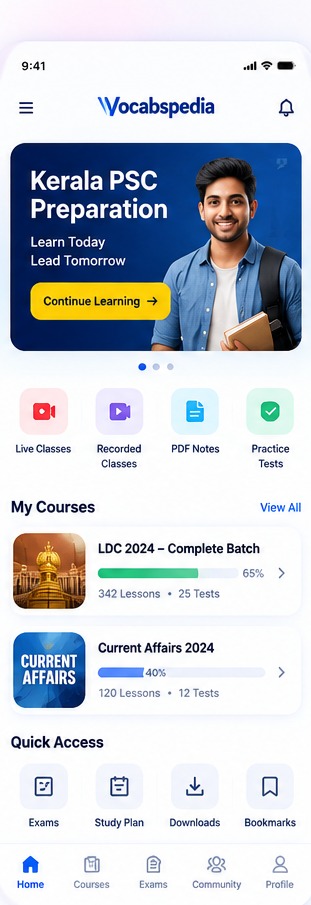
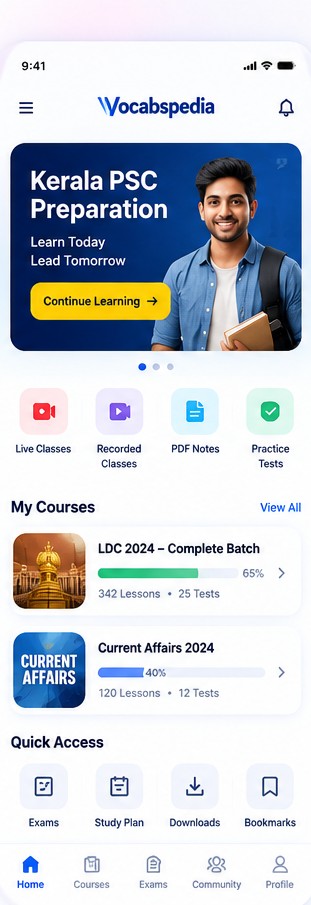
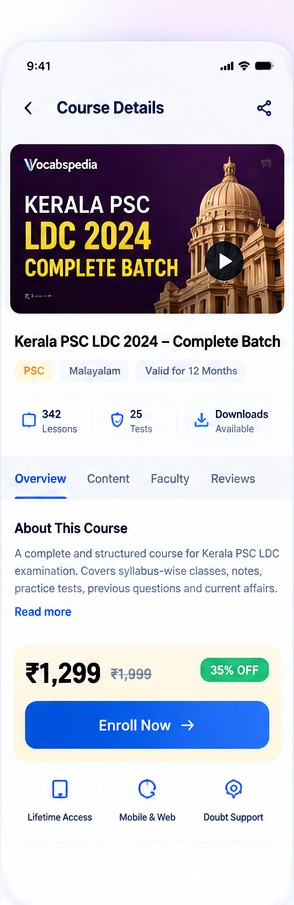
The Vocabspedia app organizes Kerala PSC and competitive-exam preparation into one mobile-first experience — from discovering the right course to tracking progress after every test.
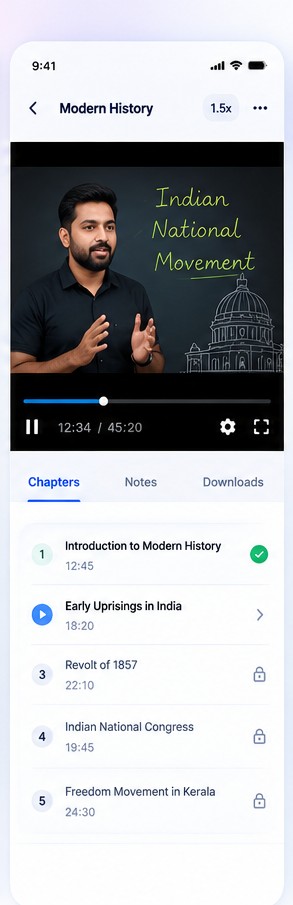
Students can join live sessions or catch up anytime with recorded, chapter-wise video lessons.
Structured notes and downloadable study material support offline revision anywhere.
Dedicated practice tests tied to each course help students evaluate their preparation.
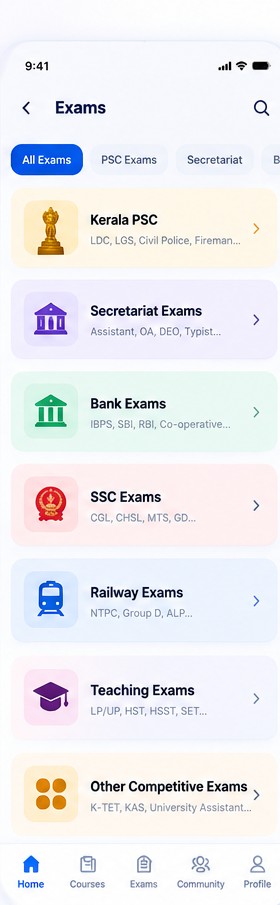
Courses are organized by exam category — Kerala PSC, Secretariat, Bank, SSC, Railway, Teaching and more — so students find relevant content quickly.
A dedicated video player with chapters, notes and downloads keeps long courses like Kerala PSC LDC easy to navigate.
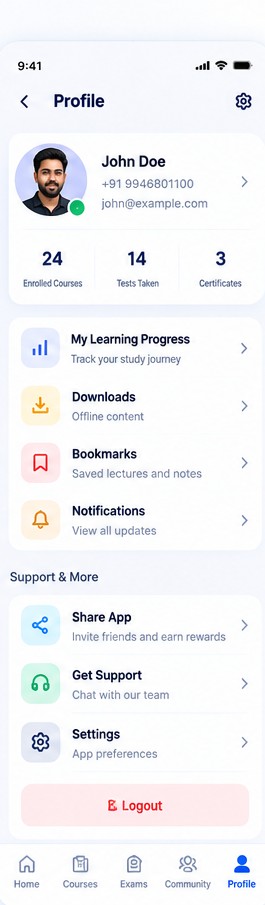
Students can track enrolled courses, tests taken and certificates earned from a personal profile.
From the first open to the last chapter of a course, the app was designed to feel simple and learner-focused at every step.
Behind every one of Vocabspedia's 75,000+ learners is a student working toward the same outcome — a stable government job that can change the direction of their life and their family's. That's the weight a PSC coaching platform carries, long before it's a question of technology.
For Vocabspedia, reaching that scale also meant something very practical: a platform that could reliably deliver live classes, recorded lessons and practice tests to thousands of learners at once, across every district in Kerala, without the experience breaking down as the numbers grew.
Delivering structured PSC coaching at scale generally depends on a few baseline capabilities in the underlying learning platform.
Clear structuring of subjects, departments and exam categories so students know exactly what to study.
The ability to learn on your own schedule, not just during fixed class hours.
Regular, exam-pattern practice is central to how PSC aspirants actually prepare.
Visibility into strengths and weak areas helps students focus their remaining time well.
For most aspirants, the phone is the primary — often the only — device used for exam prep.
The platform needs to keep performing as thousands of learners join and use it at the same time.
These are the general capabilities a strong PSC-coaching LMS should offer. They describe what the category typically requires, not a confirmed list of every module implemented specifically for Vocabspedia.
As a coaching institute's learner base grows, a generic, off-the-shelf platform can start to feel limiting. A custom-built LMS gives institutes room to grow on their own terms.
A dedicated, branded app builds trust and recognition that a generic, shared platform can't offer.
The platform is shaped around how the institute already teaches, instead of forcing a change in approach.
A platform built to scale avoids the disruption of migrating systems again as the institute expands.
Classes, materials, tests, and student progress all live in one connected system rather than scattered tools.
Kerala has one of India's most active competitive-examination cultures, with a large pool of aspirants preparing for PSC, banking, SSC, railway and teaching exams every year. Government jobs remain highly sought after, and the competition for a limited number of seats is intense.
In that environment, digital learning isn't replacing classroom coaching — it's extending its reach. A mobile app can carry structured guidance into towns and villages that a physical coaching center may never reach.
Vocabspedia's growth to 75,000+ learners raises a useful set of questions for any coaching institute evaluating its own technology:
Would it hold up if our learner base doubled or tripled tomorrow?
Or does it feel like a generic tool shared with other institutes?
Are we meeting students on the device they actually study from?
Or are we adapting our teaching to the limits of the software?
Do learners get clear visibility into how their preparation is going?
Can our technology partner support us as our needs evolve, not just at launch?
No platform, however well built, sits the exam for a student or guarantees a result. What a well-built platform can do is remove friction — making it a little easier for a determined aspirant to study consistently, access the right material at the right time, and track their own progress along the way.
That's the role TutorPro played in Vocabspedia's journey: not replacing the effort of 75,000+ aspirants, but giving that effort a structured, reliable place to happen.
A quick look at the Vocabspedia project, built and supported by TutorPro.
| Category | Details |
|---|---|
| Client | Vocabspedia |
| Application | Vocabspedia Learning App |
| Industry | Kerala PSC & Competitive Exam Coaching |
| Platform | TutorPro — Customizable & Scalable LMS Platform |
| Solution Type | Custom Mobile Learning App |
| Learner Base | 75,000+ Learners |
| Key Capabilities | Live Classes, Recorded Classes, PDF Notes, Practice Tests, Structured Course Catalog, Progress Tracking |
| Availability | Android & iOS |
For coaching institutes considering a custom LMS or mobile learning app, Vocabspedia's journey shows what's possible when a platform is built around real student constraints — vast syllabi, limited time, and uneven access to quality coaching — rather than around a one-size-fits-all template.
Vocabspedia is a Kerala PSC and competitive-exam coaching platform built with TutorPro. It brings live classes, recorded lessons, study materials and practice tests to more than 75,000 learners across Kerala.
Vocabspedia supports a growing community of more than 75,000 learners preparing for Kerala PSC and other competitive examinations.
The app organizes courses across categories including Kerala PSC, Secretariat exams, Bank exams, SSC exams, Railway exams, Teaching exams and other competitive exams.
The app includes live and recorded classes, downloadable PDF notes, practice tests and mock exams, a chapter-wise video learning player, and a student profile that tracks enrolled courses, tests taken and certificates.
Kerala PSC aspirants are spread across the state, including areas without easy access to in-person coaching. A dedicated mobile app lets Vocabspedia deliver structured, consistent learning to a large number of students regardless of location.
Yes. TutorPro has experience developing 200+ LMS platforms across exam preparation, skill development and corporate training, including dedicated mobile learning apps for Kerala PSC coaching institutes like Vocabspedia.
TutorPro — Build Your Own LMS. Teach. Engage. Scale.