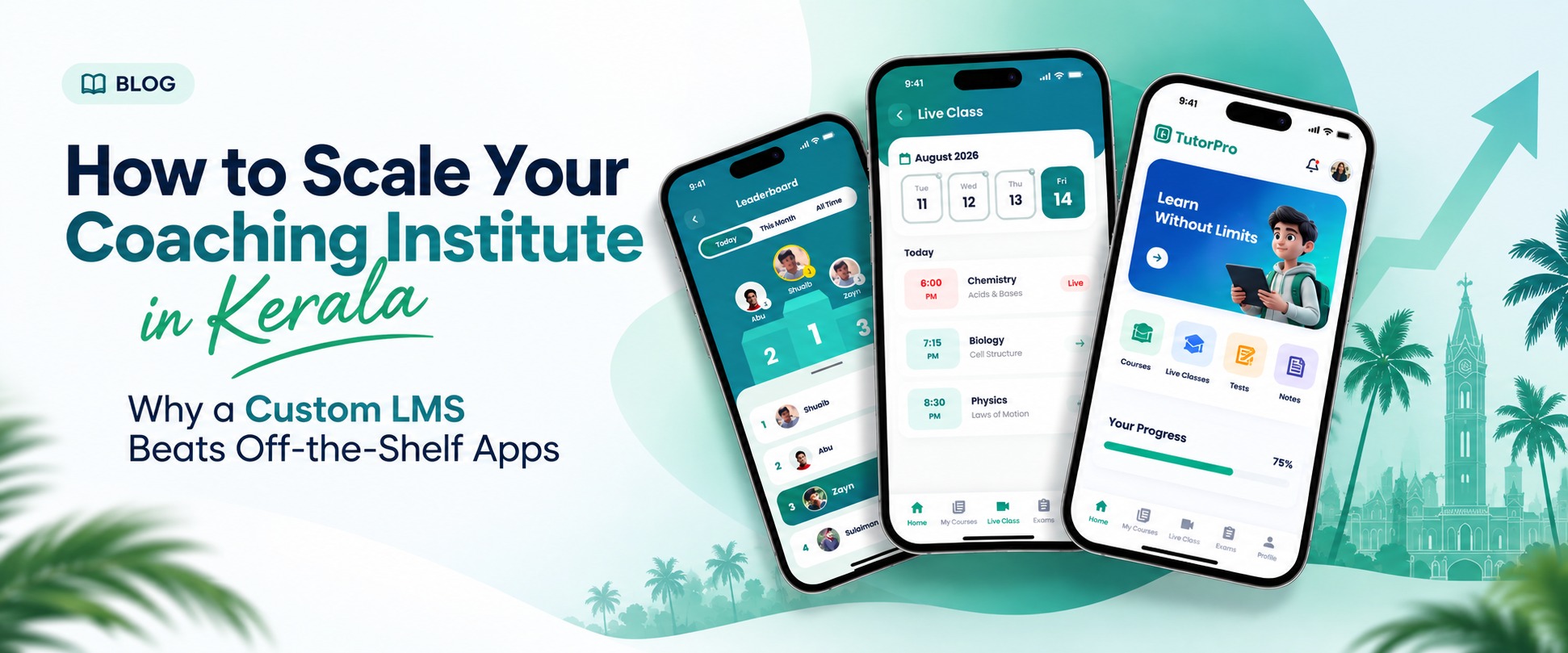
A coaching institute starts with 50 students, a few teachers, and a WhatsApp group to share notes and class links.
Within a year, it has 500 students. There are more batches, more recorded classes, weekly examinations, and students joining from different parts of Kerala.
Suddenly, the same system that worked for 50 students becomes difficult to manage.
Teachers are sharing class links manually. Students cannot find old recordings. Exam results are maintained in spreadsheets. The administration team spends hours answering questions that a proper learning platform could handle automatically.
This is a familiar challenge for growing education businesses.
And it explains why choosing the right Learning Management System (LMS) in Kerala has become an important business decision.
The question is no longer just, "How do we start online classes?"
It is, "How do we build a learning experience that continues working when our institution grows?"
At Tutor Pro, we have seen this challenge from different sides: a growing online education startup, a multi-centre language academy, a PSC coaching platform, and institutions moving away from restrictive ready-made software.
Their requirements were different. But they all needed technology that could support the way they actually teach.
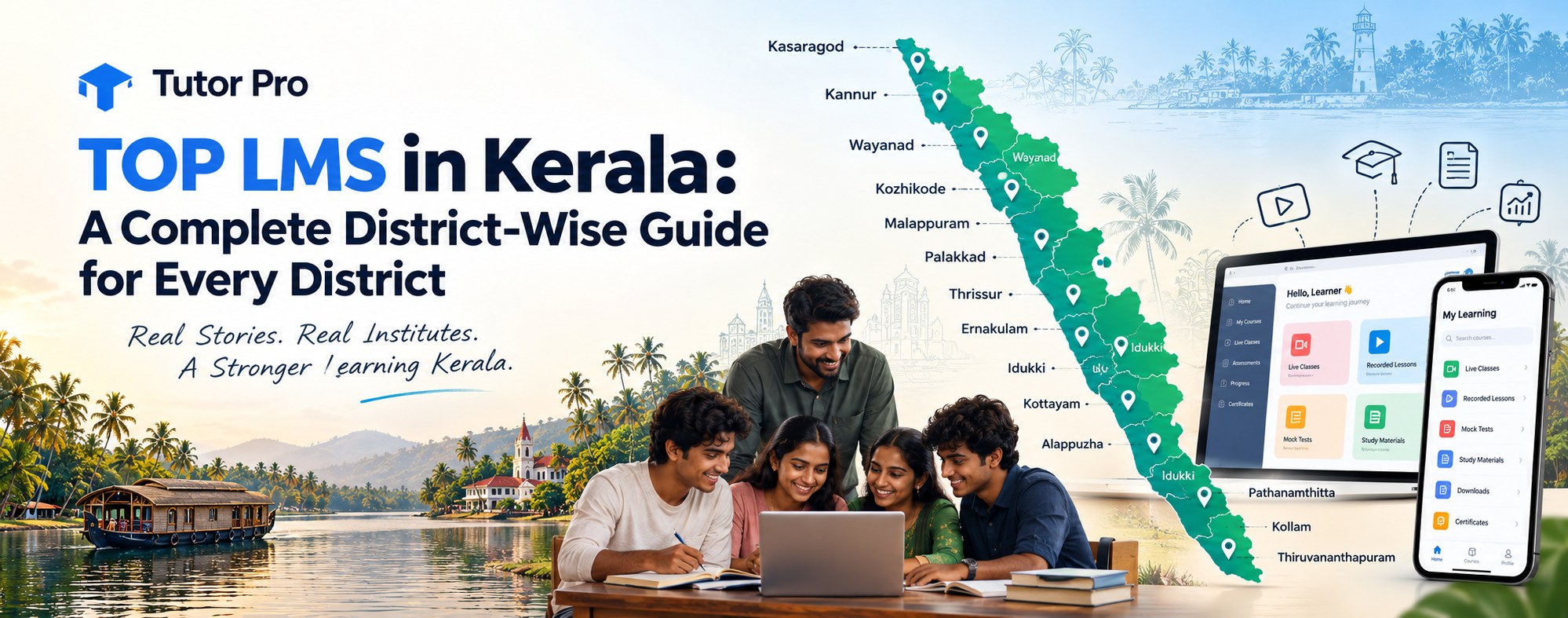
This guide explores what schools, colleges, coaching institutes, and training businesses across Kerala's 14 districts should consider when choosing an LMS, with real examples from education businesses that have already taken that journey.
Table of Contents
- What Makes an LMS the Right Choice for Kerala?
- Real Stories: How Kerala Education Businesses Built Their Digital Learning Platforms
- District-Wise Guide: Choosing the Right LMS Across Kerala's 14 Districts
- Kerala LMS Selection Report: Which Platform Fits Each District?
- What Should You Check Before Choosing an LMS in Kerala?
- SaaS LMS vs Custom LMS: Which Is Better for Your Institution?
- Why Tutor Pro Is an LMS Option Worth Considering in Kerala
- Frequently Asked Questions About LMS Software in Kerala
- Final Thoughts: Build for the Institution You Want to Become
What Makes an LMS the Right Choice for Kerala?
An LMS is software that helps educational institutions deliver courses, manage learning materials, conduct examinations, and track student progress.
But two institutions may use an LMS in completely different ways.
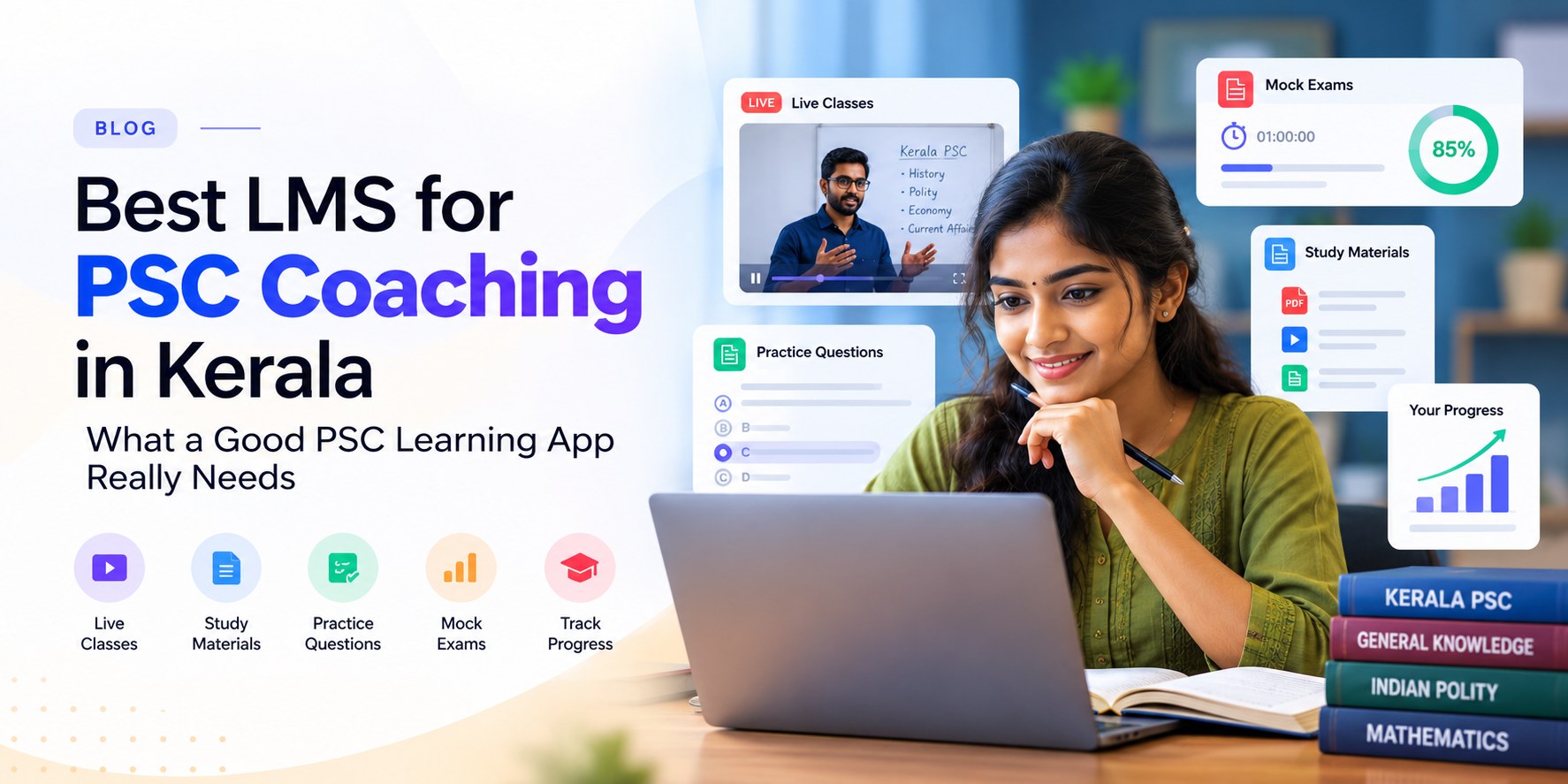
A Kerala PSC coaching centre might consider its question bank and mock examination system the most important feature.
An IELTS academy might focus on recorded lessons, speaking practice, assignments, and trainer feedback.
A school might need attendance, homework, parent communication, and academic reports.
An EdTech startup serving thousands of learners might care most about platform performance, video delivery, scalability, and the freedom to introduce new features.
That is why the best LMS in Kerala is not necessarily the one offering the longest list of features. It is the one that solves the institution's real problems without creating new ones.
Before exploring the districts, consider what has happened with some of Kerala's education businesses.
Real Stories: How Kerala Education Businesses Built Their Digital Learning Platforms
Case Study 1: Eduport — From a Small Startup to a Learning App With 4 Lakh+ Downloads

In 2020, Eduport began with a founder, one employee, and an ambition to make quality education more accessible.
At that stage, the challenge was not managing lakhs of students. It was building a learning platform that could support the business as it grew.
The app needed to bring recorded classes, learning materials, online examinations, and student progress into one experience.
Tutor Pro developed a custom learning application around those requirements.
As Eduport expanded its courses, teachers, and student base, its digital platform became an important part of its operations.
Figures reported in the Eduport customer case study; business outcomes should not be attributed solely to the LMS.
The lesson from Eduport is not that buying an LMS guarantees business growth. It is that a growing education business needs technology capable of supporting its ambitions.
A platform designed only for the first few hundred students may become an obstacle when thousands more arrive.
Case Study 2: Ajinorah — One Learning App Connecting 11 Centres

Imagine managing an education business with multiple centres, different courses, hundreds of lessons, and students who need to continue learning after they leave the classroom.
This was the kind of operational challenge Ajinorah needed its technology to address.
Its courses included IELTS, OET, German language training, and other professional and entrance examination programmes.
A basic video-sharing application would not have been enough.
Ajinorah needed a learning platform that could organise courses, connect students across centres, and provide a consistent experience.
Tutor Pro delivered its custom learning app in 2021.
The platform supports live classes, recorded lessons, study materials, mock examinations, and course access across Ajinorah's 11-centre network.
The important detail is not just that the app was launched in 2021. It has remained in active use as the institution expanded.
For any multi-branch academy in Kochi, Thrissur, Kottayam, or elsewhere in Kerala, this is an important lesson: your LMS should connect your branches, not create another system each branch has to manage separately.
Case Study 3: GEC SkillPlus — When a Ready-Made SaaS Platform Was No Longer Enough
Not every institution starts by building a custom learning platform.
Many begin with a subscription-based SaaS LMS because it is quick to launch and requires a smaller initial commitment.
That approach can work well.
But as an education business grows, its requirements may become more specific.
GEC, through its SkillPlus platform, had previously used a SaaS solution. Over time, the institution found that its existing setup was not sufficiently flexible for its plans.
The decision was to move towards a more customised LMS with Tutor Pro.
The relationship subsequently expanded to two additional projects involving healthcare education and critical-care training.
This is an important example because it shows that LMS requirements are not limited to traditional school or coaching content.
A healthcare training application may require a different course structure, assessment process, and learning journey from a general coaching app.
The takeaway for institutions considering a switch from SaaS is simple:
Changing your LMS should be about gaining the capabilities you actually need, not just replacing one software brand with another.
Read the GEC SkillPlus Case Study
Case Study 4: Skillage — Supporting a Growing Coaching Business
Skillage began its journey in 2023, with its learning app introduced in 2024.
The institution has reported a learner community of more than 50,000 across its offline and online activities.
Its story reflects an increasingly common model in Kerala: students discover an institution through its teaching, but continue engaging through a combination of classroom sessions, digital lessons, practice, and revision.
For this kind of institution, a learning app becomes a bridge between the physical classroom and everyday student learning.
It allows students to revisit lessons, access materials, and continue preparing without depending entirely on classroom schedules.
For coaching businesses planning to expand beyond one location, that continuity matters.
District-Wise Guide: Choosing the Right LMS Across Kerala's 14 Districts
Kerala's education sector cannot be treated as one uniform market. The needs of institutions in Thiruvananthapuram, Kochi, Kozhikode, and Wayanad can be quite different.
The following district profiles highlight practical LMS use cases, rather than claiming that every institution in a district has identical requirements.
1. Best LMS in Thiruvananthapuram — Built for PSC and Competitive Exam Coaching
Thiruvananthapuram has a substantial ecosystem of government examination coaching, schools, colleges, and professional training institutions.
Consider a PSC coaching centre preparing students for several examinations simultaneously. Each batch follows a different syllabus, examination schedule, and revision plan.
The problem is not just delivering classes. The institution needs to understand whether students are actually improving.
A suitable PSC coaching LMS in Thiruvananthapuram should support topic-wise practice, timed mock examinations, previous-question-paper collections, rank lists, and detailed performance reports.
Tutor Pro's experience developing examination-focused platforms, including Vocaspedia, provides a relevant example of how learning content and assessment tools can work together.
For competitive examination businesses, the real value of an LMS is helping students identify their weak areas before the actual examination.
2. Best LMS in Kollam — Connecting Classrooms, Teachers and Parents
For a school, adopting an LMS is not simply about giving students access to recorded videos.
Think about the everyday routine of a school teacher: taking attendance, assigning homework, correcting assessments, communicating with parents, and preparing progress reports.
When these activities happen in separate systems, teachers and administrators spend unnecessary time on repetitive work.
A school LMS can bring these activities together.
Tutor Pro's work on Albirr Schools' customised ERP illustrates how attendance, assignments, grades, fees, parent communication, and administration can be integrated.
For schools and colleges in Kollam, the priority should be a platform that is easy for teachers to operate and gives parents meaningful visibility into student progress.
3. Best LMS in Pathanamthitta — Taking Coaching Beyond the Classroom
A student in a smaller town should not have to travel every day to access a good teacher.
For coaching centres in Pathanamthitta, an LMS offers the opportunity to extend classroom teaching to students who cannot attend every session physically.
Imagine an entrance coaching academy with students attending regular classroom sessions and others joining remotely.
Instead of maintaining two separate teaching systems, the institute can offer live classes, recordings, assignments, practice examinations, and revision materials through one platform.
This hybrid model can also help institutions serve students outside their immediate catchment area.
4. Best LMS in Alappuzha — Mobile Learning That Students Actually Use
Many education businesses invest heavily in course content but overlook the experience of the student using the application.
A student may have only 30 minutes between classes or work commitments. If finding a recorded lesson takes five minutes, the application is creating friction rather than helping.
For professional training centres, language academies, and coaching institutes in Alappuzha, simplicity should be a priority.
Students should be able to open the application, find their course, resume a lesson, download permitted materials, and attempt a test without confusion.
A mobile-first LMS with a clear interface, efficient video delivery, and straightforward course navigation is often more useful than an unnecessarily complicated platform.
5. Best LMS in Kottayam — From Course Delivery to Academic Management
Kottayam's long association with education makes it a relevant market for college learning platforms, school management solutions, and professional coaching systems.
Consider a professional academy offering CA, CMA, or other structured programmes.
Students are not simply watching videos. They are moving through a syllabus, completing assignments, attempting examinations, and preparing for assessments over several months.
The LMS should help the institution monitor that entire journey.
Teachers need to know which students are behind schedule. Academic coordinators need visibility into completion rates. Students need to understand what to study next.
An LMS that connects course management, assignments, assessments, and reporting can make these activities easier to manage.
6. Best LMS in Idukki — Making Distance Less of a Barrier
In geographically dispersed regions such as Idukki, digital learning has a practical purpose.
It can reduce how frequently students need to travel for specialised coaching.
But an LMS intended for such students must be designed around actual connectivity conditions.
A beautifully designed application is of little use if students struggle to load lessons.
For institutions serving rural or hill-region learners, the priorities should include efficient video streaming, appropriately sized learning materials, recording access, and reliable mobile performance.
Where supported and permitted, in-app video downloads can help students study with intermittent connectivity.
7. Best LMS in Ernakulam (Kochi) — Custom Learning Platforms for Professional Academies
Kochi has a diverse professional education environment, including language training, overseas education, healthcare training, corporate learning, and specialised coaching.
An IELTS academy and a healthcare training institute may both require an LMS, but their assessment workflows can be very different.
For IELTS or OET training, institutes may need speaking practice, trainer feedback, listening assessments, writing submissions, and progress reports.
Healthcare training providers may need structured learning modules, practical assessments, certification workflows, and specialised course access.
The experience of Ajinorah and GEC SkillPlus illustrates why a customised approach can be valuable for such institutions.
Ajinorah's multi-centre learning model demonstrates the importance of centralised course access, while GEC's transition from SaaS to a more customised solution highlights the need for flexibility as requirements evolve.
8. Best LMS in Thrissur — Blending Traditional Teaching With Digital Learning
For many established coaching institutes, the classroom remains central to the student experience.
An LMS does not need to replace it.
Consider an academy conducting regular classroom sessions and weekly examinations. Students attend lectures physically but revise through recorded lessons and complete practice tests on their phones.
The institution can extend the value of each classroom session by making its learning materials available afterwards.
The platform can also help teachers identify which topics require additional attention.
This makes blended learning particularly relevant for institutions that want to improve their existing teaching model without completely changing it.
9. Best LMS in Palakkad — Flexible Learning for Competitive Exams and Skill Development
Palakkad's geographical connection with Tamil Nadu creates an interesting opportunity for institutions serving learners across language and regional boundaries.
A coaching academy might teach in Malayalam while also offering English-language materials or programmes relevant to students from neighbouring regions.
An LMS can help organise these learning experiences under one system.
For competitive examinations, question banks and analytics are important. For skill-development programmes, structured lessons, assignments, and certificates may matter more.
The platform should allow the institution to introduce new courses without rebuilding its entire digital infrastructure.
10. Best LMS in Malappuram — Helping Growing Coaching Institutes Manage Scale
Imagine a coaching centre that begins with one branch and gradually expands into several towns.
At first, the founder personally knows most students and teachers.
As the institution grows, managing batches, schedules, course access, payments, and examination results becomes more complicated.
This is where a centralised LMS can make a difference.
For coaching centres, parallel colleges, language academies, and professional training institutes in Malappuram, the system should be able to manage multiple courses, batches, and branches without making the experience difficult for students.
Ajinorah's 11-centre model is a useful example of how a learning app can bring distributed education operations into a common digital environment.
11. Best LMS in Kozhikode (Calicut) — Where EdTech Ideas Become Scalable Platforms
Kozhikode has a growing technology and education ecosystem, with private coaching businesses, professional academies, and EdTech companies operating alongside established educational institutions.
It is also where Tutor Pro, developed by Trogon Media, is based.
Eduport's journey provides an important local example.
What began as a small online education initiative in 2020 developed into a substantial learning business with a reported 4 lakh-plus app downloads.
The platform had to support increasing volumes of courses, students, teachers, and examinations.
For founders building education businesses in Kozhikode, the lesson is clear: a learning application should be planned as a long-term product, not merely a place to upload videos.
This is particularly relevant for NEET, JEE, KEAM, PSC, CBSE, and other coaching businesses that expect to introduce new courses and serve larger student communities.
12. Best LMS in Wayanad — Learning Beyond Geographical Boundaries
A student in Wayanad may want to attend a specialised course taught by a faculty member based in Kozhikode or Kochi.
With a suitable LMS, the institution can deliver that learning without requiring regular travel.
The platform must make it easy to attend live sessions when connectivity permits, revisit recordings, access notes, and complete assessments.
For institutes serving students across dispersed locations, accessibility should come before unnecessary visual complexity.
The best learning experience is one that students can consistently access.
13. Best LMS in Kannur — Making Digital Teaching Easier for Educators
One of the biggest obstacles to LMS adoption is not always cost or technology.
Sometimes it is the difficulty teachers face when using a new system.
If uploading a lesson, scheduling a class, or preparing an examination requires too many steps, teachers may return to their old methods.
For schools, colleges, and coaching institutions in Kannur, ease of use should be an important selection criterion.
An effective LMS should provide clear teacher dashboards, simple content management, student attendance records, online examinations, and accessible reports.
Training and ongoing support also matter.
A platform succeeds when educators are comfortable using it as part of their normal teaching routine.
14. Best LMS in Kasaragod — Multilingual Learning and Wider Student Reach
Kasaragod's location near Karnataka creates opportunities for educational institutions serving students from different language backgrounds.
A learning platform should not assume that every learner follows the same language or course structure.
Institutions offering competitive exam preparation, language training, and professional courses may benefit from multilingual interfaces and organised content delivery.
A custom LMS can also help local coaching businesses reach students beyond their immediate district.
Instead of limiting enrolments to students who can attend a physical centre, an institution can make selected courses available through its own branded application.
Kerala LMS Selection Report: Which Platform Fits Each District?
The following is a practical needs-based guide, not a ranking of district-level LMS adoption or a statistical market survey.
| District | Suggested LMS Focus | Main Consideration |
|---|---|---|
| Thiruvananthapuram | PSC & Exam LMS | Mock tests and rankings |
| Kollam | School & College LMS | Academic administration |
| Pathanamthitta | Hybrid Coaching LMS | Remote access |
| Alappuzha | Mobile Learning LMS | Ease of use |
| Kottayam | Academic LMS | Course and faculty management |
| Idukki | Lightweight LMS | Connectivity |
| Ernakulam | Custom Professional LMS | Specialised workflows |
| Thrissur | Hybrid LMS | Classroom integration |
| Palakkad | Multilingual LMS | Language flexibility |
| Malappuram | Multi-Branch LMS | Batch and branch management |
| Kozhikode | Scalable EdTech LMS | Long-term growth |
| Wayanad | Blended Learning LMS | Accessible content |
| Kannur | School & Coaching LMS | Teacher usability |
| Kasaragod | Multilingual Mobile LMS | Wider learner reach |
What Should You Check Before Choosing an LMS in Kerala?
A good product demonstration should answer more than whether a feature exists.
Ask the vendor to show how a teacher schedules a class, how a student attempts an examination, how administrators access reports, and how the platform handles an increase in users.
Pay particular attention to these areas:
1. Ownership and branding: Can your institution have its own branded application and website? Who owns the content, student data, and relevant intellectual property?
2. Live and recorded learning: Can teachers manage sessions, recordings, and course materials without complicated processes?
3. Online examination system: Does it support the types of questions, evaluation methods, and reports your courses require?
4. Scalability: What happens when enrolments increase substantially? Can the vendor demonstrate appropriate capacity planning and performance testing?
5. Student engagement: Can students access practice activities, progress reports, reminders, and doubt support?
6. Customisation: Can new academic workflows and features be introduced as your institution changes?
7. Technical support: Who handles issues after launch, and what service commitments are documented?
8. Total cost: What will you pay for development, hosting, video storage, third-party services, maintenance, and future upgrades?
A platform may appear affordable during the first year but become expensive when additional users, storage, integrations, or custom features are required.
That is why institutions should compare total cost over several years rather than focusing only on the initial price.
SaaS LMS vs Custom LMS: Which Is Better for Your Institution?
There is no universal winner.
| SaaS LMS | Custom LMS |
|---|---|
| Usually faster to start | Requires development and setup |
| Often subscription-based | Often higher initial investment |
| Standardised features | Features tailored to requirements |
| Vendor-controlled product roadmap | Greater influence over development priorities |
| Suitable for common workflows | Suitable for specialised or evolving workflows |
| Hosting often included | Hosting model depends on contract |
A small academy with straightforward course delivery requirements may find SaaS perfectly suitable.
An institution operating several branches, offering specialised assessments, or planning significant expansion may benefit from a custom platform.
The GEC SkillPlus experience is a useful reminder that an institution's first LMS does not necessarily have to be its last.
The right decision depends on its current needs, future plans, budget, and technical capabilities.
Why Tutor Pro Is an LMS Option Worth Considering in Kerala
Tutor Pro focuses on building learning platforms around the requirements of schools, colleges, coaching centres, professional academies, and education businesses.
Rather than expecting every institution to follow an identical workflow, Tutor Pro supports customisation across teaching, assessments, administration, and the student learning experience.
Depending on the project scope, solutions can include live classes, recorded videos, online examinations, self-practice, study materials, student analytics, AI-powered learning support, payment integration, and branded Android and iOS applications.
Its project portfolio includes education businesses such as Eduport, Ajinorah, GEC SkillPlus, Skillage, and other specialised training platforms.
What makes these projects relevant is their variety.
A multi-centre language academy does not operate like a PSC coaching institution. A growing EdTech startup has different priorities from a school. A healthcare training provider may need specialised academic workflows.
The ability to adapt the platform to these differences is an important part of Tutor Pro's approach, built around Tutor Pro's features and solutions for different kinds of education businesses.
Explore Tutor Pro's Project Portfolio
Frequently Asked Questions About LMS Software in Kerala
1. Which is the best LMS in Kerala for coaching institutes?
The best option depends on the courses, examination requirements, number of students, and growth plans. Tutor Pro is one option for institutes looking for a customised coaching LMS with live classes, recorded content, assessments, and mobile applications.
2. Is Tutor Pro suitable for Kerala PSC coaching?
Yes. Tutor Pro can support PSC-focused learning platforms with question banks, mock examinations, practice modules, student reports, and recorded lessons. Specific requirements should be confirmed during project scoping.
3. Can I get my own branded learning app?
Yes. Tutor Pro develops custom-branded learning applications for educational institutions. App functionality, platform support, and ownership terms should be defined in the project agreement.
4. Can an LMS manage multiple coaching branches?
Yes. A properly configured multi-branch LMS can centralise courses, batches, faculty, students, and academic reports. Ajinorah's learning app is an example of a platform supporting a multi-centre education business.
5. How much does an LMS cost in Kerala?
Pricing depends on whether you choose a SaaS subscription, a ready-made branded solution, or custom development. The number of features, mobile platforms, integrations, expected users, and hosting requirements all affect the cost. Request an itemised quotation that includes ongoing expenses.
6. Can an existing SaaS LMS be migrated to Tutor Pro?
Migration may be possible, depending on the existing provider's data export options, content formats, integrations, and contractual restrictions. A technical assessment should be completed before confirming the migration scope.
Final Thoughts: Build for the Institution You Want to Become
An LMS should not be selected simply because another coaching institute uses it.
A school with 300 students, an IELTS academy with 11 centres, and an EdTech startup expecting thousands of enrolments have different needs.
Eduport's growth shows the importance of planning for scale. Ajinorah demonstrates the value of connecting multiple centres. GEC SkillPlus highlights why flexibility matters when an institution outgrows its original software.
These stories point to one conclusion.
The right LMS is not simply software that helps you start online education. It is a platform that can continue supporting your institution as your teaching methods, students, and business evolve.
Whether your institution operates in Thiruvananthapuram, Kochi, Thrissur, Malappuram, Kozhikode, Kannur, or any other district in Kerala, the starting point should be the same: understand your students, define your teaching model, and choose technology that fits.
Looking for a Custom LMS in Kerala?
Tutor Pro helps schools, coaching institutes, colleges, professional training centres, and EdTech businesses build their own branded learning platforms.
From launching your first learning app to migrating from an existing LMS or scaling a multi-branch education business, the team can help evaluate your requirements and plan an appropriate solution.