

Book a Free Demo Talk to an Expert
Blog
LMS & Technology

LMS for PSC Coaching Centres: Mock Tests, Rank Lists & Negative Marking

Why the right examination system matters as much as the quality of your coaching.

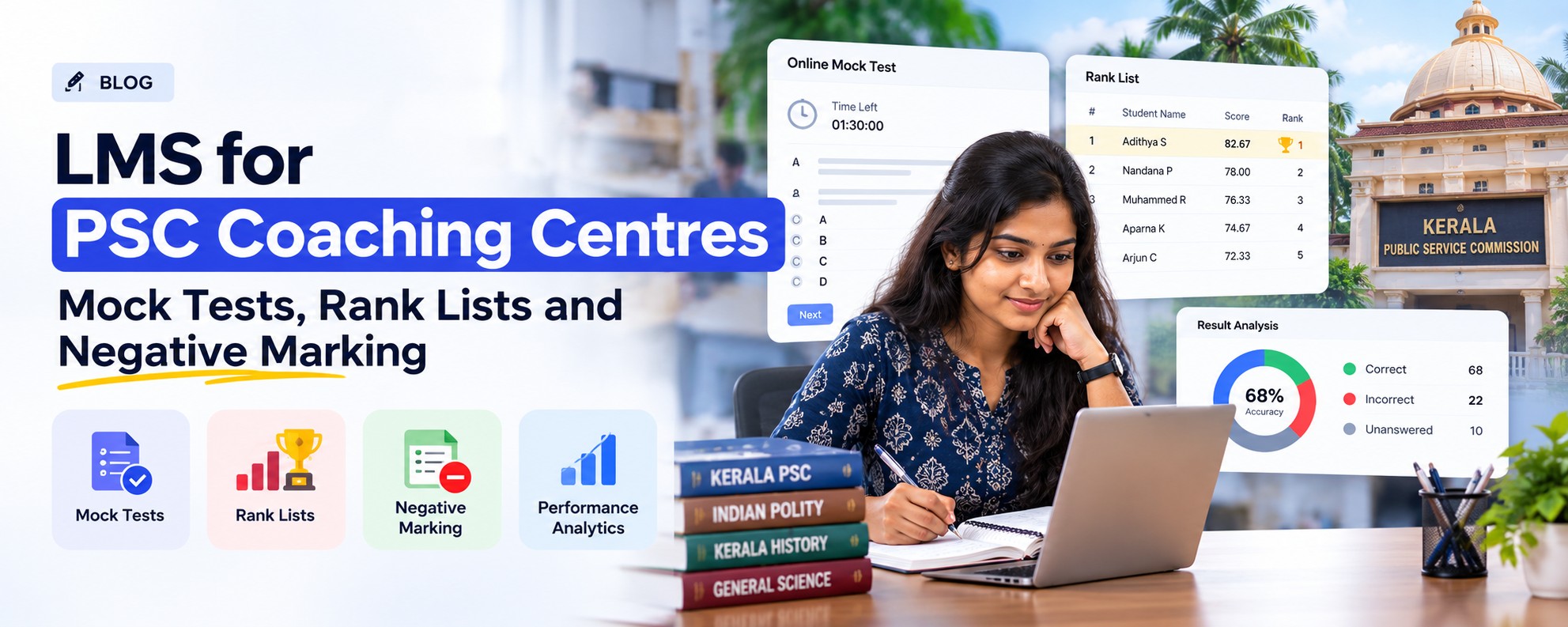
LMS for PSC Coaching Centres: Mock Tests, Rank Lists and Negative Marking banner

Imagine a PSC coaching centre conducting its weekly mock examination.

Hundreds of students participate. Some attend from the classroom, while others take the test from home. Once the examination ends, everyone wants to know their marks, rank and mistakes.

The teachers have another challenge. They need to evaluate the results, prepare the rank list, identify difficult questions and understand which students need additional support. And next week, the entire process starts again.

For a small batch, much of this work can be managed manually. But as an academy grows, managing examinations, results, study materials and student progress across different tools becomes increasingly difficult.

This is where a well-designed Learning Management System (LMS) for PSC coaching centres can make a meaningful difference — not simply by putting examinations online, but by making every examination more useful for students and educators.

Table of Contents

  1. Why PSC Coaching Centres Need More Than a Regular LMS
  2. Online PSC Mock Tests: Make Every Examination Count
  3. Negative Marking: Why Accurate Evaluation Matters
  4. PSC Rank Lists: Turn Results Into Useful Feedback
  5. Performance Analytics: Understand Why Students Lose Marks
  6. Question Bank Management
  7. Connect Mock Tests With Classes and Study Materials
  8. Why Mobile Learning Matters for Kerala PSC Aspirants
  9. Managing Multiple Batches Without More Admin Work
  10. Choosing the Right LMS for Your PSC Coaching Centre
  11. How Tutor Pro LMS Supports PSC Coaching Institutes
  12. Frequently Asked Questions

Why PSC Coaching Centres Need More Than a Regular LMS

PSC preparation is different from a conventional online course. Students don't simply watch a lesson, complete an assignment and move to the next chapter. Their preparation involves repeated practice, timed examinations, revision, accuracy improvement and performance comparison.

A typical learning journey might look like this:

Learn a Topic → Practise Questions → Attend a Mock Test → Review Mistakes → Improve Accuracy → Attempt the Next Test

An LMS designed for PSC coaching should support this entire cycle. For academy owners, this means bringing classes, question banks, mock examinations, rank lists and student performance reports into one connected platform. For teachers, it means spending less time calculating results and more time helping students improve. For students, it means knowing what to study next instead of simply receiving another mark.

Online PSC Mock Tests: Make Every Examination Count

Mock tests are central to competitive examination preparation. They help students become familiar with examination patterns, manage time and recognise gaps in their knowledge. However, conducting an online test is only the beginning — a useful PSC mock test platform should allow institutes to organise different types of assessments.

Daily Practice Tests

Short examinations covering recently taught topics help students maintain consistency and reinforce what they have learned.

Chapter-Wise and Subject-Wise Tests

Students can practise specific areas such as Kerala history, Indian polity, general science, mathematics, reasoning and current affairs. These assessments help teachers understand whether students have mastered a topic before moving forward.

Weekly Mock Examinations

Weekly examinations allow students to evaluate their progress across multiple subjects and practise completing questions within a fixed time.

Full-Length PSC Model Examinations

Full-length mock tests help students practise under conditions resembling the relevant PSC examination, including time limits, question patterns and applicable marking rules.

The important point is that different examinations should serve different learning purposes. A daily practice test may focus on understanding. A full-length mock examination may focus on speed, accuracy and examination readiness. A flexible LMS should accommodate both.

Negative Marking: Why Accurate Evaluation Matters

In competitive examinations, knowing the correct answer is important. Knowing when not to guess can be equally important.

Kerala PSC uses negative marking in many objective examinations. Official instructions for applicable examinations specify one mark for a correct answer, a deduction of one-third of a mark for an incorrect answer, and no deduction for an unanswered question. Coaching institutes should always verify the exact marking scheme against the notification for the examination being simulated.

Example: Calculating PSC Mock Test Marks

Consider a student attempting a 100-question mock examination under the one-third negative-marking rule.

Answer StatusQuestions
Correct answers65
Incorrect answers25
Unanswered questions10
Total100

The score is calculated as:

Final Score = Correct Answers − (Incorrect Answers ÷ 3) = 65 − (25 ÷ 3) = 56.67 marks

Although the student answered 65 questions correctly, negative marking reduced the final score to approximately 56.67. Now imagine an examination platform that automatically calculates these marks for every student. There is no need for teachers to manually prepare spreadsheets or recalculate individual results. More importantly, students can understand how incorrect attempts affected their performance.

What Should a Negative-Marking Exam System Support?

A PSC coaching LMS should ideally provide configurable marks for correct answers, penalties for incorrect answers, rules for unanswered questions and automatic score calculation. It should also display the number of correct, incorrect and unanswered questions alongside the final result — giving teachers a clearer picture of each student's examination strategy.

Automatic, Every Test

A properly configured examination engine applies the same marking rule to every student, every time — no spreadsheets, no manual recalculation, no inconsistency between batches.

1/3 Mark deducted per incorrect answer under Kerala PSC's standard negative-marking rule — calculated instantly for every mock test.

PSC Rank Lists: Turn Results Into Useful Feedback

For many PSC aspirants, the first thing they look for after a mock examination is their rank. Where do I stand among the other students? Rank lists can create motivation and help students understand their relative performance. But a rank list becomes more valuable when it provides context.

Imagine a student who secured rank 42 in last week's examination and rank 18 this week. That improvement deserves attention. Now consider another student who remains within the top 10 but consistently loses marks in mathematics. Both students need different guidance.

A well-designed PSC examination platform can help institutes generate:

  • Examination-wise rank lists
  • Batch-wise rankings
  • Scores and percentage comparisons
  • Performance history across tests
  • Leaderboards and progress reports
  • Clear rules for ties and absentees

Institutes should also establish clear rules for ties, absent students and late submissions to ensure rankings remain fair and consistent.

A Rank List Should Encourage Progress, Not Just Competition

Rankings are useful, but they shouldn't be the only measure of student development. A student improving from 30 to 55 marks may be making significant progress even without reaching the top 20. A good LMS helps educators recognise this improvement rather than focusing exclusively on top-ranked students.

The purpose of a rank list should be to guide preparation, not simply announce winners.

Performance Analytics: Understand Why Students Lose Marks

Every mock examination produces valuable information. Unfortunately, much of that information is lost when an institute publishes only the total marks and rank.

Consider two students who both score 60 marks. One performs well in general knowledge but struggles with mathematics. The other is strong in mathematics but loses marks in current affairs and Kerala history. Their scores are identical. Their learning needs are not.

This is why performance analytics matter. A PSC coaching LMS can help educators analyse results at different levels.

Student-Level Analysis

Teachers can review individual scores, accuracy, unanswered questions, examination history and improvement over time.

Subject-Level Analysis

Performance reports can highlight subjects where a student consistently struggles.

Question-Level Analysis

Teachers can identify questions that most students answered incorrectly — which may indicate a difficult concept, a poorly understood lesson or even a question that needs review.

Batch-Level Analysis

Academy owners and academic coordinators can compare the performance of different batches and identify areas requiring additional teaching support.

These insights make it easier to organise revision classes, targeted practice sessions and academic interventions.

Instead of asking only, "How many marks did this student score?" teachers can begin asking, "What is preventing this student from scoring better?"

Question Bank Management: Build Once, Use Across Multiple Tests

A growing PSC academy may maintain thousands of questions across different subjects and examination categories. Without a structured system, teachers often spend considerable time searching old files, preparing question papers and avoiding unnecessary repetition.

A centralised question bank can make this work more manageable. Questions can be organised by subject, chapter, topic, difficulty level and examination category. Teachers can use the same question bank to prepare daily practice tests, chapter examinations, weekly assessments and full-length mock tests.

For example, questions from Indian Constitution, Kerala Renaissance and quantitative aptitude can be selected to create a mixed-subject examination. With suitable configuration, institutes can also randomise question order and answer options.

The real benefit isn't simply storing questions digitally. It's building an academic resource that becomes more useful as the institute grows.

Connect Mock Tests With Classes and Study Materials

Imagine a student completing a mock examination and discovering that most incorrect answers came from Indian polity. What should happen next?

In a disconnected system, the student may need to search through WhatsApp groups, old PDFs or recorded classes to find the relevant lessons. In a connected LMS, the institute can organise the learning experience more effectively — students can access recorded classes, notes, chapter-wise materials and practice tests from the same platform, and teachers can recommend specific lessons or additional practice based on examination performance.

This creates a more meaningful learning cycle:

Attend Class → Take Test → Review Results → Revise Weak Topics → Practise Again

An LMS becomes much more valuable when teaching and examination preparation work together.

Why Mobile Learning Matters for Kerala PSC Aspirants

Not every PSC aspirant is a full-time student. Some are working professionals. Others are college students or candidates managing family responsibilities. They may study early in the morning, during travel or after work. For these learners, mobile accessibility is important.

A branded PSC learning app can provide a convenient way to attend recorded classes, read study materials, practise questions, participate in mock examinations and check results. For coaching centres, a mobile-first experience can also help extend learning beyond the physical classroom.

Test the real experience, not just the demo. Institutes should test the actual examination experience on ordinary smartphones, including loading speed, navigation, timer behaviour and recovery from temporary connectivity problems. A platform is only useful if students can rely on it when they need it.

Managing Multiple Batches Without Increasing Administrative Work

Consider a PSC academy operating separate batches for different examination categories. Each batch may have its own teachers, study schedules, examinations and learning materials. As student numbers increase, coordinating everything manually becomes difficult.

A customisable LMS can help organise batch enrolments, course access, examination schedules, student progress and academic reports through a central system. For institutes operating multiple centres or online and offline batches, this becomes especially useful.

The objective isn't to replace teachers or academic coordinators. It is to reduce repetitive administrative work so they can concentrate on students.

Choosing the Right LMS for Your PSC Coaching Centre

Before investing in PSC coaching software, institute owners should look beyond the appearance of the dashboard. Ask practical questions.

01

Can it handle the load?

Can the platform handle hundreds of students attending the same mock examination at once?

02

Is negative marking configurable?

Can teachers set it up according to the relevant examination's own rules?

03

Are rank lists automatic?

Can it generate accurate rank lists without manual recalculation?

04

Can students review mistakes?

Can they see incorrect answers and track improvement over time?

05

Is the question bank manageable?

Can the institute organise large banks without unnecessary manual work?

06

Will it scale with you?

Will it support additional batches, courses and students as the academy grows?

And perhaps most importantly: will the technology make life easier for our teachers and students?

The best LMS for a PSC coaching centre is not necessarily the one with the longest feature list. It is the one that supports the academy's teaching methods, examination processes and long-term growth.

How Tutor Pro LMS Supports PSC Coaching Institutes

At Tutor Pro, we understand that running a competitive examination coaching centre involves much more than delivering video lessons. Academies need reliable examinations, organised study materials, meaningful student reports and a learning experience that reflects their own brand.

Tutor Pro LMS is a customisable learning management platform designed for coaching institutes and educational businesses. For PSC coaching centres, its capabilities include:

  • Online Mock Examinations & Series
  • Configurable Negative Marking
  • Rank Lists & Leaderboards
  • Question Bank Management
  • Student Performance Analytics
  • Live & Recorded Classes
  • Branded Learning Applications
  • Customisable Workflows

Specific configurations and integrations can be discussed according to each institute's needs. The goal is simple: give educators a system that supports the way they teach, while helping students prepare with greater clarity and consistency.

Final Thoughts: Better Preparation Begins With Better Feedback

A mock examination should do more than produce a score. It should help students understand their mistakes, recognise their strengths and prepare more effectively for the next attempt. A rank list should do more than create competition — it should help students measure progress. And an LMS should do more than digitise existing classroom activities. It should give educators the time, information and flexibility to support their students better.

For PSC coaching centres planning to grow, investing in the right examination and learning platform can be an important step toward building a more organised and student-focused academy.

Request a Product Demo Explore TutorPro

FAQ

Frequently Asked Questions

An LMS for PSC coaching centres is a digital platform that helps institutes manage online classes, study materials, question banks, mock examinations, student progress and academic administration.

Yes. An LMS with a configurable online examination system can support timed mock tests, automatic evaluation and negative-marking rules. Institutes should confirm that the scoring configuration matches the relevant PSC examination notification.

Yes. An examination platform with ranking functionality can calculate student scores and generate examination-wise or batch-wise rank lists according to configured ranking rules.

Performance analytics help students and teachers identify weak subjects, recurring mistakes, accuracy trends and improvement opportunities across multiple examinations.

Yes. Custom LMS providers such as Tutor Pro offer branded learning platforms that can be configured for an institute's courses, examinations, study materials and student experience.

Prioritise examination reliability, negative-marking configuration, question bank management, rank lists, student analytics, mobile usability, scalability, data access and ongoing technical support.

Planning to Launch or Upgrade Your PSC Platform?

Smarter Mock Tests. Fairer Rank Lists. Better Preparation.

Explore Tutor Pro LMS to learn how a customisable learning management system can support your institute's classes, mock examinations, rank lists and student progress.

You Might Also Like

Never Miss an Insight

Subscribe to get expert insights, EdTech trends and TutorPro updates delivered to your inbox.

Chat with us+91 96051 31100