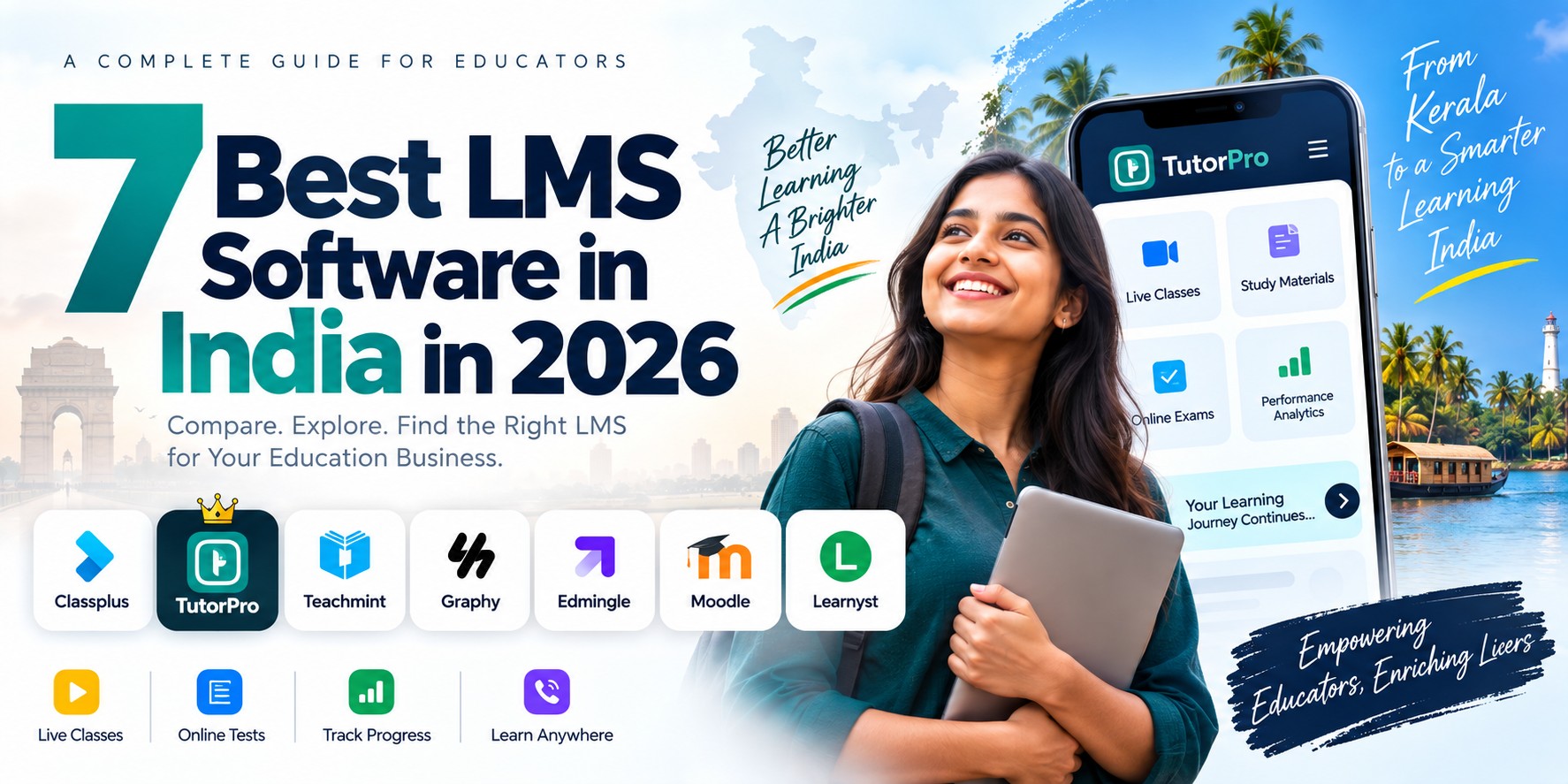

Teaching is no longer limited to a classroom, tuition centre, or coaching institute.
Today, a teacher sitting in Kozhikode can teach students in Dubai. A PSC trainer in Kerala can build a batch of learners across India. A spoken English trainer can sell recorded courses while continuing to conduct live classes. A subject expert can even build a complete online education business around their knowledge.
The opportunity is real. But teaching online is not simply about opening a Zoom meeting and sharing a PDF.
If you want to teach online and make money, you need to think about your subject, students, content, pricing, marketing, payments, student engagement, and the technology you use to manage everything.
This guide explains how to start teaching online, how to get your first students, different ways to earn money from online teaching, and how you can turn your teaching experience into a scalable education business.
Table of Contents
- What Does It Mean to Teach Online?
- Can You Really Make Money by Teaching Online?
- How to Start Teaching Online in 2026
- How to Get Your First Online Students
- How to Make Money From Online Teaching
- How Much Should You Charge for Online Classes?
- Why Student Experience Matters More Than Ever
- Use AI to Make Online Teaching More Efficient
- When Should You Move From Multiple Tools to an LMS?
- Build Your Own Online Education Brand
- From Online Teacher to Education Entrepreneur
- Common Mistakes Teachers Make When Starting Online
- A Simple Online Teaching Business Model
- How TutorPro Can Help You Build an Online Teaching Business
- Frequently Asked Questions About Teaching Online
What Does It Mean to Teach Online?
Online teaching means delivering education through digital platforms instead of relying entirely on a physical classroom.
But there is no single way to teach online.
Depending on your subject, audience, and business model, you can choose from several formats.
1. Live Online Classes
Live classes are the closest experience to traditional classroom teaching.
You conduct classes at a scheduled time while students join through their phones, tablets, or computers.
This model works particularly well for:
- School tuition
- PSC coaching
- NEET and JEE preparation
- IELTS and OET training
- Professional courses
- Spoken English
- Coding classes
- Skill development programmes
- Competitive examination coaching
Live classes also allow teachers to interact with students, answer questions, monitor attendance, and create a stronger learning relationship.
2. Recorded Online Courses
You can record your lessons once and allow students to access them whenever they want.
Recorded courses are useful for subjects where students need flexibility.
For example:
- Digital marketing
- Graphic design
- Coding
- Accounting
- Excel
- Language learning
- Business skills
- Entrance exam preparation
- Professional certification courses
The major advantage is that your teaching time is no longer directly tied to the number of students.
3. One-to-One Online Tutoring
Some students prefer individual attention.
One-to-one online tutoring allows you to charge based on your time, expertise, and the level of personal support you provide.
This can work well for:
- Language training
- School subjects
- Music
- Career mentoring
- Interview preparation
- Professional training
- Exam preparation
4. Online Test Series
If you are preparing students for competitive exams, a test series can become an independent product.
You can create:
- Mock exams
- Chapter-wise tests
- Previous-year question papers
- Practice tests
- Timed examinations
- Question banks
- Subject-wise assessments
Students can purchase the test series separately or as part of a complete course.
5. Study Materials and Digital Products
Your knowledge does not always have to be sold through live classes.
You can also create:
- Digital notes
- E-books
- Worksheets
- Revision materials
- Question banks
- Study guides
- Practice materials
- Recorded revision sessions
These can become additional revenue streams alongside your main courses.
Can You Really Make Money by Teaching Online?
Yes, but online teaching is not a shortcut to instant income.
Your earning potential depends on several factors:
- What you teach
- Who you teach
- Your level of expertise
- Your pricing
- Number of students
- Course format
- Student retention
- Marketing
- Quality of your learning experience
For example, a teacher charging ₹1,000 per month with 50 students has a different business model from an educator selling a ₹10,000 professional course to 100 learners.
The important thing is not simply to ask:
"How much can I earn from online teaching?"
A better question is:
"How can I build a teaching model that gives students real value and can grow without increasing my workload at the same rate?"
That is where technology becomes important.
How to Start Teaching Online in 2026
Starting an online teaching business can feel overwhelming because there are so many tools and platforms available.
You don't need everything on day one.
Start with the basics.
Step 1: Choose What You Want to Teach
Don't try to teach everyone.
Choose a specific subject, skill, exam, or outcome.
For example:
Instead of:
"I teach English."
Try:
"I help students improve their spoken English for job interviews."
Instead of:
"I teach Maths."
Try:
"I help Class 10 students prepare for their Mathematics board examination."
A clear offer makes it easier for students and parents to understand why they should learn from you.
Step 2: Identify Your Target Students
The next question is simple: Who are you teaching?
Your target audience could be:
- School students
- College students
- Working professionals
- Competitive exam aspirants
- Parents
- Job seekers
- Entrepreneurs
- Teachers
- Skill development learners
You should also understand where your students are located.
For example, an educator in Kerala may have students from:
- Kozhikode
- Kochi
- Kannur
- Malappuram
- Thrissur
- Thiruvananthapuram
- Other parts of India
- UAE
- Oman
- Saudi Arabia
- Qatar
Online education removes many geographical limitations.
Step 3: Build Trust Before Asking Students to Pay
People don't buy courses simply because you say you are a teacher.
They want to know: Can this person actually help me?
This is why free educational content is important.
You can create:
- YouTube videos
- Instagram Reels
- Short concept videos
- Free webinars
- Sample lessons
- Free mock tests
- Study tips
- Exam preparation tips
- Downloadable study materials
Don't make every piece of content promotional.
Teach something useful.
If a student watches one of your videos and thinks, "This teacher explained it better than I expected," you have already started building trust.
Step 4: Decide How You Want to Teach
Different subjects require different teaching methods.
A six-month PSC programme may work better with live classes, recorded lessons, practice tests, and doubt-solving.
A graphic design course may work better with recorded tutorials and project assignments.
A spoken English programme may need regular live interaction.
So don't choose technology first.
Choose your learning model first. Then select the technology that supports it.
Step 5: Create Your Online Teaching Platform
This is where many educators initially use multiple disconnected tools.
One tool for live classes. Another for recorded videos. Google Drive for notes. Google Forms for tests. WhatsApp for communication. A payment link for fees. A spreadsheet for student records.
It may work when you have 10 or 20 students.
But as your student count increases, managing everything separately becomes difficult.
A dedicated LMS can bring these activities together.
TutorPro, for example, is designed as a customized Learning Management System for schools, colleges, coaching institutes, universities, EdTech businesses, and other education providers. It supports live classes, recorded courses, online exams, study materials, student performance tracking, analytics, and AI-powered learning features.
Step 6: Start With a Small Paid Programme
You don't need to record a 100-hour course before you launch.
Start small.
For example:
- 2-hour workshop
- 7-day programme
- 14-day crash course
- 1-month batch
- 10-class programme
- Small exam preparation batch
This gives you an opportunity to understand your students.
You will learn:
- What questions they ask
- Where they struggle
- Which lessons they enjoy
- What content they need
- What price they are comfortable with
- What they expect from your course
Then you can use that feedback to build a larger programme.
How to Get Your First Online Students
This is one of the biggest challenges for new online teachers.
You don't need 100,000 followers.
You need the right students.
Start With People You Already Know
Your first students could come from your existing network.
Think about:
- Current students
- Former students
- Parents
- Friends
- Colleagues
- Professional contacts
- Local communities
If you already teach offline, your existing students are often the easiest place to start your online programme.
Use WhatsApp Strategically
For Indian educators, WhatsApp can be a powerful communication channel.
But don't use it only to send advertisements.
Share useful content:
- Daily questions
- Exam updates
- Short explanations
- Revision tips
- Important notifications
- Free resources
When you eventually announce your paid course, you are speaking to people who already know your teaching style.
Create Short Educational Videos
You don't need expensive equipment to start.
Create short videos around questions students commonly ask.
For example:
"3 mistakes students make in IELTS speaking."
"How to solve this PSC question in 30 seconds."
"One simple trick to remember this Chemistry formula."
"5 English words you should know before your next interview."
Useful content attracts the right audience.
Conduct Free Demo Classes
A free demo class can help students understand your teaching style before they purchase.
Instead of saying:
"Join my course."
Give them something useful first.
Teach one topic properly. Solve a real problem. Answer their questions.
Then explain what the complete programme includes.
Ask Existing Students for Referrals
If your students are happy with your teaching, ask them to recommend you.
A simple referral can bring highly relevant students because the recommendation already carries trust.
You can also create referral programmes where existing students receive benefits for bringing new learners.
How to Make Money From Online Teaching
There isn't just one way to monetize your teaching knowledge.
A successful online educator can combine multiple revenue streams.
Examples of quick workshops you can start with: Interview Preparation Workshop, IELTS Speaking Workshop, AI Tools for Teachers, Digital Marketing Basics, Exam Strategy Workshop.
How Much Should You Charge for Online Classes?
There is no single correct price for an online course.
Your pricing should depend on:
Course Duration
A two-hour workshop should not be priced like a six-month programme.
Subject
Specialized professional and competitive examination courses may have a different price range from general enrichment programmes.
Level of Personal Support
A recorded course and a course with daily live doubt-solving are not the same product.
Your Experience
Experience, student results, qualifications, and testimonials can influence how much students are willing to pay.
Target Audience
Your pricing should also match the purchasing power of your intended audience.
Instead of asking:
"What is the cheapest price I can offer?"
Ask:
"What price allows me to provide a genuinely good learning experience?"
Why Student Experience Matters More Than Ever
Getting students is only one part of building an online education business.
Keeping them engaged is another.
A student who purchases your course but stops watching after three lessons is not a successful outcome.
Your platform should make it easy for students to:
- Find their classes
- Watch recordings
- Download study materials
- Attend live sessions
- Take exams
- Practice questions
- Ask doubts
- Track progress
- Receive notifications
- Continue learning
TutorPro combines these types of learning activities in a single LMS environment, with features including live classes, recorded content, exams, analytics, personalized learning, gamification, and AI-powered learning assistance.
Use AI to Make Online Teaching More Efficient
AI is changing how educators prepare lessons and support learners.
But AI should not replace the teacher.
It should reduce repetitive work and give teachers more time to focus on students.
For example, AI can assist with:
- Lesson planning
- Question generation
- Evaluation
- Personalized revision
- Remedial learning
- Timetable planning
- Student doubt support
TutorPro includes AI-focused capabilities such as an AI Teacher Assistant, AI-powered evaluation, personalized revision plans, AI lesson planning, remedial planning, timetable generation, and an AI Mentor that can support learners through text or audio interactions based on course material.
The goal is simple:
Less administrative work for teachers. More meaningful learning for students.
When Should You Move From Multiple Tools to an LMS?
You don't necessarily need a complete LMS when you have your first five students.
But as your online teaching business grows, you may notice familiar problems.
You are managing:
- Multiple WhatsApp groups
- Payment records
- Attendance
- Course videos
- Study materials
- Tests
- Student questions
- Certificates
- Notifications
- Performance reports
At that point, managing everything manually takes time away from teaching.
A Learning Management System can bring these activities together.
TutorPro is built around this idea: instead of forcing every educator into the same generic workflow, it can be customized around an institution's brand, academic process, learner journey, and business model.
Build Your Own Online Education Brand
There is an important difference between teaching on someone else's platform and building your own education business.
When you build your own branded platform, you can create a learning experience around your own identity.
That can include:
- Your logo
- Your colours
- Your courses
- Your domain
- Your mobile application
- Your student database
- Your learning content
- Your payment structure
- Your academic workflow
TutorPro supports branded web, Android, and iOS experiences and allows organizations to build a learning platform around their own workflows and roadmap.
For an educator who wants to grow from a teacher into an education entrepreneur, this difference can become important.
From Online Teacher to Education Entrepreneur
There is a natural journey many educators can follow.
You have knowledge and teach students.
You start delivering classes digitally.
You package your knowledge into structured courses.
You manage multiple batches, courses, students, tests, and learning materials.
You build a recognizable brand, develop multiple products, use technology, and create systems that allow your organization to grow.
You don't have to reach every stage immediately. The important thing is to build the right foundation at each stage.
Common Mistakes Teachers Make When Starting Online
Trying to Teach Everyone
A very broad audience makes marketing difficult. Choose a specific learner group and solve a specific problem.
Focusing Only on Followers
Followers are useful, but students are the real business. Focus on enquiries, enrolments, engagement, completion, and results.
Creating Too Much Content Before Launching
Don't spend six months creating a huge course before knowing whether students actually want it. Start small. Learn. Improve. Then expand.
Using Too Many Tools
The more disconnected systems you use, the more administration you create. At scale, an integrated LMS can reduce this complexity.
Ignoring Student Engagement
Uploading videos is not the same as creating a learning experience. Students need interaction, practice, assessments, feedback, and support.
Competing Only on Price
The cheapest course isn't always the most attractive course. Students also care about teaching quality, support, convenience, results, and learning experience.
A Simple Online Teaching Business Model
Here's a practical model you can follow:
For example:
You publish useful YouTube videos.
↓
Students discover you.
↓
They join your free webinar.
↓
They understand your teaching approach.
↓
They enrol in your paid course.
↓
You provide a strong learning experience.
↓
Students achieve results.
↓
They share testimonials and refer friends.
↓
Your next batch becomes easier to sell.
This is how online teaching can gradually become a sustainable education business.
How TutorPro Can Help You Build an Online Teaching Business
Once your teaching starts growing, you need more than video conferencing.
You need a system to manage the complete learning journey.
TutorPro is a customizable LMS designed for educators, coaching institutes, schools, colleges, universities, EdTech companies, and training organizations.
With TutorPro, you can bring together:
- Live Classes
- Recorded Courses
- Online Exams
- Practice Tests
- Study Materials
- Attendance
- Student Management
- Performance Analytics
- Certificates
- Payment Integration
- Gamification
- Discussion and Communication
- Personalized Learning
- AI Teacher Assistant
- AI Evaluation
- AI Revision Plans
- AI Lesson Planning
- AI Remedial Planning
- AI Timetable Generation
- AI Mentor
You can also build the platform around your own brand and learning model rather than adapting your entire teaching process to a generic system.
Frequently Asked Questions About Teaching Online
How can I start teaching online?
Choose a platform, structure your first offer as a live class or recorded course, and start with a small group of students, such as friends, family, or your existing students. You can begin with tools you already have, like Zoom and WhatsApp, and move to more structured tools as you grow.
Can I teach online without experience?
Yes. Most successful online teachers began with classroom or tuition teaching experience. What matters most is having knowledge worth sharing and the willingness to learn basic digital teaching skills.
How can I make money teaching online?
Common methods include live paid classes, recorded courses, one-to-one mentoring, test series, membership programs, and study materials. Most successful online teachers combine two or three of these methods.
How do I get students for online classes?
Start with people who already know you, ask for referrals, offer free demo classes, share useful content online, and build trust through consistent, honest teaching. Paid promotion is optional and works best once your teaching process is already proven.
How much does it cost to start online teaching?
You can start with almost no cost using tools you already have, such as a smartphone, Zoom, and WhatsApp. Costs increase gradually as you add better internet, basic recording equipment, and eventually a dedicated platform or LMS.
What is an LMS for online teaching?
An LMS, or Learning Management System, is a platform that brings together live classes, recorded courses, exams, study materials, student management, and payments in one place, instead of using many separate tools.
Can I create my own online teaching app?
Yes. Once your teaching income is stable, you can move to a branded platform or app, often built on an LMS such as TutorPro, so students experience your brand rather than a generic tool.
Is online teaching better than offline teaching?
Online teaching is not a replacement for offline teaching. It is an additional way to reach students beyond your immediate location, and many teachers successfully combine both formats.
Can I teach students outside Kerala?
Yes. Online teaching removes location limits. Once you teach online, you can reach students anywhere, not just within your local area.
Final Thoughts: Start With Teaching, Build With Technology
Teaching online is not about becoming a technology expert.
It is about using technology to reach more students, teach more effectively, and build a sustainable income from your knowledge and experience.
Start simple. Stay consistent. Focus on your students' results. Improve your systems as you grow.
Whether you're taking your first live class or ready to build your own branded learning platform, TutorPro can support you at every stage of your online teaching journey.